When Borders Dissolve at the Water's Edge
On Friday morning at Tollcross Aquatics Centre in Glasgow, two sisters will stand on opposite sides of the same starting blocks—Astrid Carroll, 17, representing Scotland where she was born, and Ursula Carroll, 14, representing England where she came into the world. Both are visually impaired swimmers, both train at the same club in Stockport, and both will compete in the women's 100m freestyle S13 heats. Their grandparents are apparently debating a half-Scottish, half-English T-shirt.
"It'll be nice walking out and just seeing you," Astrid says.
"Scottish, unbelievable," Ursula responds, grinning.
This is Glasgow 2026: a Commonwealth Games where nations compete but families—and the broader human family—connect.
Take Mohammed "Chico" Qureshi. He's run a curry restaurant in Glasgow's southside for more than 50 years. Yet this month, the 68-year-old represents Pakistan on the bowling green at Kelvingrove, just as he did when the Games were last held here in 2014. "I'm a bit scared to go back this week in case he puts something in my food," joked rival bowler and world number one Greg Banks—also competing for Scotland—proving that even competition carries warmth.
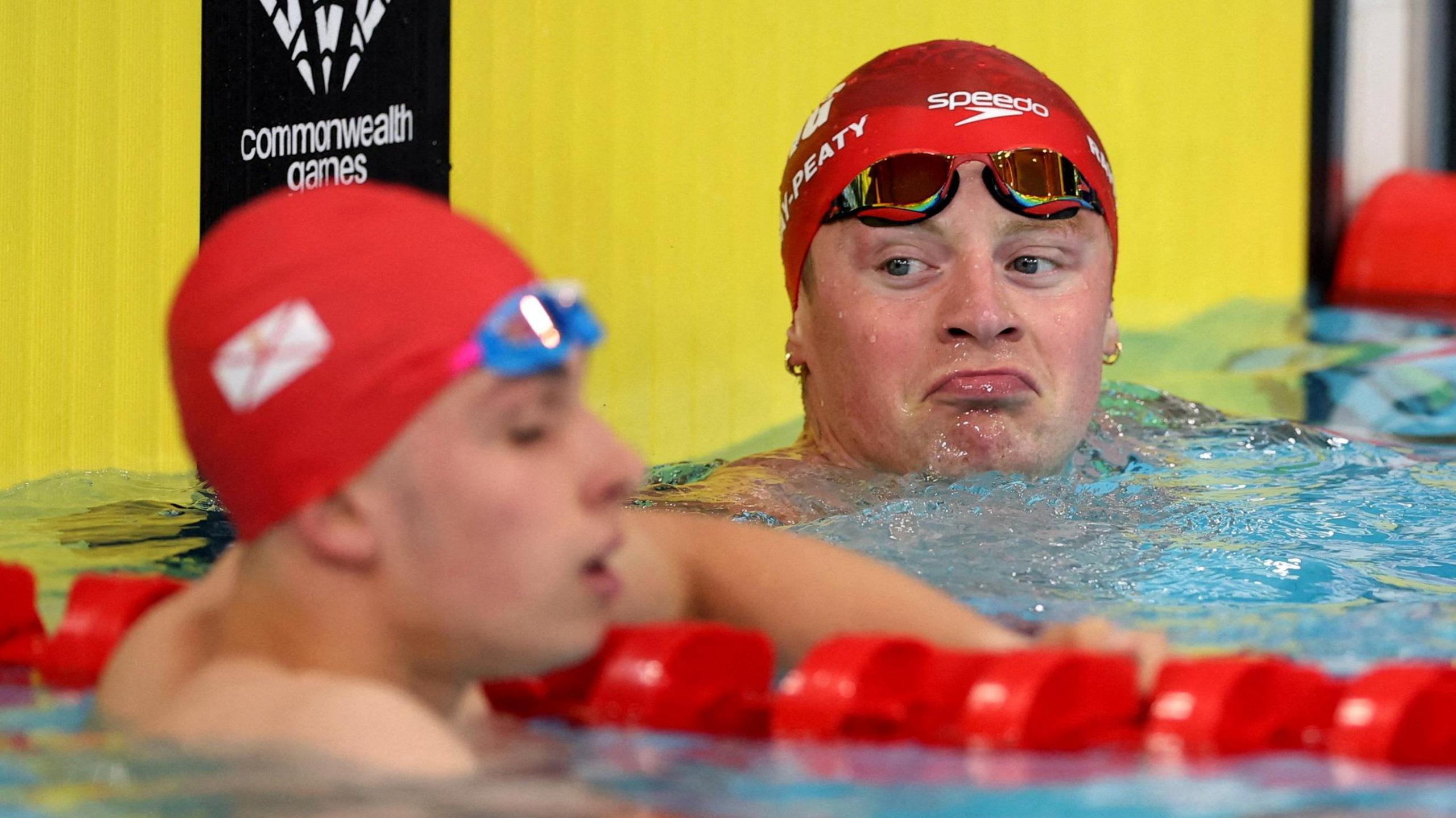
The sporting stakes are real, of course. Scotland kicked off its campaign with a stunning 45-minute burst of medals in the pool, with poster boy Duncan Scott defending his 200m individual medley gold while para-swimmer Stephen Clegg fought back from an injury-ravaged year just to make the starting blocks. Chad le Clos of South Africa arrived in Glasgow chasing a record: 18 career Commonwealth medals would make him the most decorated male athlete in Games history. And in the 100m breaststroke, master swimmer Adam Ramsay-Peaty faced his apprentice, 18-year-old Filip Nowacki, who broke Ramsay-Peaty's junior British record last year.
"I saw his front wave, but that is what I train for," Ramsay-Peaty said after holding him off in the semifinals. "I know I am a sprinter."
Meanwhile, Team Wales chose reigning boxing champion Rosie Eccles as its flag bearer—a woman who wept when she heard the news, remembering watching Olympic champion Geraint Matthews carry the flag in Birmingham. "I don't think I've stopped smiling," Eccles said. "It doesn't get much better than that."
Across the world in Winnipeg, Communities in Bloom celebrated its first Southport winner of 2026, recognizing neighbors who transform shared spaces through dedication and dirt under their fingernails. Local beautification efforts that ask nothing of borders or nations—only of care.
And in a quieter report released this month by five United Nations agencies, a striking number emerged: global hunger declined for the third consecutive year in 2025, with approximately 645 million people affected—43 million fewer than in 2022. Asia and Latin America are steadily improving. Africa's share of hungry people is stabilizing, even as its growing population means absolute numbers remain high. The report is careful to note these gains remain fragile and uneven. But they exist. Progress, demonstrably, is possible.
At Glasgow 2026, the world gathers in one city for 12 days of competition. Athletes arrive representing 72 nations and territories—from tiny island states to vast continental powers. Some, like the Carroll sisters, share kitchens and childhoods yet stand beneath different flags. Some, like Chico Qureshi, have built entire lives in one country but carry the colors of another in their hearts. What emerges is not a story of nations winning or losing, but of humans connecting across the lines drawn to separate them.
The SOFI 2026 report reminds us that progress is slow, uneven, and far from guaranteed. The Carroll sisters will still race each other. Ramsay-Peaty will eventually pass the baton. Hunger still stalks millions.
But in Glasgow this month, strangers cheer strangers. And that kitchen table in Yorkshire—where a Scottish flag might share space with an English one on a single grandparent's shirt—offers a small, stubborn hope that perhaps we're learning to do the same.
Sign in to join the conversation.
Comments (0)
No comments yet. Be the first to share your thoughts.