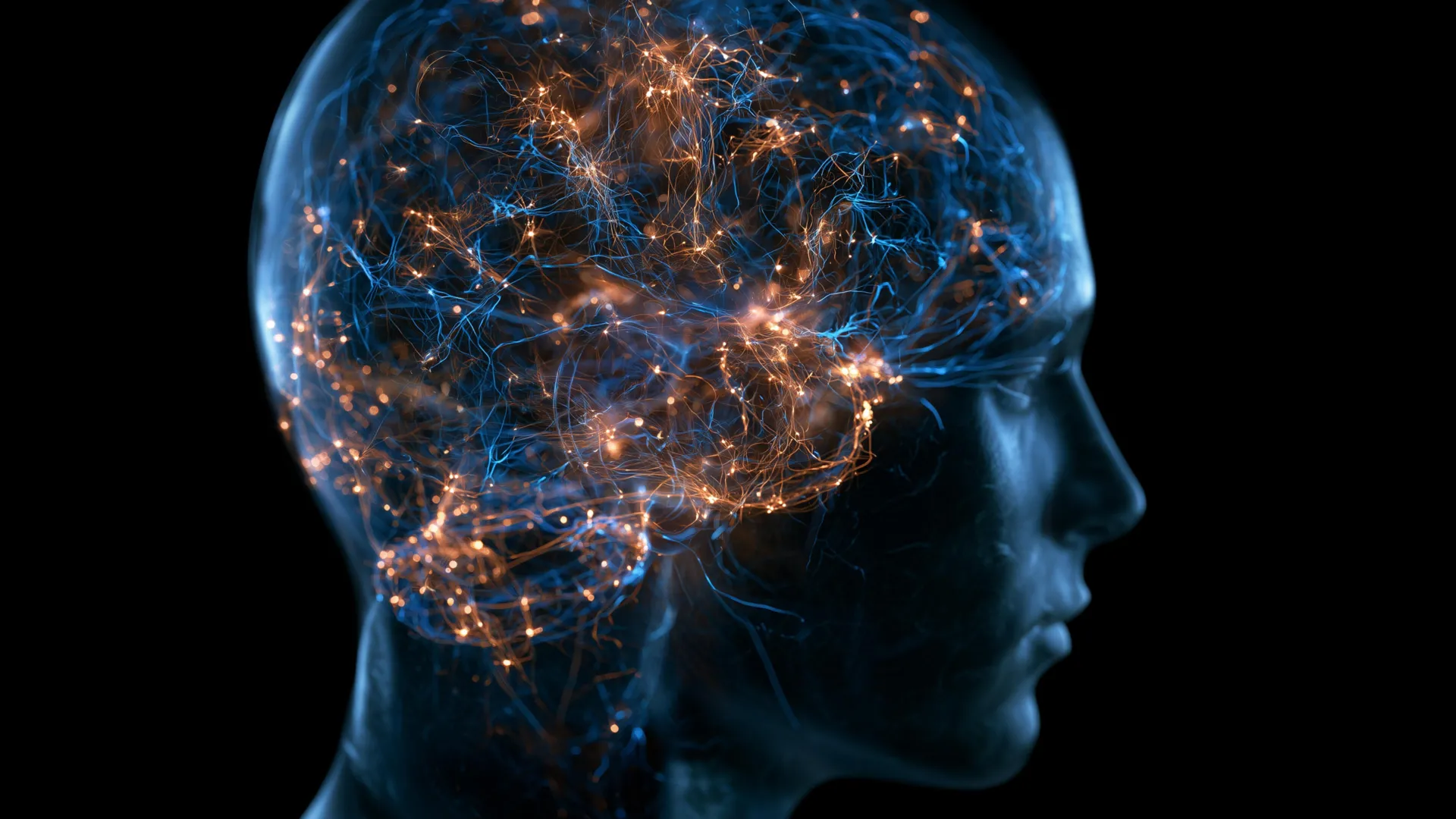
A map of 8 million cells deep inside the human brain sounds like a city atlas for a place we’ve barely explored. At the University of California, Irvine, researchers identified 60 cell types in the basal ganglia, a network involved in movement, motivation, habits and decisions. Their work, published in Cell, gives scientists a more detailed reference for asking what changes in disorders such as Parkinson’s and Huntington’s disease.
That map is one piece of a broader shift in how researchers study the brain: not as a single mystery, but as a system whose cells, signals and wiring can be measured at different scales. The promise isn’t an instant cure. It is better questions—and, increasingly, ways to ask them before damage becomes obvious.
Reading risk before memory falters
At Stanford Medicine, researchers looked for clues not in a single protein, but in patterns of brain activity. Their study, published November 4 in Science Advances, compared older adults with Alzheimer’s disease and “super agers,” whose memories remained comparable to those of people decades younger. The team used those contrasts to create a scoring system, then applied it to cognitively healthy adults ages 55 to 70.
People whose brain activity more closely resembled the Alzheimer’s group were more likely to experience cognitive decline, accumulate amyloid-beta plaques and receive an Alzheimer’s diagnosis during follow-up periods of up to 12 years. The same approach also highlighted brain patterns associated with resilience.
That matters because activity patterns may eventually be more than warning signs: unlike many conventional biomarkers, researchers suggest they could potentially be changed through targeted interventions. For now, the finding points toward a future in which risks might be recognized years earlier, while there is more time to understand what could help.
The brain’s flexibility, in motion and in winter
Some clues come from watching the brain do ordinary—and extraordinary—things. At Columbia University’s Zuckerman Mind Brain Behavior Institute, Weihao Xu and colleagues created a biological blueprint of how body parts are represented in a mouse brain. Published in Nature Communications, the work focuses on the motor cortex and may help explain how the brain coordinates compound movements: arm, hand, head and lips working together to lift a spoon of soup.
That coordination can be effortless for us, Xu noted, even as it remains difficult for robots. Understanding the circuitry could help researchers investigate dexterity lost after injuries such as strokes.
A very different kind of movement through brain states is found in hibernating golden hamsters. Researchers at VIB and KU Leuven found that changes in gene expression across hibernation partially resemble changes associated with amyloid plaque accumulation in Alzheimer’s. Published in Science Advances, the study suggests some disease-linked cellular changes may also appear during a natural, adaptive process.
The resemblance does not mean hibernation is Alzheimer’s, or that the findings translate directly into treatment. It does offer a useful question: how does the brain enter and recover from states that involve potentially harmful changes? Studying reversibility may help scientists separate damage from adaptation.
From stem cells to blood flow
The search for explanations reaches back to brain development. Researchers in Taiwan and Japan, including teams at National Yang Ming Chiao Tung University, Academia Sinica and Kyoto University, identified a small DNA region that helps control the production of specialized neural stem cells. Published in Science Advances, the research adds a new possibility to the story of primate brain evolution: evolution may shape not only how many brain-building cells are made, or how long they multiply, but which kinds are produced.
And in a clinical trial at the University of Oklahoma, a potential intervention was tested in people living with obesity. Fifty adults ages 40 to 64 received either 1,000 milligrams of urolithin A daily or a placebo for four weeks. Those taking the supplement showed a greater increase in brain blood flow during a challenging memory task, especially in the left dorsolateral prefrontal cortex, which supports working memory. The study, published in JAMA Network Open, did not establish that the supplement prevents disease; it offers a measured clue about blood-vessel function and brain activity.
Knowledge grows by connecting scales
Other discoveries in the collection reach beyond neuroscience, but share its spirit of careful mapping. Scientists at National Taiwan University reported experimental evidence for the orbital Nernst effect, in which heat drives a transverse accumulation of electrons’ orbital angular momentum—a phenomenon with possible relevance to future memory devices. And researchers from the Chinese Academy of Sciences, Peking University and Chongqing University showed how tiny rhodium clusters can balance activity and selectivity in producing butenes, valuable chemical feedstocks.
Different fields, same work: identify what is happening, distinguish one mechanism from another, then test what that understanding makes possible. The brain atlas, the mouse movement map and the early-risk signal are not finished answers. They are better starting points.
For readers, that is a hopeful kind of progress. Research advances through patient steps—cell by cell, signal by signal—and each clearer map gives future scientists, clinicians and communities a more grounded place from which to act.
Sign in to join the conversation.
Comments (0)
No comments yet. Be the first to share your thoughts.