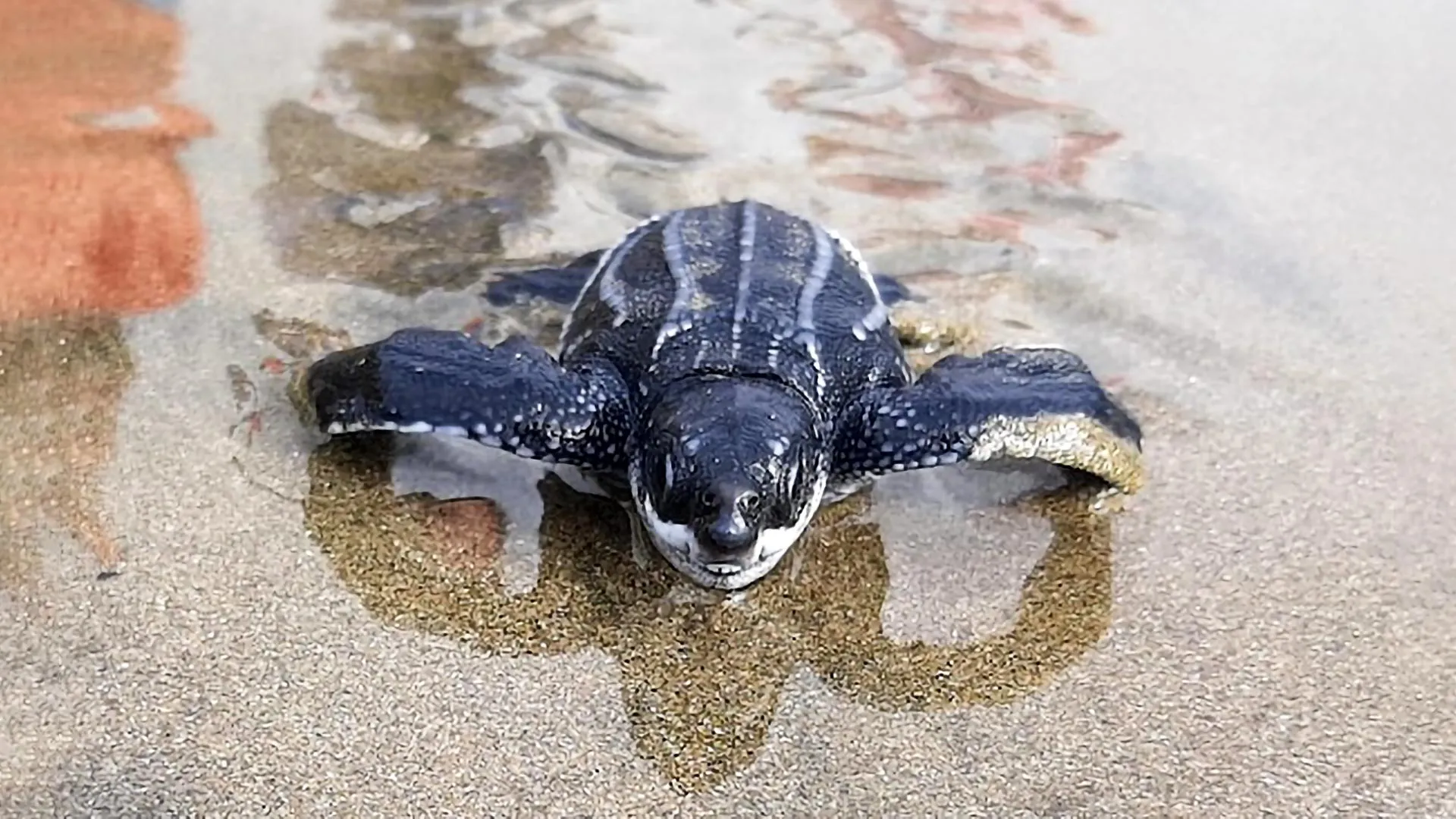
More than 1,000 miles from their traditional nesting beaches in Mexico and Costa Rica, leatherback turtles are laying eggs on Ecuador’s coast. In the 2025–2026 nesting season, researchers recorded an unprecedented number of nests there—an unexpected shift for the world’s largest sea turtle, whose eastern Pacific population has fallen by more than 90% since the 1980s.
That movement is not a cure for extinction. But it suggests that some animals may be finding new ways to persist as conditions change. And across forests, mountains and oceans, people are learning to notice those openings—and help make them count.
Reading change in the wild
The Ecuador findings, published in Chelonian Conservation and Biology, point to cooler coastal conditions as a possible draw for leatherbacks facing rising ocean temperatures. Researchers examined more than 45 years of historical data, giving the new nesting activity a longer context than a single season can provide. The hatching rates are promising, though the species remains critically endangered.
In Argentina’s Patagonia and the Beagle Channel, another long recovery is taking shape. Humpback and sei whales are returning to feeding grounds after commercial hunting depleted their populations. A local initiative has identified 208 individual whales in the Beagle Channel since 2013, including Shima, a female seen there for eight consecutive years, and Buddha, a young male spotted again after a gap in sightings.
Satellite tracking and drones are helping researchers follow the whales’ routes. Yet a comeback can be vulnerable: climate change, krill fishing, vessel traffic and offshore oil development all pose new risks. Recovery is real, but so is the need to protect the places animals depend on.
Forests, measured and tended
That challenge is one reason a five-year international effort led by the University of Bristol matters. The Global Canopy Atlas brings together 3,458 airborne LiDAR surveys across 56 countries—the largest integrated collection of high-resolution 3D maps of forests, woodlands and savannas. More than 100 institutions contributed.
By showing the structure of tree canopies and the land beneath them, the atlas can support research on forest carbon and help guide biodiversity conservation and restoration. It offers a common view of ecosystems that are often difficult to compare across borders. A map does not protect a forest by itself, but better information can help people decide where protection and restoration matter most.
On the ground, resilience can begin with a seed. Mountain pine beetles have killed millions of lodgepole pines across western North America since the 1990s. A study coauthored by Western University biologist David Coltman found that nearly half the variation in survival among the offspring studied was attributable to inherited genetic differences. That points to a possible tool for growing forests better equipped to withstand future beetle outbreaks—while underscoring that forest resilience is partly shaped by the diversity already within a population.
Conservation is also a human story
In Liberia’s East Nimba Nature Reserve, biologist ranger Grace Kotee-Zansi patrols 13,500 hectares of forest to deter hunting and tree cutting. The proposed extension to a UNESCO World Heritage Site shelters rare wildlife, including the Nimba viviparous toad and western chimpanzees. The work is urgent: the Mount Nimba landscape lost about 9.9% of its forest cover between 2013 and 2020, according to satellite analysis.
Kotee-Zansi is among just 17 women in Liberia’s 143-ranger workforce. Globally, women account for less than 11% of rangers. Her presence is more than a milestone in representation; it places local knowledge and new perspectives directly into the daily work of protecting habitat.
In Uttarakhand, India, women farmers are cultivating medicinal plants such as kutki and sugandha bala that have become scarce in alpine meadows after heavy wild harvesting. The effort offers an alternative source of the herbs while helping families earn income. But certification rules that demand land-ownership proof can exclude women, since few own land. Udyogini, an NGO, says it is pushing to have certifications issued in women farmers’ names.
Even conservation’s tools are changing. In Nepal’s Chitwan National Park, trained elephants still carry workers through difficult terrain to count wildlife, rescue distressed animals and manage populations of tigers and greater one-horned rhinos. The approach raises concerns about the safety and welfare of both elephants and mahouts, while genetic identification may offer a newer way to monitor rhinos. The question is not simply whether an old method should continue, but how to protect wildlife without creating new harms.
From turtle nesting beaches to forest maps and community patrols, these stories share a grounded kind of hope: conservation works best when it adapts. The next gains may depend on listening to local guardians, supporting livelihoods, improving evidence and making room for new methods. Those choices are not remote from everyday life. They shape whether the species, forests and waters we rely on can meet a changing world.
Sign in to join the conversation.
Comments (0)
No comments yet. Be the first to share your thoughts.