Insights
AI-synthesized editorial coverage of positive news from around the world
The Invisible Revolution: How Scientists Are Finally Seeing What Was Always There
Scientists worldwide are developing powerful new ways to see and manipulate the molecular and quantum world. Northwestern University solved a 30-year mystery surrounding two cancer-fighting molecules in rye pollen. Meanwhile, researchers at Kanazawa University watched molecular switches change shape in real-time, and physicists discovered that quantum vacuum fluctuations can break chemical bonds w
For 30 years, two cancer-fighting molecules in rye pollen remained a mystery—until Northwestern chemists finally saw the

How Mathematicians Found a Hidden Degree of Freedom in Stability Theory
Mathematicians found a better way to check if complex systems stay steady or fall apart. The new method tracks "weighted" volumes—p
A new method turns impossible stability proofs into tractable ones by weighting phase space differently—and produces a

How Evolution Turns Altruists Into Parasites' Worst Nightmare
Imagine a world where kindness inevitably becomes corruption — where species that once helped each other reproduce inevitably evolve to serve themselves first. Now imagine that this selfish turn actually makes the entire community stronger. This is the paradox at the heart of a new mathematical model of evolution, and it may explain one of biology's most enduring puzzles: why cooperation exists at all, and how life protects itself from parasites that should, by all rights, destroy it.
Pure altruists evolve into selfish network members — and become immune to parasites in the process.

How Simple Math Beat Fancy Machine Learning at Energy Grid Planning
The world's energy grids are becoming impossibly complex. Tomorrow's power systems need to balance solar panels in the Sahara against wind farms in the North Sea, coordinate short-term battery storage with seasonal hydrogen reserves, and ensure reliable electricity reaches hospitals and data centers regardless of whether it's a calm August afternoon or a frigid January morning. The mathematical models that plan these systems have grown so large and tangled that even the most powerful computers struggle to solve them in any reasonable time.
55% faster energy grid calculations using simple math instead of machine learning

Teaching Weather Models to Embrace Uncertainty
Scientists made weather prediction more accurate. Two Japanese researchers built an algorithm that blends computer models with real sensor data. Weather services currently use a method that struggles when conditions get messy. The new system learns when to add randomness for better accuracy. It was tested on a simulated chaotic atmosphere and beat existing methods.
A new algorithm outperforms existing weather forecasting methods — by learning when to embrace uncertainty.

The Algorithm That Could Unlock Better Renewable Energy Planning
Scientists at ETH Zurich have a supercomputer solving a huge problem. It plans the best mix of solar, wind, and batteries for a whole continent's power grid. But it must cover 30 years and thousands of weather scenarios. This problem is so big, regular computers run out of memory or take too long.
A 30-50% speed-up in solving massive energy planning problems could unlock better renewable infrastructure.

The Grid's Hidden Vibration Problem—and the Tool That Might Finally Solve It
In 2016, a Texas wind farm started shaking apart. Turbine gearboxes failed about ten times more often than expected. The cause was a hidden problem called subsynchronous oscillation—a vibration below the grid's normal 60 hertz. By the time engineers found it, six turbines were ruined.
A new modeling approach simulates dangerous grid oscillations 22x faster, potentially preventing failures like the 2016

How a 1931 Mathematical Trick Is Transforming Control of Chaotic Systems
Here's the rewritten text at an 8th-grade reading level, under 550 characters:
A 1931 mathematical trick is revolutionizing how we control chaotic systems—from drones to power grids.
The Right Way to Measure Complexity in Learning Dynamical Systems
A team from Princeton and Tel Aviv University built a smart algorithm. It predicts how machines with many sensors will act, even when you don't know how the parts connect. The big surprise? The number of guesses (parameters) you need depends only on the "hard" parts (like unstable shakes), called k. If a machine has hundreds of parts but just two tricky ones, you only need a few numbers to predict it. This beats old methods that needed one for every part.
A 10,000-variable system with 2 unstable modes needs just ~2 parameters to predict, not 10,000.

The Shape of Learning: How Robot Arms Get Smarter Depends on Their Activation Function
Universities in Finland study robot arms. They found a smart choice inside the computer brain that controls the arm. This choice—called an "activation function"—can make the arm track targets over 50% better.
The shape of a learning curve inside a robot's brain can determine whether it tracks a surgeon's hand with

The Right Split: How Separating Optimization from Tracking Makes Multi-Agent Systems Safer
Scientists from MIT and Shanghai Jiao Tong University made a system to help robots work together safely. Robots need to agree on where to go, but they must stay safe the whole time, not just at the end. This is called "safe optimal output agreement."
Robots that optimize and stay safe: a new control framework fixes the gap between theory and practice.
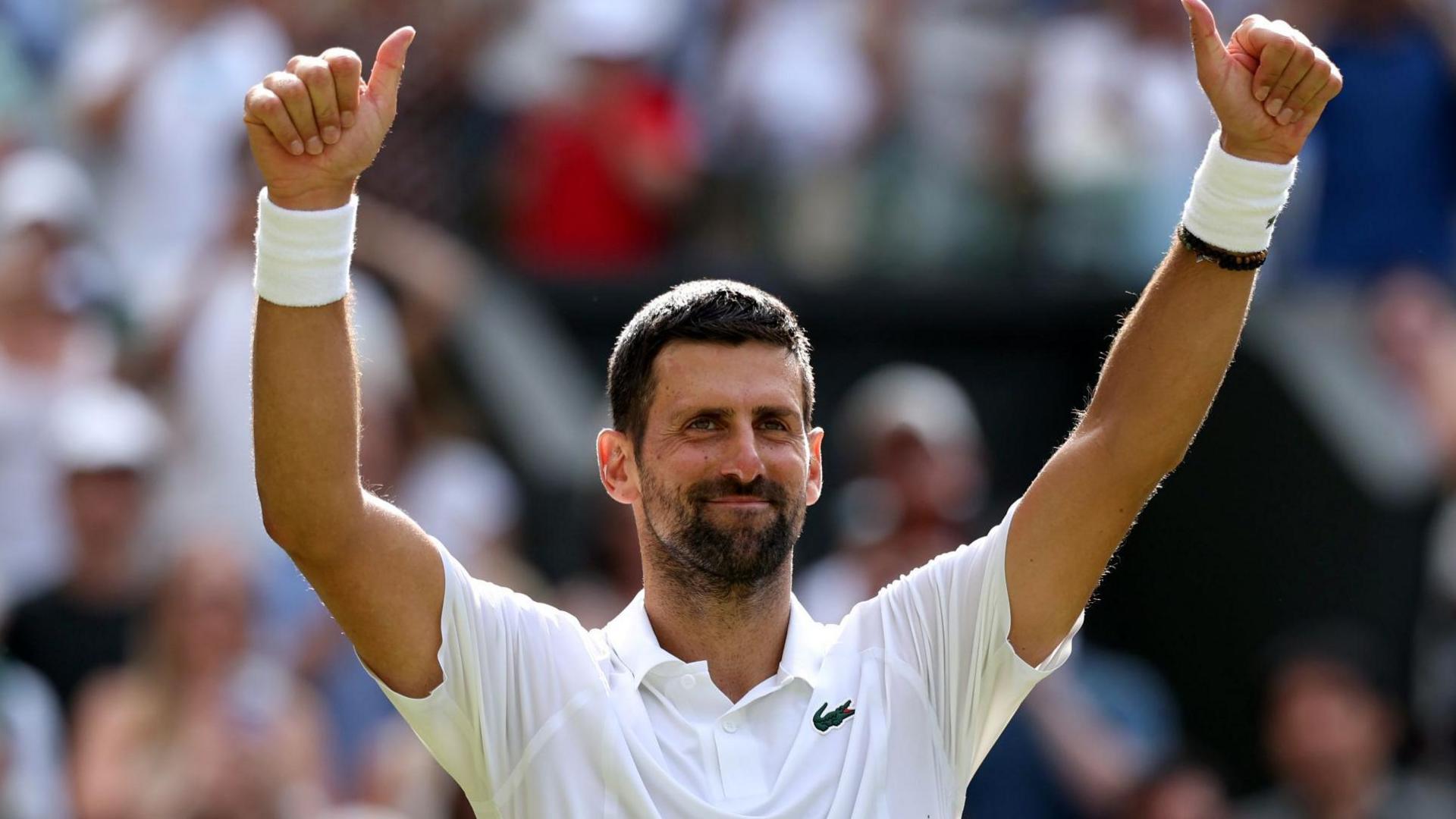
The Qualifier Revolution: How Underdogs Are Rewriting Wimbledon's Story
Arthur Fery's dream run at Wimbledon 2026 is part of a qualifier revolution sweeping across the All England Club. The British 21-year-old became the first from his country to reach the fourth round as a qualifier, joining Novak Djokovic (who broke Roger Federer's match-win record) and Alexandra Eala (the first Filipino to reach a Grand Slam fourth round) in rewriting the tournament's story. "Survi
A 21-year-old British qualifier just became the first in history to reach Wimbledon's fourth round—and he's not alone.

The Stanford Grad, The Giant Gorilla, and the Neighbors Who Became Heroes: A Week of Dreams Realized
Arthur Fery, a Stanford-educated Brit who grew up steps from Wimbledon, reached his first Grand Slam fourth round this week in a five-set thriller. Meanwhile, Naomi Osaka also broke new ground at SW19, and Leicestershire celebrated Sir David Attenborough's 100th birthday with a giant gorilla maze—while heroes nearby saved an 87-year-old from a house fire.
A Stanford grad who grew up steps from Wimbledon just became Britain's last hope—and his story is pure magic.

The Field, The Grid, and The Highway: Clean Energy's Quiet Revolution
From lettuce farms shaded by solar panels in the Philippines to German drivers earning €720 a year by feeding energy back to the grid, the clean energy transition is proving it can work at every scale. BEV sales are surging globally while PHEVs decline for the fifth straight month, and Asia's top forum confirmed: the debate is over, now it's about speed.
In the Philippines, lettuce is growing under 200 megawatts of solar panels — and it's part of a much bigger story.

Scientists Are Discovering the Secret Conversations Happening Inside Every Living Thing
Scientists around the world are discovering the hidden conversations that keep life running—from immune cells using brain chemicals to communicate, to plants sending distress signals via cellular projections, to ocean sponges photosynthesizing like plants. These findings reveal a living world far more interconnected than we ever imagined, with implications for medicine, climate resilience, and eco
Scientists just watched a white blood cell talk to itself using the same brain chemicals as neurons.

The Code Breakers: How Scientists Are Learning to Read—and Rewrite—Disease
Researchers worldwide are cracking the genetic code of disease with eight groundbreaking studies: MD Anderson scientists found two prostate cancer mutations predict opposite responses to a new therapy; UC Davis researchers discovered how to prevent drug resistance before it starts; a blood test using circular RNAs can now predict Alzheimer's symptoms nearly three years early; and preserved testicu
Scientists can now predict which cancer patients will respond to treatment—and which won't—using genetic codes.

The Secret Is in the Network: How Math Reveals the Optimal Way to Hide Information Across Connected Systems
Zlatić's key idea: Where you hide pieces of secret data matters as much as how you lock them up. He created a math tool called a
Copy your secret everywhere and hackers win. Fragment it everywhere and disasters win. A new framework finds the
The Math Behind Better Weather: A New Framework for Deciding Where to Look
Every day, thousands of weather stations, satellites, and buoys send data to weather models. Every six hours, billions of observations help make forecasts that tell you if you need an umbrella. But even with this huge global network, we can't measure everything.
23% forecast improvement by optimizing WHERE we measure the atmosphere, not just how much.

The Mathematics of Invisible Grid Failures
New research from Johns Hopkins and Lund University finds a big problem with how we check if power grids are safe. Old safety checks assume ideal conditions that modern grids don't have. The study shows that when power flows unevenly and lines are heavily loaded, the safe zone for inverter settings
The grid can fail even when nothing seems wrong. New math explains why—and how to prevent it.
The Scientists Who Arrived Too Late: How Market Forces, Not Merit, Shaped Soviet Émigré Careers
In the 1990s, many Soviet scientists got top jobs at schools like Yale, Stanford, and Argonne. They became professors and leaders. By the 2000s, scientists with the same skills couldn't get those jobs. They worked in industry or left science.
Scientists who fled the USSR in the 1990s landed Stanford professorships. Those who came later, just as capable, took