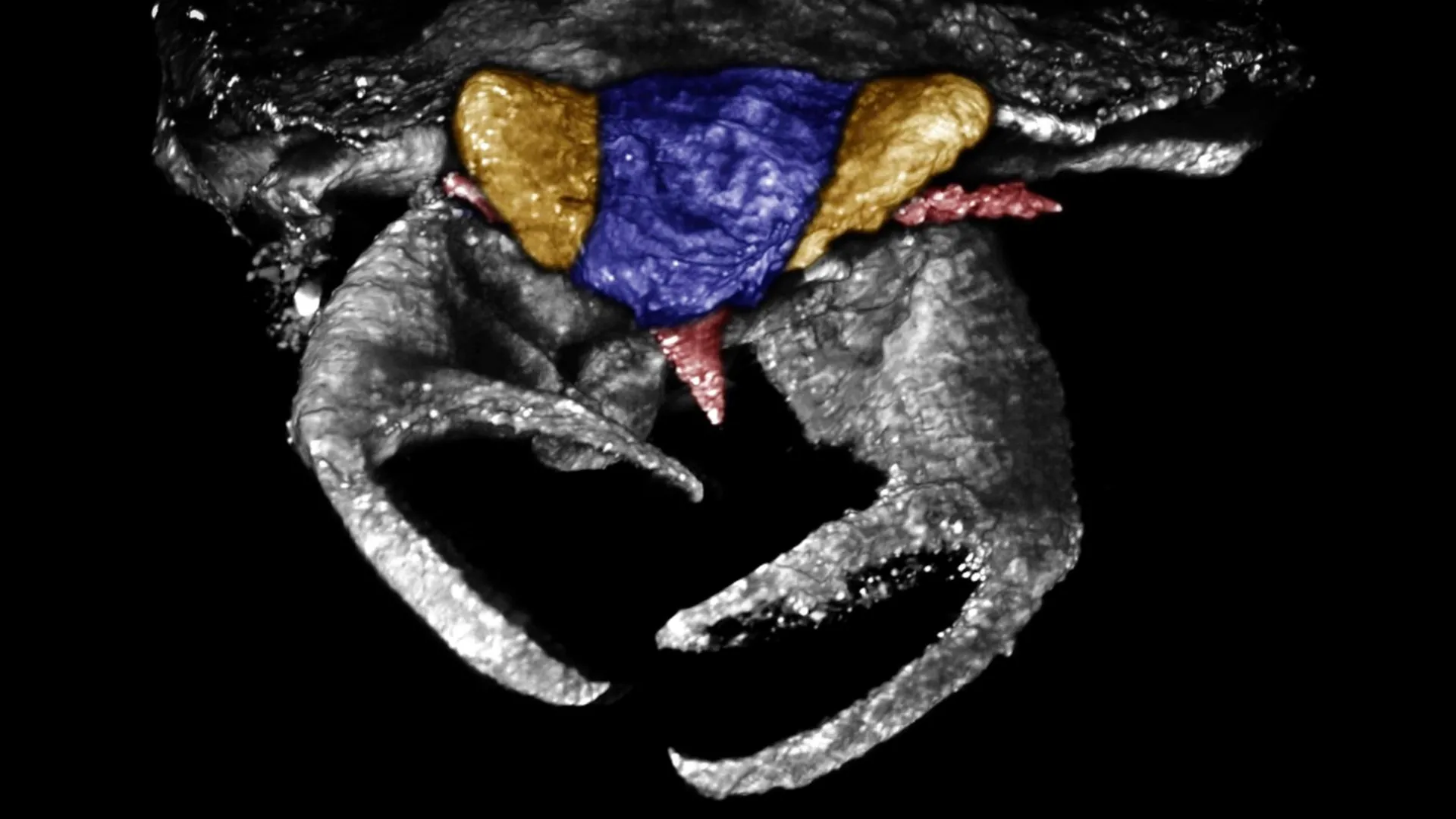
A hundred million years ago in Myanmar's Kachin region, a peculiar bug scuttled through a Cretaceous coastal forest, its outsized front legs ending in crab-like claws that would make it unique among the insects of its time—and more remarkable still, utterly unlike anything scientists would discover in the modern world.
Preserved in amber since the age of dinosaurs, this specimen reveals something profound about how evolution solves problems: the same solution to grasping and hunting can emerge independently across vastly different lineages. Researchers at Ludwig Maximilian University of Munich, working alongside colleagues from the University of Rostock and the University of Oulu in Finland, have identified this 100-million-year-old true bug (Heteroptera) with structures known as chelae—claw-like appendages that function like forceps. What makes this discovery scientifically striking is its rarity. "Previously, such chelae were known from only three insect groups. This fossil therefore represents the fourth known case of these structures evolving independently in insects," explains Carolin Haug, zoologist at LMU's Faculty of Biology.
The team examined the fossil using micro-computed tomography, creating highly detailed 3D images that revealed the insect's anatomy with remarkable precision. They then conducted a morphological comparison involving more than 2,000 chelae and similar grasping appendages from both living and extinct species. The results were striking: the claws of this ancient bug differed substantially from those found in other insects, instead resembling structures seen in more distant arthropods such as crabs, lobsters, shrimp, and tanaids.
Because of its unusual anatomy, the insect was assigned to an entirely new genus: Carcinonepa, combining the Latinized Greek term for "crab" with nepa, a reference to the true water bug group. The species name, libererrantes, carries an unexpected modern touch—it's a Latinization of Stray Kids, the K-pop group beloved by one of the paper's authors. The name proved fitting, Haug notes, because the posture of the fossil's chelae strongly resembles the band's trademark pose, a whimsical detail that nevertheless speaks to how living, breathing scientists approach their work.
The researchers classified Carcinonepa libererrantes within the true water bugs (Nepomorpha) of the broader true bug group. Yet aside from its dramatic claws, its body shares similarities with modern Gelastocoridae, known as toad bugs—small, land-dwelling predators. This combination suggests a creature with a particular lifestyle adapted to its Cretaceous environment. "We can imagine it living in a Cretaceous forest, probably near the coast," Haug observes. Those oversized chelae on its front legs were almost certainly used to seize and hold small insect prey as it hunted through the ancient forest ecosystem.
What emerges from this discovery is a window into deep time, where the fossil record shows us not just extinct creatures but the principles by which life evolves. The same problem—how to grasp a moving insect—was solved by different evolutionary paths in different groups. This bug, frozen in Myanmar amber for a hundred million years, stands as evidence that nature's solutions are countless, and that even in an ancient forest lost to time, life found ingenious ways to hunt and survive.