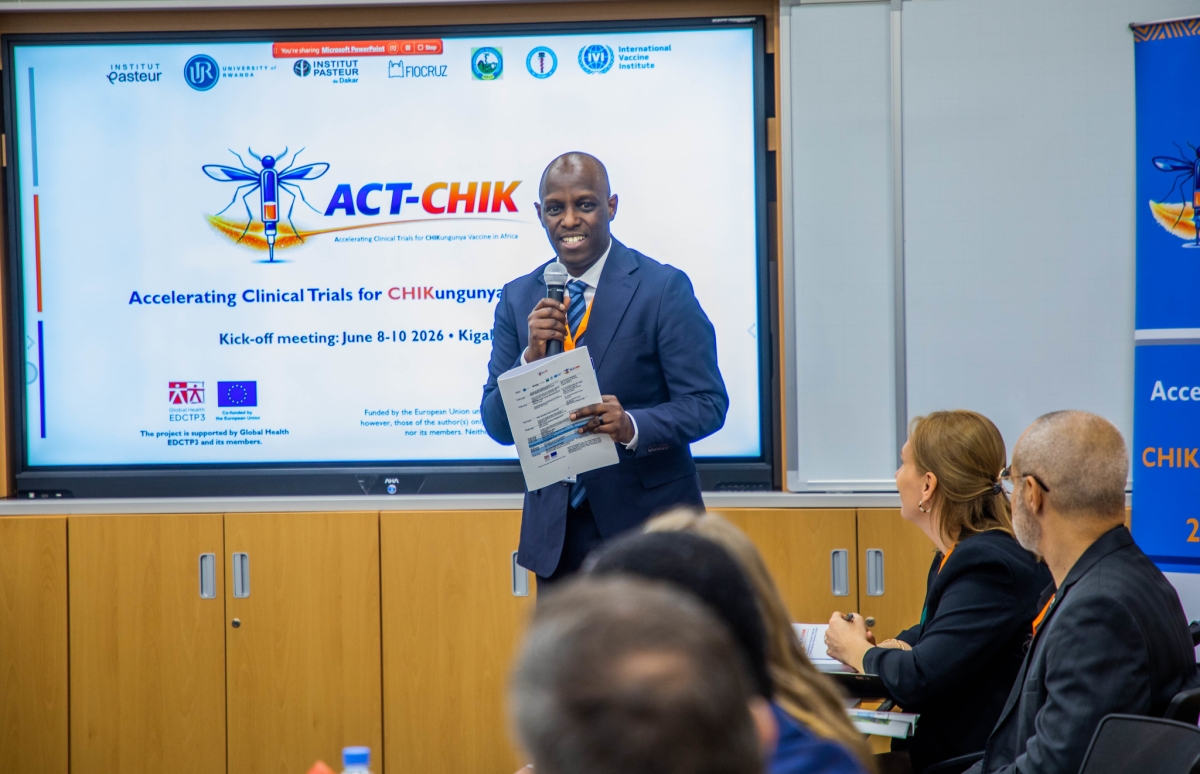
In the heart of Kigali, researchers from Africa, Europe, South America and Asia gathered this month to launch a four-year quest against a disease so frequently mistaken for malaria that countless cases slip through undiagnosed. The ACT-CHIK Project—officially the Accelerating Clinical Trials for Chikungunya Vaccine initiative—represents a pivotal commitment to developing the first chikungunya vaccine designed specifically for African populations and, crucially, safe for children.
Chikungunya is a mosquito-borne virus that health experts now describe as a growing public health threat. Its symptoms—fever, headache, joint pain and stiffness—mirror those of malaria, dengue and Zika so closely that many cases go undetected entirely. In Rwanda alone, a 2024 study revealed something striking: about 69 percent of sampled individuals tested seropositive for chikungunya, indicating prior exposure to the virus. Many of those infections occurred without causing noticeable illness, leaving people unaware they had ever encountered the disease.
The €15.3 million initiative, funded by the European Union's Horizon Europe programme through the Global Health EDCTP3 Joint Undertaking, will conduct Phase Ib/III clinical trials—early safety assessments and large-scale effectiveness studies—across Rwanda, Kenya, Nigeria and Senegal over the next four years. Participants will include adults, adolescents and children. Partners in the work span continents: Brazil's FIOCRUZ institution, South Korea's International Vaccine Institute as the manufacturing and project sponsor, and the Institut Pasteur in France, which developed the vaccine candidate based on a measles-virus platform.
Prof. Léon Mutesa, Director of the Centre for Human Genetics at the University of Rwanda, explained that Rwanda earned its role as scientific leader of the consortium after successfully competing for the position. "Rwanda has shown a strong commitment to developing vaccine manufacturing capacity and supporting scientific research," he said. The country's selection reflects its growing investment in research infrastructure and its regulatory framework—factors that, as Dr. Menelas Nkeshimana of Rwanda's Ministry of Health noted, demonstrate "the integrity, transparency and scientific rigor required for vaccine development."
Currently, two chikungunya vaccines exist globally, but both target travellers and neither is manufactured in Africa. Dr. Sotiris Missailidis, Head of Vaccine Innovation Development at the Institut Pasteur, emphasized that this project aims to fill that gap. The new vaccine would be the first adapted specifically for African populations and formulated for paediatric use—a critical distinction for a continent where younger populations face the highest burden of mosquito-borne diseases.
The timing feels urgent. As Dr. Nkeshimana pointed out, many Rwandans were infected without diagnosis, particularly in the Eastern Province, revealing how silently this virus circulates. He urged anyone feeling unwell to seek medical care, noting that proper testing guides treatment and helps monitor complications, even before a vaccine becomes available.
What emerges from Kigali is not just a vaccine trial, but a commitment to African scientific leadership. Rwandan researchers are increasingly leading studies on new vaccines and treatments. This project signals that solutions to diseases affecting African populations need not come only from outside; they can be shaped by the researchers and institutions closest to those communities. Over the next four years, that partnership will determine whether a generation of African children gains protection against a disease their predecessors faced unaware.