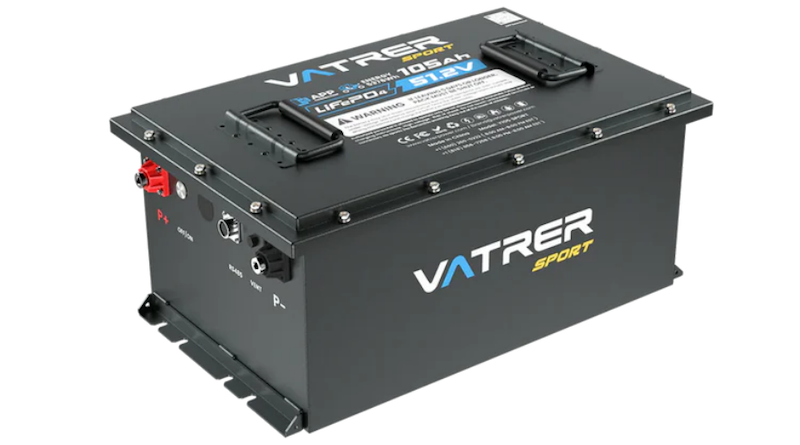
When Maria Santos upgraded her ranch UTV from lead-acid to lithium battery power last spring, she noticed something unexpected: the machine started to feel lighter on its feet. The steering responded more quickly. The suspension seemed to recover faster over rough ground. Over months of daily use hauling feed and checking fence lines across her Texas property, those small improvements added up to something she couldn't quite name at first — but kept noticing.
"It just feels more predictable now," Santos said. "Like it's not fighting me anymore."
That shift in feel — from gradual fatigue to steady confidence — is what many users report when making the switch to high-output lithium systems like the Vatrer 48V 105Ah UTV battery. And while the numbers on paper suggest a significant upgrade, longtime equipment reviewers say the real difference shows up in the details of daily work.
Consider the raw specifications: this battery stores 5.37 kWh of energy and delivers up to 300 amps of continuous discharge, with peaks around 600 amps. Compare that to typical 48V lead-acid setups, which generally offer 150 to 200 amps of output — and lose stability as voltage drops during demanding work. On long inclines or when hauling heavy loads, that difference in sustained power becomes tangible.
But perhaps the most meaningful long-term benefit is durability. Lead-acid batteries typically last 300 to 500 cycles before performance degrades noticeably. Lithium systems like this one are rated for 4,000 to 6,000 cycles or more — meaning years of heavy use without the gradual loss of "pull" that equipment operators have come to expect as normal. With typical 48V lead-acid setups weighing between 250 and 300 pounds, the Vatrer's 100.31-pound frame also cuts more than 100 pounds from the vehicle, a reduction that changes how the whole machine handles terrain.
For property owners, farmers, and utility vehicle operators who rely on these machines daily, the upgrade represents more than convenience. It's a shift in expectation — from managing gradual decline to simply getting consistent work done. Charging intervals stretch longer. Maintenance drops. The vehicle responds the same way on the hundredth use as it did on the first.
Of course, performance still depends on the broader system. If the vehicle's controller is capped at lower amperage — around 200 to 250 amps — the battery won't fully deliver its potential. But for properly matched setups, reviewers note that the power feels immediate and steady, especially on terrain that demands quick adjustments: uneven ground, sudden inclines, or loads that shift during transport.
For Santos and others making similar upgrades, the appeal isn't any single feature. It's the cumulative feeling of reliability — equipment that doesn't gradually become harder to trust. In a world where tools often seem designed for planned obsolescence, that's a small but meaningful change worth noting.