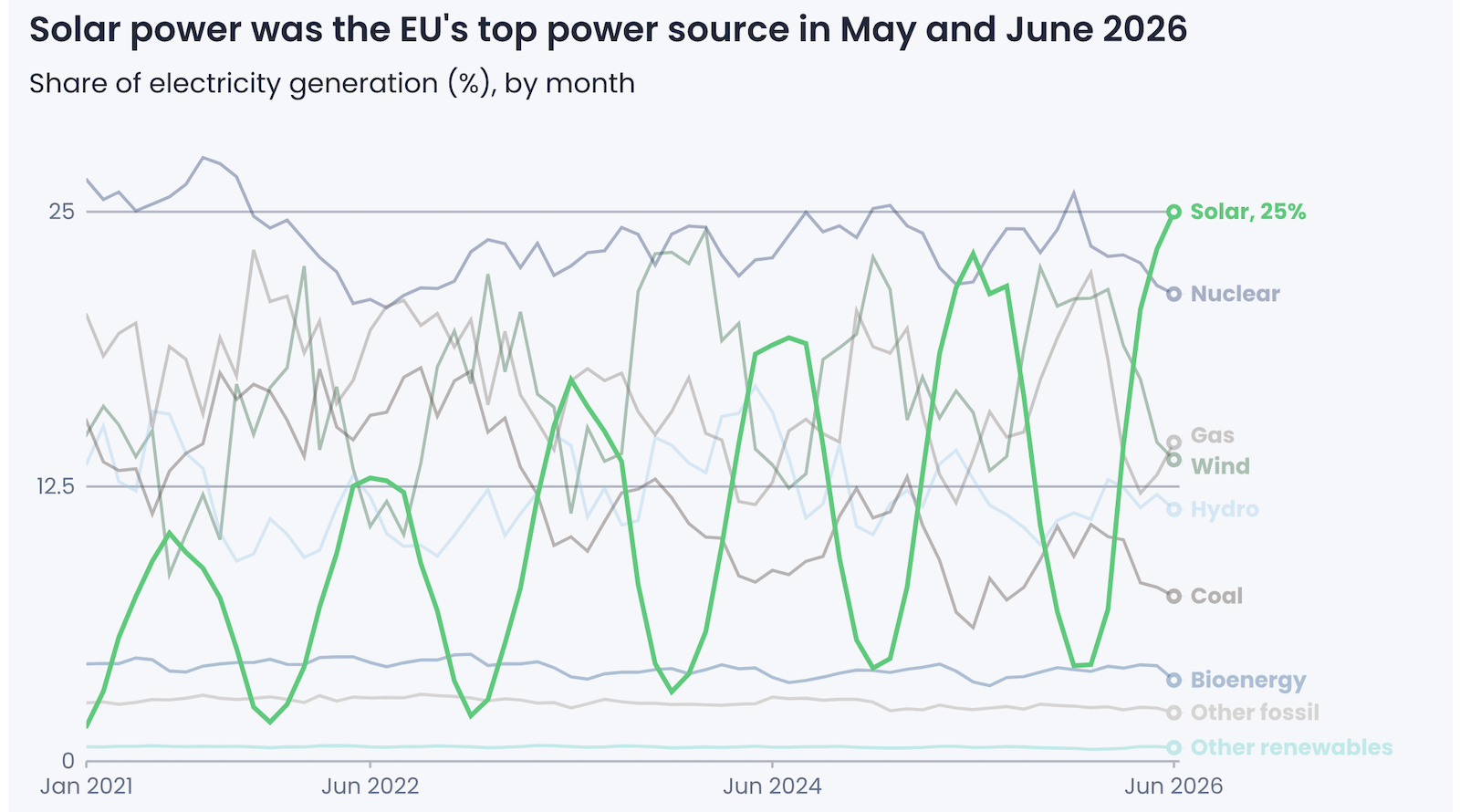
For the first time ever, solar panels produced a full quarter of the European Union's electricity in a single month. In June 2026, EU solar farms and rooftop panels generated 52 terawatt-hours of electricity — enough to power millions of homes — making up exactly 25% of the bloc's power that month, according to energy research group Ember.
That might sound like a sudden leap, but the numbers tell a different story. Just five years earlier, in June 2021, solar provided only 10% of EU electricity — 21 terawatt-hours. Since then, solar has grown by more than a fifth every single year, the fastest growth rate of any power source in Europe. Last year alone, countries installed 65.1 gigawatts of new solar capacity. To put that in everyday terms, one gigawatt can power roughly 750,000 homes.
Solar also became the EU's biggest electricity source in June, outpacing nuclear (21%), natural gas (15%), wind (14%), and hydropower (12%). Coal barely registered at 8%. This was only the third month in history that solar claimed the top spot, after June 2025 and May 2026.
The timing mattered. Record-breaking heatwaves drove high demand for air conditioning across Europe, yet solar stepped up when other sources faltered. Hot, still weather made it harder for wind turbines to spin and reduced hydropower from rivers, but panels kept generating in the sunshine.
Chris Rosslowe, a senior energy analyst at Ember, called solar's trajectory "truly stratospheric." He said that in just a few years, solar has gone from a small player to an essential part of Europe's power system, as countries look for affordable, homegrown energy.
The boom stretches across the continent. So far in 2026, eighteen EU countries have broken their own monthly records for the share of power coming from solar. In Spain, solar supplied 34% of electricity in June — the first time it topped a third. Supportive government policies have accelerated installations there, and clean energy has helped shield households from higher bills during global energy price spikes. In Germany, solar reached a 36% share in June after hitting 33% in May. Poland, despite being one of the EU's biggest coal users, generated nearly a quarter of its electricity from solar (24%) in June, having added over 20 gigawatts of solar capacity since 2020.
The shift matters for the planet too. Burning less coal and gas means fewer climate-warming emissions. And because solar panels keep getting cheaper and faster to install, experts expect the growth to continue.