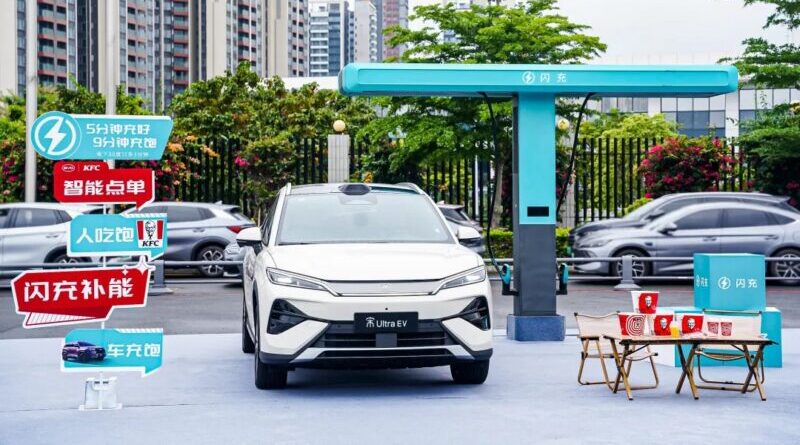
BYD, the Chinese automaker, is rolling out 3,000 ultrafast electric vehicle chargers across Europe by 2027, with 600 arriving in the UK—a move that challenges the perception that EV charging is painfully slow. These "Flash" chargers can fully power a vehicle in approximately five minutes, depending on the model, fundamentally reshaping how drivers think about refueling on long journeys.
The infrastructure challenge that has plagued EV adoption—the fear that charging takes too long—may finally have a solution. Long-distance drivers know that a typical rest break during a multi-hour journey lasts 20–40 minutes, time typically spent eating, stretching, or grabbing a coffee. A common fast charger can top up a battery during that window, but the psychological barrier remains: the belief that EV charging is inherently slow. Ultrafast chargers with rates exceeding 400 kW address this anxiety head-on, reassuring drivers that the infrastructure exists to match their travel needs.
What makes BYD's deployment genuinely innovative is how each charging station pairs with its own battery system. Rather than drawing peak power directly from the local electrical grid—which could destabilize energy networks already strained in many European cities—the batteries store electricity and feed it to vehicles as needed. This design sidesteps one of the biggest obstacles to rapid EV infrastructure rollout: grid congestion. "The challenge is not the set-up," noted Bono Ge, BYD's UK business head. "It's really how quickly the councils can give their permission. We can roll out really quickly." The barrier to speed, it turns out, isn't engineering—it's bureaucracy.
Each installation represents a substantial investment, hovering around half a million pounds per station, according to Stella Li, BYD's chief international executive. That figure underscores why this infrastructure matters: the company is betting hundreds of millions of pounds on European EV adoption, wagering that charging anxiety will dissolve once drivers experience 5-minute refueling times firsthand. The rollout suggests confidence that the market will follow.
The deployment timeline is equally striking. Public EV charger networks are being built faster than new petrol stations—a reversal that would have seemed impossible a decade ago. Those familiar gas station networks took decades to construct and operationalize globally. BYD's timeline compresses that trajectory dramatically, suggesting that EV infrastructure will soon feel as ubiquitous as the fuel pumps it's replacing.
For drivers anxious about long-distance travel in an EV, these chargers may prove to be a turning point. Many will likely discover, after their first ultrafast charging stop, that their fears were unfounded. A five-minute charge, paired with a brief meal break, makes an eight-hour journey feel nearly identical to the petrol car experience they're leaving behind. By 2027, Europe will have significantly more proof that the EV transition isn't a future prospect—it's already here, and it's fast.