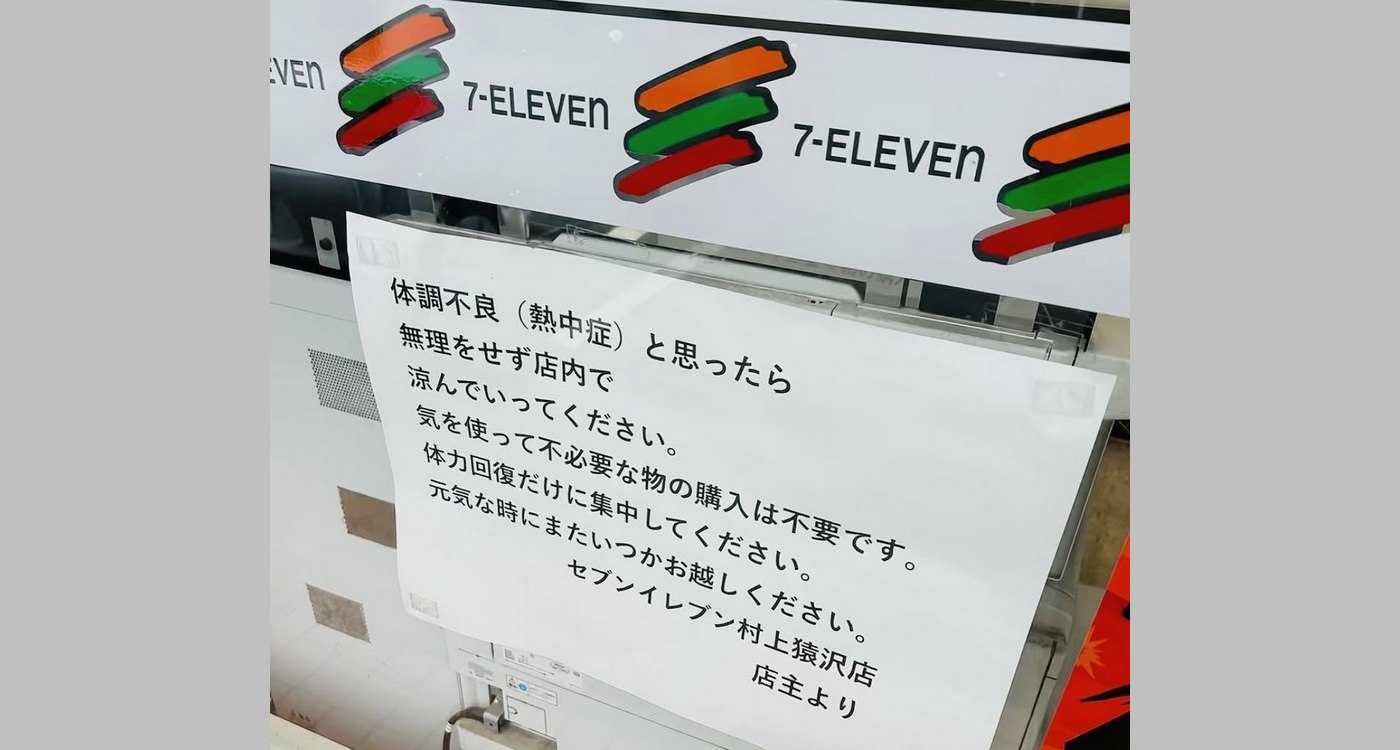
At 63, Tatsuya Takahashi stood in his 7-Eleven stores across Niigata Prefecture and decided to do something the convenience store chain had never considered its primary mission: save lives without expecting payment. He posted signs in simple, direct language: "If you feel unwell and think it may be heatstroke, please don't push yourself — come inside and cool off. There is no need to purchase anything out of courtesy. Please focus solely on recovering your strength."
The signage was not originally his invention. Takahashi had spotted a similar notice online during last summer's relentless heat wave while contemplating how he might serve his community. Something resonated. He adopted the message for his stores across several cities in Niigata, a prefecture in western Japan where summer temperatures regularly climb past 30°C. The act of quiet generosity spread faster than he could have imagined: the first viral post on X attracted half a million likes, with overseas accounts sharing translated versions across social media.
But Takahashi's kindness wasn't performative. It was rooted in gratitude earned a decade earlier. He had suffered heatstroke while traveling and stumbled into a restaurant seeking refuge. The owners there did what his signs now promise to others: they gave him cold water, guided him to the coolest spot available, and cared for him until he recovered. That simple act of giving never left him. He wanted to be, for strangers, what strangers had been for him.
As autumn turned to winter and Niigata's infamous heavy snows began to fall, Takahashi didn't remove the signs—he reimagined them. "You must be tired of driving on snowy roads," the new message read. "Then, please don't hesitate to come inside and warm up. We pray for your safety." The message carried particular weight at the Ozumi Parking Area near Nagaoka, a region known for treacherous winter conditions where truck drivers often sleep in their cabs through the longest, coldest nights.
The response revealed something profound about his community. People weren't just using the stores to escape discomfort; they were using them to survive. Takahashi explained his philosophy to the Mainichi Shimbun, Japan's longest-running English-language daily newspaper, in language that captured something essential about how kindness moves through the world: "Even small acts of kindness can come full circle."
His stores became an unofficial refuge system, and the idea spread upward through the system itself. Inspired by Takahashi's initiative, 7-Eleven Japan launched its own "cool share" campaign, inviting customers nationwide to step inside and recover—from heat, cold, exhaustion, or simply being alive in a difficult moment. A single convenience store owner's memory of care became a national framework for compassion.
In Niigata, where temperatures swing from scorching to subzero, Takahashi had created something simple and radical: a place where needing help is never an inconvenience, where survival doesn't require a transaction, and where one person's remembered kindness becomes shelter for everyone.