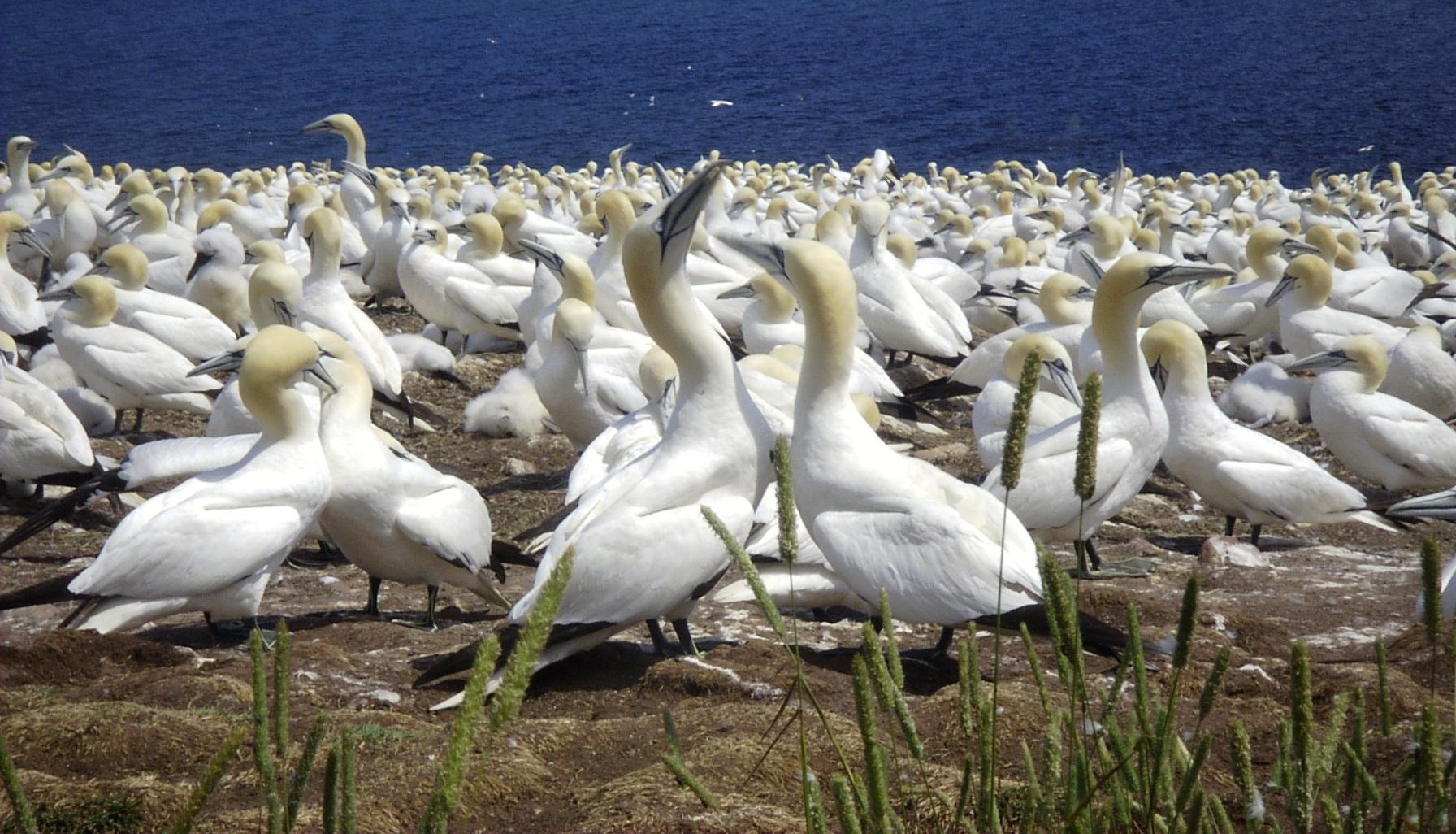
On Bonaventure Island, a rocky outcrop off the coast of Quebec that hosts the world's largest northern gannet breeding colony, something quietly remarkable is happening. The eggs of these white seabirds, which dive for fish in the St. Lawrence Seaway, are getting cleaner. After soaring through the 1960s, 70s, and 80s, the concentration of "forever chemicals" in their eggs peaked in the 1990s and has since plummeted by as much as 74 percent—a dramatic reversal that scientists say proves environmental regulations actually work.
The chemicals in question are PFAS, a class of human-made compounds engineered to resist water, stains, and heat. For decades, they were prized by manufacturers and used everywhere: in food packaging, nonstick cookware, waterproof textiles, and firefighting foams. But PFAS don't break down. Once released into the environment, they persist indefinitely—hence the nickname "forever chemicals." They bioaccumulate in wildlife and have been linked to serious health problems in humans and animals alike.
The story of their presence in northern gannet eggs is essentially a story of globalization and its consequences. Bonaventure Island sits near the St. Lawrence Seaway, directly downwind and downstream from the manufacturing centers of the Great Lakes region straddling the U.S.-Canada border. Throughout the 20th century, as PFAS production ramped up, the chemicals flowed into waterways, contaminated fish, and then accumulated in the seabirds that ate those fish. By the 1990s, PFAS levels in gannet eggs had reached concentrations that exceeded known toxicological thresholds for these birds.
Then the regulations began to bite. A study published in Applied Toxicology, examining 55 years of gannet egg samples, documented the shift. Perfluorooctanesulfonic acid (PFOS) dropped 74 percent. Perfluorooctanoic acid (PFOA) fell 40 percent. Perfluorohexanesulfonic acid (PFHxS) was 70 percent lower than baseline levels. "We see this incredible rise to a peak where concentrations seem to be higher than toxicological threshold for those birds, then it really decreases in a nice way," said Raphael Lavoie, an ecotoxicologist with Environment and Climate Change Canada. "The regulations are having a good effect."
The turning point came in the late 1990s and early 2000s, when manufacturers and governments finally acknowledged the problem. Chemical companies, including 3M, scaled back production under regulatory pressure. In 2009, the Stockholm Convention restricted several PFAS at the United Nations level. Three years later, the chemical sector agreed with the EPA to phase out PFOA and PFOS entirely. These decisions, made across borders and through multiple regulatory bodies, had real consequences in the natural world—measurable in the eggs of seabirds thousands of miles away.
Yet the scientists behind this study stress caution. PFAS are forever, meaning any contamination we create today will remain in the environment and wildlife for generations. The decline in gannet eggs shows that we can reverse some of the damage through regulation and corporate accountability. But it also underscores how fragile that progress is, and how dependent it remains on continued vigilance. The gannets of Bonaventure Island have already taught us one lesson: environmental stewardship works. The challenge now is making sure we don't forget it.