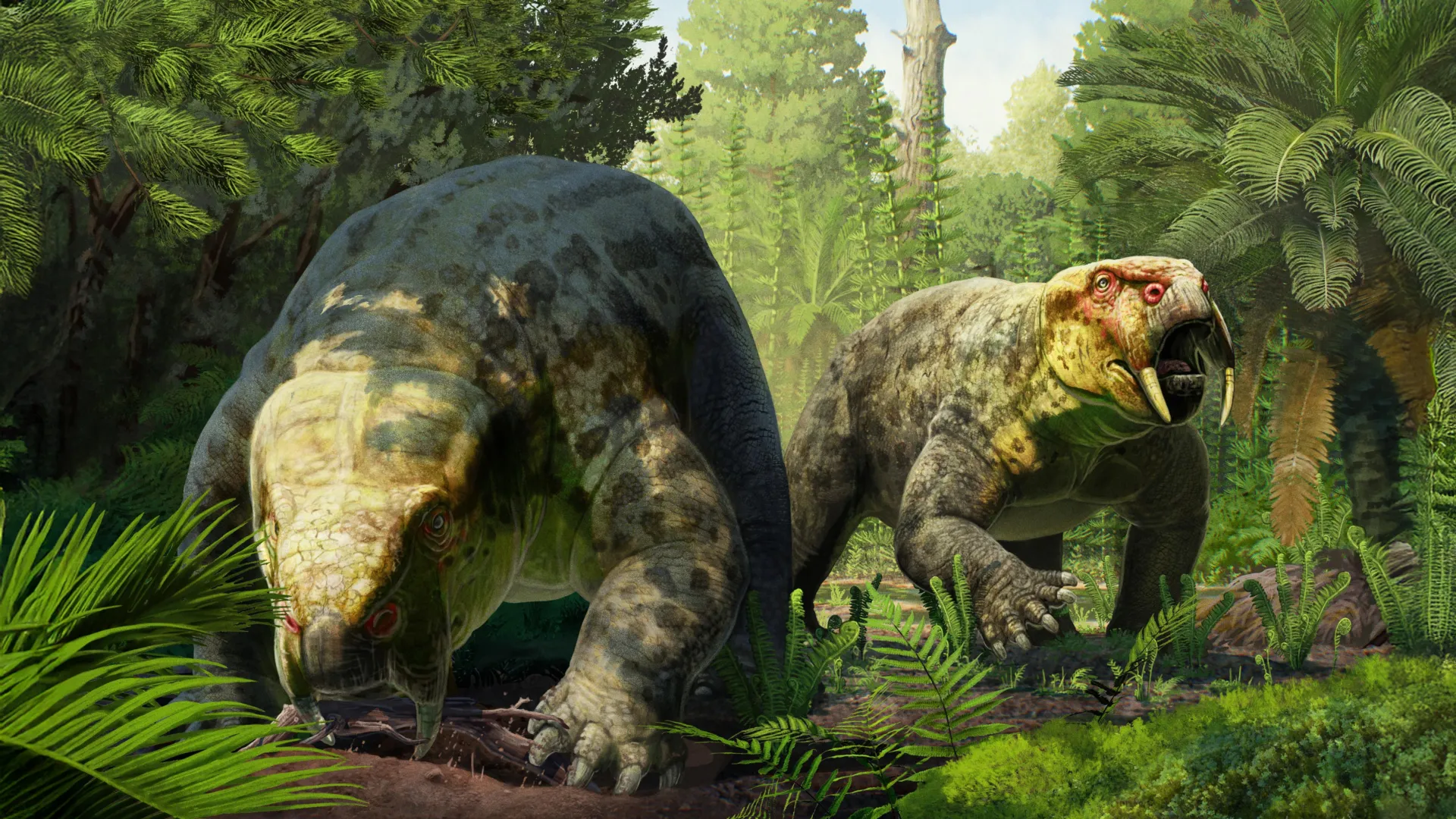
Hidden in the collections of London's Natural History Museum for decades, a dinosaur-adjacent creature from Tanzania turned out to be a brand-new species — and it is quietly rewriting the timeline of when dinosaurs first appeared on Earth.
The animal, named Dinodontosaurus isiyavamanda, lived roughly 240 million years ago during the Triassic period, long before the great reptiles came to rule the land. It belonged to a group called dicynodonts, plant-eating, mammal-lineage vertebrates that thrived and spread widely millions of years before dinosaurs took over. An international team led by the University of Bristol published its findings September 15 in the Journal of Vertebrate Palaeontology.
Here is where the story gets strange. The skeleton had actually been found in 1963, when a British expedition scooped up a large batch of synapsid fossils from what is now Tanzania. For years, most of the specimens were studied, but this one skeleton sat only partly examined among thousands of others. In 1994, a young paleontologist named Nigel Larkin studied it for his master's thesis at University College London and suspected it was new to science. Then life happened — it took him nearly 30 years to finally start writing it up. "What's 30 years? It's the blink of an eye," he said.
When the team finally took a hard look — helped by modern tools like micro-CT scanning that were unimaginable in the 1990s — they got two surprises. First, the Tanzanian skeleton and a fragmentary skull belonged to the genus Dinodontosaurus, which had only ever been confirmed in South America. Second, the fossils represented a species no one had ever described. Its name honors the land of the Wamanda people, who live where the fossils were found.
That identification matters far beyond adding one new animal to the books. The rocks holding this creature are the same deposits that have produced fossils once proposed as the earliest known dinosaurs. Scientists had linked those Tanzanian rocks to deposits in South Africa, which they considered Middle Triassic in age. But now that the same genus appears in both Tanzania and South America, researchers have a fresh, reliable way to match the rock sequences in those two regions. Recent radiometric dating of South American rocks suggests those early dinosaur-bearing layers are as much as 10 million years younger than their South African counterparts.
That means the Tanzanian deposits should no longer be treated as proof of the very oldest potential dinosaurs. As lead author Hady George, a PhD student at Bristol, put it, the finding "refines the timeline of dinosaur origins" — pushing that momentous first chapter later and shifting its geography. What a difference a forgotten skeleton makes.