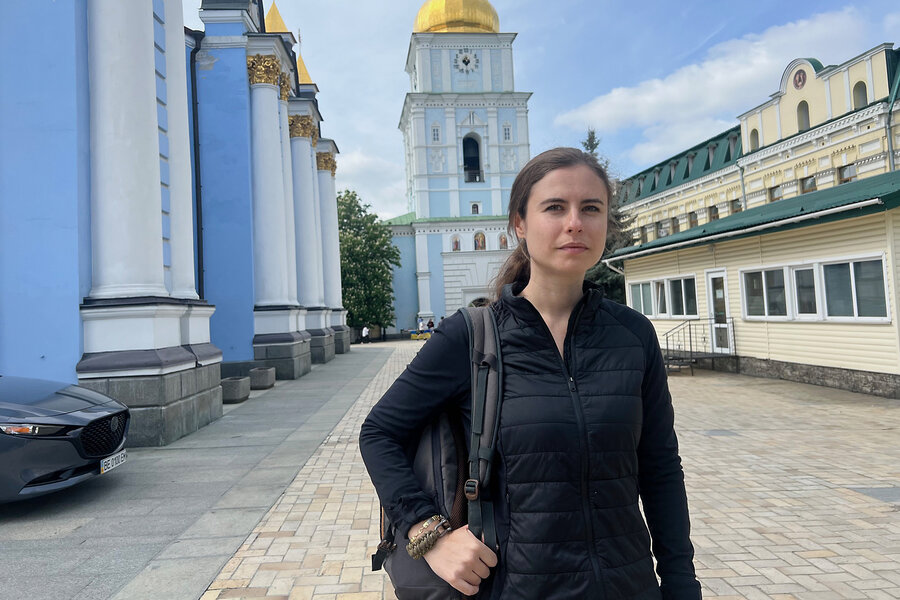
In February 2022, just days after Russia launched its full-scale invasion of Ukraine, Anastasia Fomitchova walked away from her life as a university student in Paris and arrived at Kyiv's historic St. Michael's Golden-Domed Monastery—swimming in oversized military fatigues that hung loose on her diminutive frame. She had made the choice to volunteer as a medic with Ukraine's Hospitallers corps, a decision that would take her from the post-massacre streets of Bucha to the terrifying trenches of the front lines and, ultimately, to the successful counteroffensive that liberated Kherson.
Seven months into her service, Fomitchova realized she had a story that needed telling—not just for herself, but for all of Europe. She began writing a book, later titled "Volia" (the Ukrainian word for both "will" and "liberty"), with a dual purpose: to bear witness to the bravery and humanity of the young soldiers she served alongside, and to deliver a warning to the continent itself. "I wanted this book to be a warning to Europeans that this is their war, too," she says, seated at a café overlooking the monastery where she first sheltered after arriving from France. "The Ukraine that Vladimir Putin would destroy is fundamentally European. It's the Ukraine that aspires to European values."
Writing in French, Fomitchova weaves her own family's complex history throughout the narrative—a powerful way of anchoring Ukraine's larger struggle in human terms. She chronicles the Holodomor, Stalin's engineered famine of 1932–33 that killed millions of Ukrainians. She writes of the 1986 Chernobyl nuclear disaster in Soviet Ukraine, a catastrophe that prompted her mother to uproot the family and move west. In one early, haunting scene, she describes discovering newspaper clippings from her childhood revealing the mysterious killings in Moscow of her grandmother and grandfather—her grandfather having served as security chief to Soviet leader Nikita Khrushchev, himself a Ukrainian.
Fomitchova's book arrives as part of a remarkable literary surge. Since Russia seized Crimea and occupied sections of Ukraine's eastern Donbas in 2014, more than 1,300 war-related books have been published, with a striking number appearing in the four-plus years since the full-scale invasion began. The output includes journals, poetry, nonfiction like "Volia," and fiction—much of it authored by the early volunteers whom Fomitchova calls Ukraine's "most brilliant": young entrepreneurs, engineers, doctors, writers, musicians, and artists. Many were veterans of the Maidan revolution of 2014, the pro-democracy uprising that helped crystallize modern Ukrainian identity.
What drives this creative outpouring is partly the character of those who answered the call. These were people imbued with what Fomitchova describes as a "creative spirit"—individuals with the skills to shape narratives as well as the courage to fight. She served alongside them, witnessed their compassion and humor amid horror, and felt compelled to transform that experience into testimony. Her message to Europeans is unsparing: the values under assault in Ukraine—freedom, universal human rights, international law—are not distant concerns but foundational to Europe itself. "It's why even seizing all of Ukraine would not be enough for him," she says of Putin, "and this is what I want Europe to understand."