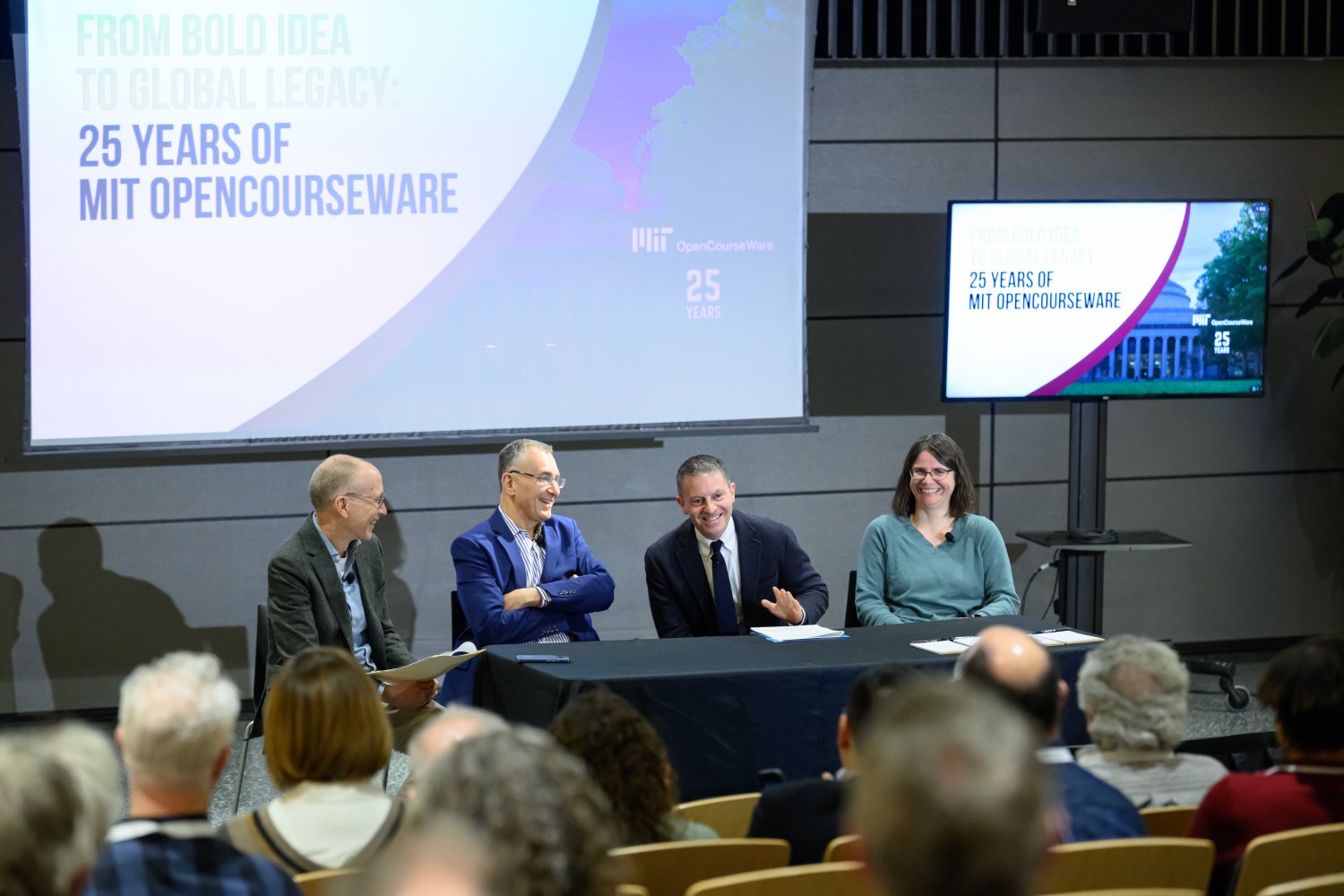
In 2001, MIT made a decision that would ripple across the globe for a quarter century: to throw open its classroom doors and give away its knowledge. Through MIT OpenCourseWare, the Institute began publishing course materials online for free, betting that knowledge should belong to everyone. That single act of generosity has now reached more than 500 million people worldwide.
The gamble has proven prescient. What started as a visionary 10-year experiment has become permanent infrastructure for learning, reshaping how education is accessed globally. At an April 8 celebration marking OpenCourseWare's 25th anniversary, Dimitris Bertsimas, vice provost for open learning, captured the scale of the impact with elegance: "That bet has paid off 500 million times over."
The numbers tell the story of a movement. MIT now offers more than 2,500 courses—spanning undergraduates to doctoral programs—all freely accessible through multiple channels. The MIT Learn platform and the dedicated OpenCourseWare website serve learners directly, but the platform's YouTube channel has become the most popular higher education channel on the platform, commanding more than 6 million subscribers. For communities where internet access is scarce or expensive, the OpenCourseWare Mirror Site Program delivers the full library on hard drives, ensuring that geography and bandwidth are not barriers to learning.
The impact extends far beyond convenience. Hinata Yamahara, a high school senior, discovered MIT's resources while exploring urban planning and credited an MIT workshop with helping him pass the Federal Aviation Administration's Private Pilot Knowledge Test. Andrea Henshall, a U.S. Air Force veteran, used OpenCourseWare to fuel her studies and advance her own goals. These are not anomalies—they are symptoms of a radical democratization of elite education. High schoolers in Australia, medical students in Turkey, and community college students in Boston now learn from the same syllabi, problem sets, and video lectures that MIT's own undergraduates study.
MIT's decision sparked a worldwide movement. Universities everywhere began launching their own open course initiatives, and grassroots efforts coalesced into coordinated communities like OE Global. The movement is no longer fringe—it now appears in national education strategies, undergirds nonprofit initiatives, and shapes international development programs. As MIT President Sally Kornbluth noted at the anniversary symposium, "Today, [OpenCourseWare] is cited in national education strategies... proof that openness scales when you lead with vision and courage."
What distinguishes OpenCourseWare from merely free content is the "open" part. MIT doesn't just make materials available—it actively permits learners and educators to download, copy, modify, reuse, remix, and redistribute resources for educational, non-commercial purposes. This openness invites participation. Professor Elizabeth Siler at Worcester State University and Victor Odumuyiwa at the University of Lagos both use MIT's freely shared pedagogical methods to reshape their own classrooms, carrying MIT's approach to instruction back to their communities and students. The generosity compounds.
Nearly 200 educators, faculty, learners, and philanthropic supporters gathered on MIT's Cambridge campus for the anniversary celebration. A new documentary, "The Courage to Be Open," premiered that day, exploring OpenCourseWare's origins and global reach. A quarter century in, MIT's original bet on openness remains the clearest wager the Institute has ever made—and the returns keep accumulating.