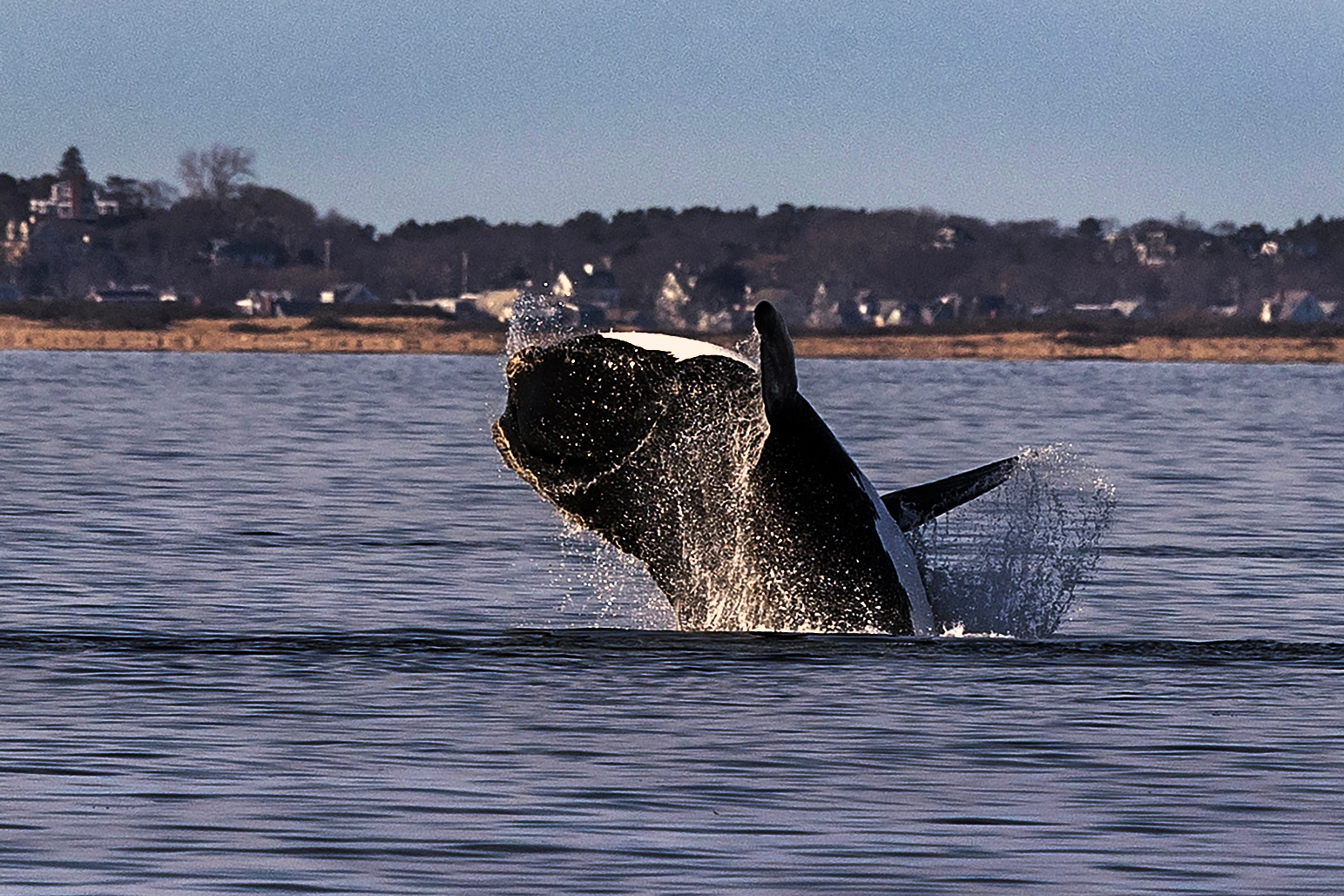
A calf swims alongside its mother in the North Atlantic—one of 23 new arrivals this breeding season, the most successful year for North Atlantic right whales since 2009. The milestone arrives as a rare moment of hope for a species that once teetered on the edge of oblivion, hunted so relentlessly that they earned their grim name: they were the "right" whales to hunt because they lived close to shore and floated when dead.
The recovery matters profoundly because North Atlantic right whales are critically endangered, with fewer than 400 individuals remaining in the entire ocean. To understand how close they came to extinction, consider this: when international whaling protections were established in 1932, the population had plummeted to somewhere between just 20 and 50 animals. The species that swims our oceans today represents an almost incomprehensible recovery from near-total annihilation.
Amy Warren, the scientific program officer at the New England Aquarium, works at the frontline of this conservation effort. Her team manages the North Atlantic Right Whale Identification Catalog, a database spanning nearly 90 years and tracking over 800 individual whales, each one catalogued from birth to death through distinctive markings. Every year, her team processes between 3,000 and 5,000 sightings and millions of photographs—a labor-intensive vigilance that makes the 23 new calves this season all the more significant.
What makes these whales identifiable is almost poetic: white patches called callosities cover their heads, created by colonies of whale lice living on rough patches of skin. Rather than a parasitic burden, Warren explains it as nature's arrangement—the lice feed on dead skin while the white lice create stark contrast against the whale's black skin, forming patterns as unique to each whale as fingerprints to humans. This natural marking system has made long-term tracking possible, turning the catalog into an archive of individual lives spanning decades.
But the path from 20 whales to 400 has never been straightforward. From the 1980s onward, human activity in the oceans intensified dramatically. Fishing gear grew stronger, vessels expanded further offshore, and ships became bigger and faster—all creating new hazards in waters where whales once had relative safety. Then climate change added another layer of disruption: as ocean temperatures shifted, the whales' food sources began migrating to unfamiliar areas, sometimes pulling right whales into regions where protections haven't been established and human activity remains concentrated.
Researchers responded by identifying critical feeding habitats and establishing protections around them—removing or slowing ships in key zones where whales congregate. These targeted measures have proven effective, preventing catastrophic ship strikes that claimed many lives in earlier decades.
This year's calving success suggests those protections are working, at least for now. Each of the 23 new calves represents not just a birth but a small victory against the odds. Yet the work is far from finished. A population under 400 remains fragile, vulnerable to any setback. The 23 calves born this season offer momentum and proof that recovery is possible—but only if the ocean's human users continue prioritizing the survival of an ancient species learning to navigate a rapidly changing world.