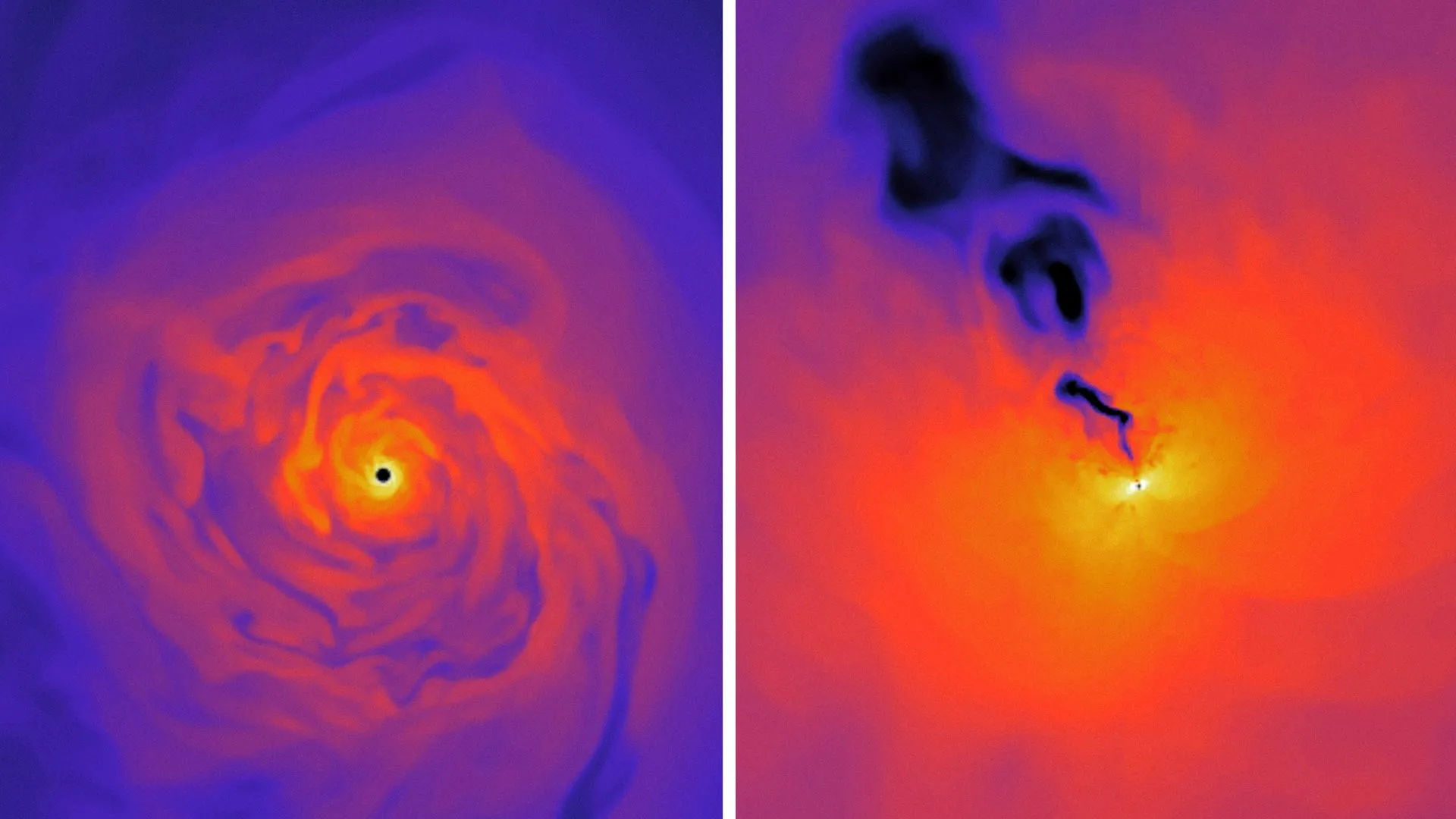
A black hole no wider than an atom could, in theory, trigger the destruction of a Sun-like star from the inside. The object would be tiny, but it could carry as much mass as an asteroid.
These hypothetical objects are called primordial black holes. They may have formed in the first fraction of a second after the Big Bang, when dense pockets of matter collapsed under their own gravity. Some researchers have suggested that surviving primordial black holes could help explain dark matter, the unseen material that makes up most of the universe’s matter. But none has yet been confirmed.
A team led by Ore Gottlieb, an assistant professor of physics at MIT, used mathematical calculations and three-dimensional computer simulations to study what might happen if one of these black holes entered a star like the Sun. Their work, published in The Astrophysical Journal, also involved researchers from the Flatiron Institute, New York University and Stanford University.
A lone star would generally be unable to capture a passing black hole, the researchers found. Its gravity would not be strong enough to stop the object from escaping. But a third body, such as a companion star or a planet, could change the encounter and leave the black hole trapped in the star’s gravitational pull.
The black hole could then pass through the star again and again. Friction with the star’s material would drain energy from its orbit, gradually drawing it toward the center. That journey could take thousands or even millions of years. Once inside the core, the black hole could begin feeding on nearby matter.
The team’s calculations suggest that much of the energy released as gas falls into the black hole would disappear inside it, rather than heating the surrounding star. That could let the black hole grow faster than earlier estimates indicated. If the star spins rapidly enough, material falling inward could form a rotating disk around the black hole.
“Once the disk forms, this is essentially a death sentence for the star,” Gottlieb said. The interaction could launch powerful jets of matter through the star, setting off an explosion that unfolds within seconds. The predicted blast would produce blue and ultraviolet light, as well as X-rays and gamma rays—signals that telescopes already in operation might detect.
That possibility turns a dramatic stellar death into a potential search method. Spotting such an outburst would not, by itself, prove that primordial black holes exist, but it could give astronomers a way to investigate them. Gottlieb said the team expects the event to be visible and worth looking for.
There is an important caveat: the objects are still theoretical, and the simulations describe what could happen under particular conditions, including rapid stellar rotation. The study offers a possible signpost, not a confirmed discovery. If astronomers find a matching burst, follow-up observations could help test whether a star’s final moments were shaped by one of the universe’s oldest imagined objects.