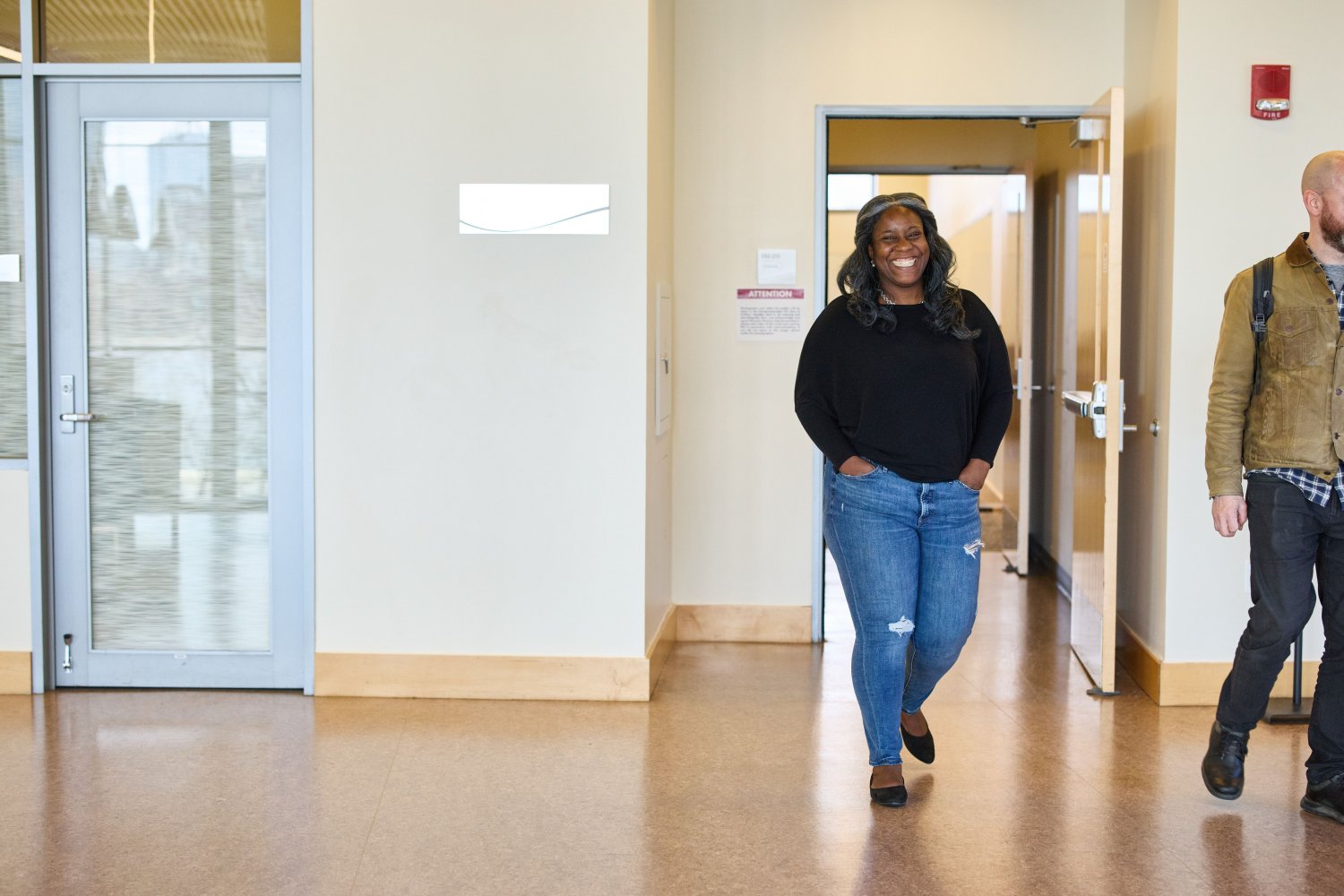
Alecia Asiamigbe began her week like any other MIT Sloan Fellow: coffee at the campus café, then into Taha Choukhmane's Managerial Finance class, where she was building the practical knowledge she knows she'll need as a founder. But there's nothing typical about what comes next for Asiamigbe—not after two decades as an energy and infrastructure professional, and certainly not now, as she completes her one-year MBA at MIT Sloan and launches Resilient Grid into a world that urgently needs what she's built.
Resilient Grid addresses a problem that touches hundreds of millions of people: in fuel import-dependent markets, energy security remains fragile, and conventional solar and wind alone cannot stabilize grids where reliable, on-demand power is essential. Asiamigbe's venture takes organic waste and converts it into sustainable natural gas capable of producing that dispatchable renewable power. The system is modular, which means it can be deployed where it matters most. By capturing methane that would otherwise escape landfills, the technology delivers measurable impact across three fronts: energy security, emissions reduction, and circular economic development.
What drew Asiamigbe to MIT Sloan wasn't prestige—it was purpose. The school's deliberate embedding of sustainability into new ventures aligned with her own mission. The Fellows program's one-year structure allowed her to compress an MBA into the exact timeframe she needed. But it was the Disciplined Entrepreneurship framework that anchored her choice. "I was anchored to my choice by the Disciplined Entrepreneurship framework and the potential to focus on climate and energy entrepreneurship," she said. Throughout her compressed year, she chose every course with surgical precision: Managerial Finance to sharpen her financial decision-making, The Art of Leadership with Wanda Orlikowski and Aithan Shapira to develop her own effectiveness as a leader, and Models and Controls of Energy Systems to deepen her technical understanding of power grids and grid optimization.
The Martin Trust Center for Entrepreneurship, along with resources and mentorship from PKG and Sandbox, transformed what began as an idea into something concrete—a venture with a team, a strategy, and a path forward. By mid-afternoon on any given day last semester, Asiamigbe was meeting with that team at noon, then sitting in a leadership seminar by one o'clock, studying energy systems by four. This wasn't a sabbatical or a pause; it was a sprint with a clear destination.
What animates Asiamigbe's work, though, goes deeper than business metrics. "My work in sustainability is deeply rooted in my need to give back to the community and to be an agent for systems-level change," she explained. She sees a dual challenge: creating access to opportunities for those currently locked out of innovation and energy entrepreneurship, while simultaneously stopping the damage already being done to the planet. It's the question she returns to again and again: "Knowing that we want better for our grandchildren, what will we do differently?"
For Asiamigbe, the answer is Resilient Grid—and a reminder that the most hopeful solutions often come from those willing to leave behind one kind of expertise to build something entirely new.