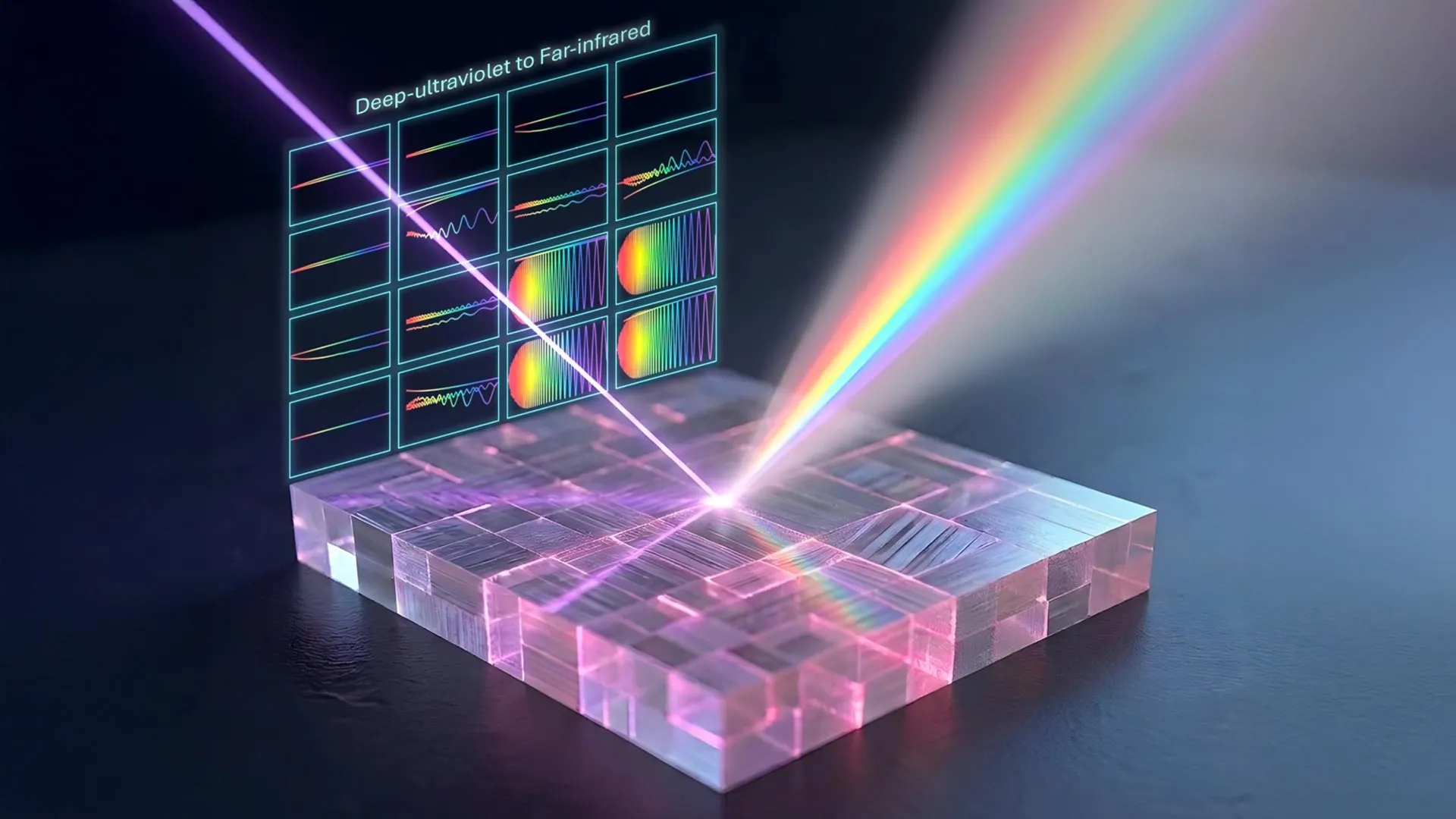
From 190-nanometer ultraviolet light to far-infrared wavelengths of 40 micrometers, researchers have mapped how barium titanate bends and absorbs light. Their measurements offer engineers a clearer guide to a material that could help carry information through faster, more efficient optical devices.
Light can carry huge amounts of data, but building systems that send information with light depends on knowing exactly how it behaves inside each material. Barium titanate, often shortened to BTO, is a strong candidate for future optical communication devices. Its optical properties, however, have been hard to pin down for decades, in part because tiny regions inside the crystal can point in different directions and respond differently to light.
A team led by Professor Min Seok Jang of the Korea Advanced Institute of Science and Technology (KAIST) worked with Professor Harry A. Atwater's group at the California Institute of Technology, the Korea Research Institute of Standards and Science, and U.S.-based J.A. Woollam Co. KAIST announced the findings on November 8. The researchers examined BTO across wavelengths from 190 nanometers to 40 micrometers, spanning ultraviolet through far-infrared light.
They used a method called Mueller matrix spectroscopic ellipsometry. It measures changes in light's polarization—the direction in which its waves move—to reveal how a material handles light. The team focused on two kinds of single-crystal samples with more consistent crystal-region orientations, reducing the mix of responses that had made earlier results difficult to compare. They split the broad wavelength range into three sections and used a different analysis for each.
Two measurements matter especially to device designers. The refractive index describes how light travels through a material; the extinction coefficient shows how much light the material absorbs. In the 2-to-10-micrometer range, the team found extremely low absorption, with extinction coefficients of about 10^-5. They also developed a way to predict the overall optical response of a crystal containing multiple regions, using the direction and share of the crystal occupied by each one.
The findings matter because BTO can change its effect on light when electricity is applied. This response, known as the Pockels effect, makes the material attractive for optical modulators—components that turn electrical information into light signals. Such components are building blocks for communication systems. Better measurements can help engineers predict how light will move through a device and how much signal will be lost, before they make it.
That could make the design of future optical components more reliable and reduce the need for trial and error. The work also points toward possible uses beyond communications, including quantum technology, though the research does not establish a finished product or a timetable for one. For now, the advance is a more dependable set of measurements and a clearer way to account for BTO's complex crystal structure—useful groundwork for turning its promise into practical devices.