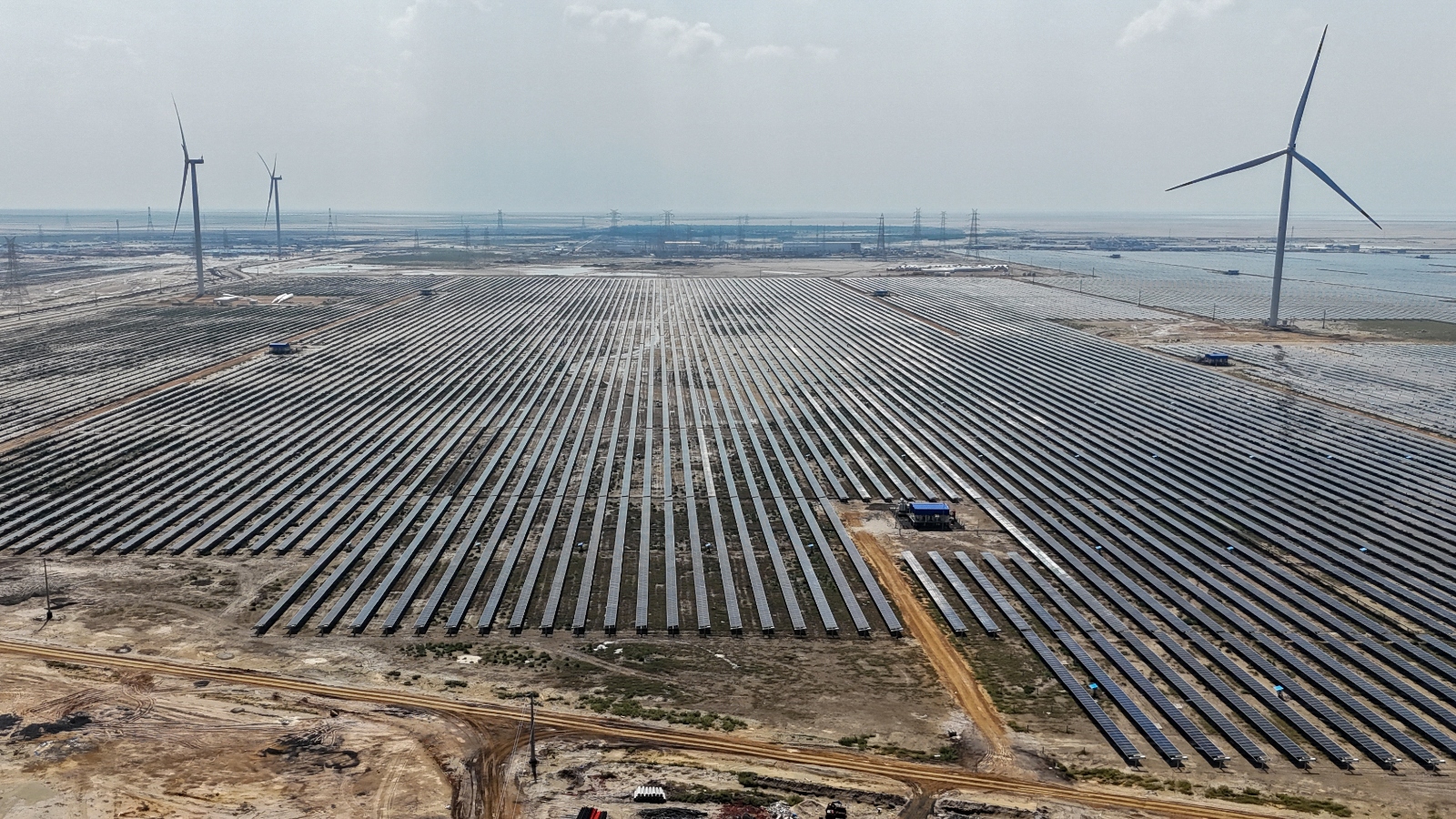
Nearly 60 million solar panels are racing across the salt flats of India's Rann of Kutch, transforming one of the world's largest deserts into a glowing engine of clean power. By 2029, the Khavda solar park will stretch across 280 square miles—nearly the size of Chicago—with a generating capacity of 30 gigawatts, making it the world's largest and most powerful solar installation. That's enough electricity to power all of Austria, a country of nine million people.
India's solar surge matters because it's rewriting the global playbook for industrialization. For centuries, wealthy nations built their economies on coal and oil, locking in decades of carbon emissions. Now, as India's economy grows faster than China's, analysts say the world's most populous nation is poised to become the first major country to power its industrial rise predominantly with solar energy. This shift could reshape how emerging economies across Africa, Southeast Asia, and Latin America approach their own development.
The numbers reveal how rapidly this transformation is unfolding. Installed solar capacity in India has been growing by 40 percent annually. In March, it surpassed 150 gigawatts, and by 2030 is expected to double again. Last year, for the first time, more than half of India's installed generating capacity came from non-fossil fuel sources—a striking reversal from just a decade ago, when solar power was virtually unknown outside of rooftop installations and remote microgrids. Electricity demand is climbing more than 6 percent each year, and according to the International Energy Agency, about half that growth between now and 2030 will be met by solar power alone, with another quarter coming from wind, hydroelectric, and nuclear sources.
The Khavda project embodies India's ambition at scale. Developed by the Adani Group, the world's second-largest solar developer, the park had already reached 9.4 gigawatts of installed capacity as of April. The engineering is as innovative as the ambition: robots dry-clean the panels at night with desert salt and dust, protecting them without wasting freshwater in an arid region. Wind turbines on the Arabian Sea shore provide nighttime power for the grid when the sun sets.
This pivot happened faster than anyone expected. In 2015, Prime Minister Narendra Modi promised to double coal output by 2020, and India's environment ministers fiercely resisted international pressure to phase out fossil fuels, arguing that developing countries needed coal to escape poverty. Yet policy shifted even as those debates raged. India's abundant sunshine and plummeting solar costs proved irresistible. Since Glasgow in 2021, the country has accelerated solar deployment year after year.
The transition is far from complete. Coal still fuels roughly 70 percent of India's total power generation and remains the backbone of baseload electricity. India ranks as the world's third-largest carbon dioxide emitter. But the direction is unmistakable: a nation once betting its future on fossil fuels is now building it on sun. As Kingsmill Bond, energy strategist at the U.K. think tank Ember, put it: "China built on coal; India is building on sun. And what India is doing could also be mirrored in other emerging economies."