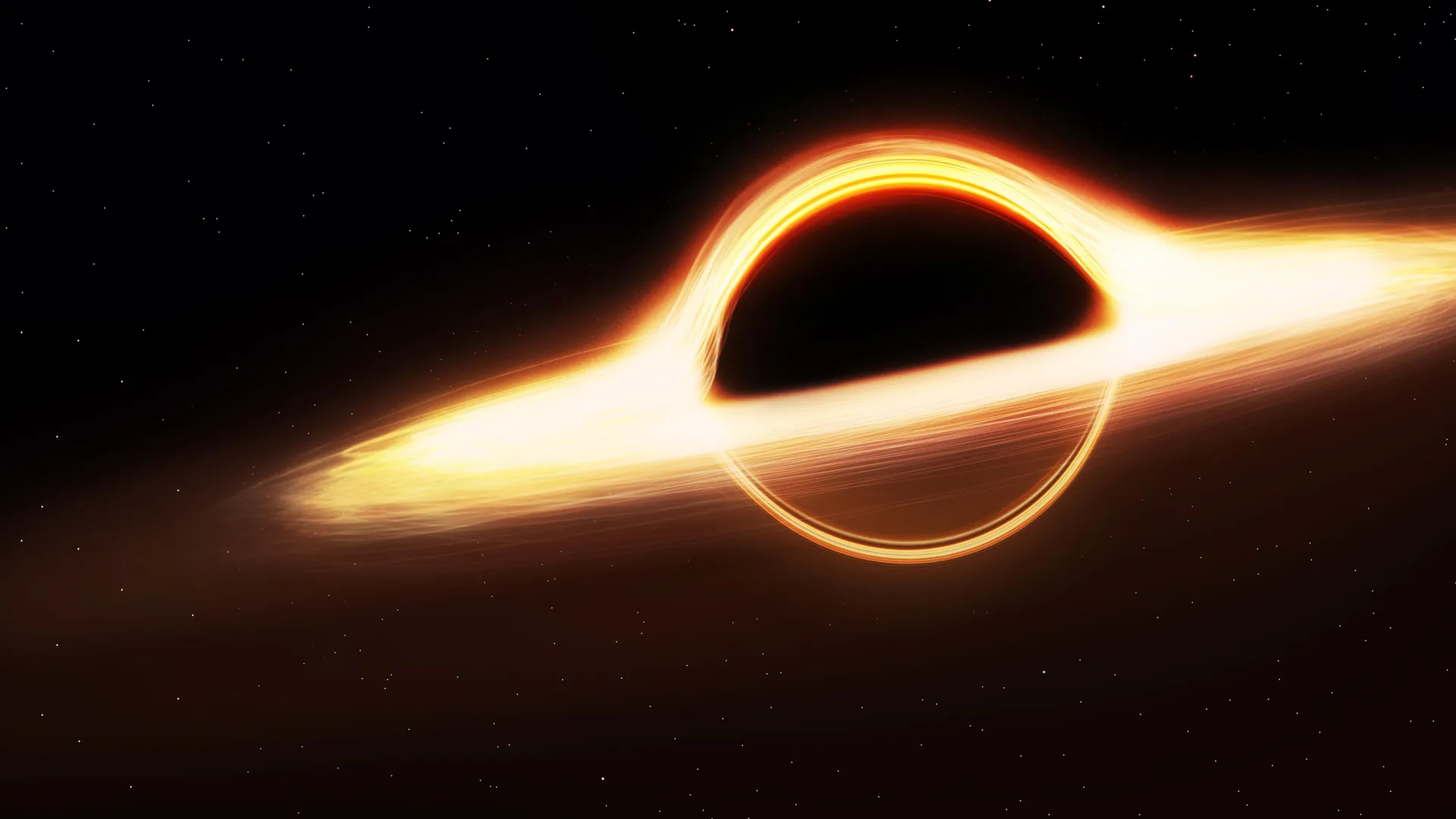
Among 257 black hole mergers, one kind of black hole showed up again and again: those weighing about 10 times as much as the Sun. A new study also found a striking shortage of black holes weighing 12 to 16 solar masses, a pattern that may point to stars that died without exploding.
The largest stars can end their lives in supernovae, blasts that fling material into space. Their cores then collapse into neutron stars or black holes. But some stars may take a quieter route, collapsing directly into black holes without a supernova. Astronomers have not yet confirmed a specific case of this so-called failed supernova, in which a star disappears without the usual bright explosion. The idea has long been supported by theory, and the new findings offer a way to test it using black holes far beyond our reach.
Led by Caltech physics professor Katerina Chatziioannou, researchers studied black holes that merged and sent gravitational waves across space. Gravitational waves are tiny ripples in spacetime. The LIGO, Virgo and KAGRA observatories detect them, allowing scientists to learn about objects that are otherwise difficult to see. The network has recorded more than 300 black hole collisions since LIGO first detected gravitational waves in 2015. For this study, the team examined the masses of black holes in 257 mergers observed over the past decade.
About three-quarters of the black holes in the sample weighed roughly 10 times the Sun’s mass. Yet objects in the 12-to-16-solar-mass range were scarce. The team also found that black holes near 10 solar masses tended to have spins—their rates of rotation—clustered within a narrower range than those of the broader population. Mass and spin can both preserve clues about how a black hole formed.
Together, the crowding around 10 solar masses, the gap above it and the shared spin pattern suggest these black holes may belong to a distinct group with a common origin. One possible explanation is that many formed when massive stars collapsed directly into black holes, instead of exploding first. In some mergers, the heavier black hole—or both—could have formed this way.
The results, published in Physical Review D, do not prove that failed supernovae exist. But they match predictions for the kinds of black holes such quiet deaths might leave behind. That makes gravitational-wave measurements a useful tool for studying a process astronomers may struggle to catch with telescopes: a star’s final moments without a flash of light.
The next step is to compare this pattern with more observations as the detector network continues to find black hole mergers. Each new collision can help researchers determine whether the mass gap and spin similarities are signs of a separate population—or whether another feature of stellar physics explains them. Either way, the data are bringing scientists closer to understanding how stars make black holes.