In a laboratory at MIT in Cambridge, Massachusetts, researchers have threaded specialized nanosensors onto a urinary catheter—a thin, seemingly simple medical device that could fundamentally change how doctors catch bladder cancer before it becomes a crisis. About 85,000 Americans are diagnosed with bladder cancer each year, but here's what makes the disease particularly punishing: roughly half of all patients who undergo treatment will develop tumors again within five years, making it one of the costliest cancers for society to manage.
The problem isn't a lack of treatment options—it's the struggle to catch recurrence early enough. Currently, doctors rely on urinalysis to monitor patients, testing urine samples for telltale proteins that signal cancer's return. But urine is a diluted messenger. By the time a protein biomarker reaches a urine sample, it has been significantly diluted, degraded, and cleared from the body, meaning tumors are only detected once they've advanced. Michael Strano, the Carbon P. Dubbs Professor of Chemical Engineering at MIT and senior author of the study published in Nature Nanotechnology, likened the new approach to a fundamentally different kind of tool: "It's like a camera for molecules instead of light."
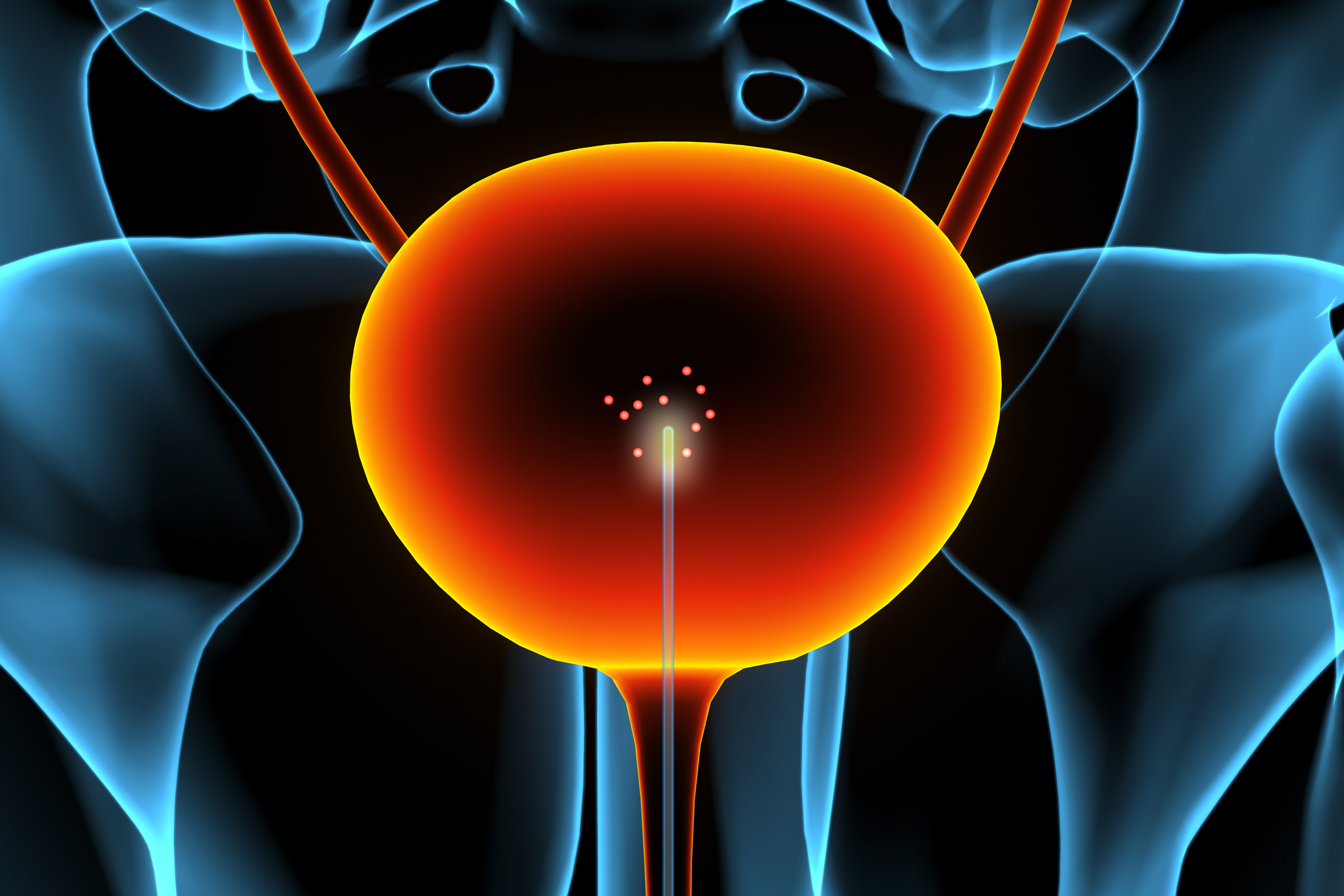
The sensor works by detecting nuclear matrix protein 22 (NMP-22), an FDA-approved bladder cancer biomarker. But instead of waiting for it to appear in urine, the nanosensors sit directly inside the bladder on a catheter coated with carbon nanotubes—hollow, nanometer-thick cylinders that naturally fluoresce under laser light. The catheter includes a tiny ball lens that rotates 360 degrees, emitting laser light and capturing the fluorescent signals the nanotubes produce when they encounter cancer proteins. By analyzing the color and location of these signals, researchers can create a chemical map showing not just whether cancer is present, but precisely where it is.
The sensitivity difference is staggering. In animal studies, the nanosensor-coated catheter proved nearly 50,000 times more sensitive than traditional urinalysis. It could detect tumors as small as 16 square millimeters—roughly the size of a grain of rice—by capturing biomarkers directly at their source in the bladder lining, rather than measuring diluted traces in urine later. This represents a paradigm shift in early detection: tumors can now be spotted before they break through the urothelium and become visibly advanced, while they're still emitting the chemical signals that the sensors can read.
The research team, led by postdoctoral researchers Wonjun Yim and Hohyung Kang alongside MIT graduate student Marco Machado and undergraduate Maeve McGinnis, built on a decade of work by Strano's laboratory developing customized nanosensors. The team coated carbon nanotubes with synthetic antibodies—polymers designed to interact with specific molecular targets—creating sensors that shift their fluorescent properties when their target appears.
While the prototype works, practical deployment remains ahead. Strano's team is now designing a more compact imaging system suitable for use in a doctor's office, and they're exploring integration with a cystoscope—a specialized catheter with an attached camera already used to visualize bladder tumors. For the roughly 50 percent of bladder cancer patients facing recurrence, earlier detection could mean the difference between catching disease at a treatable stage and discovering it only after it has spread.