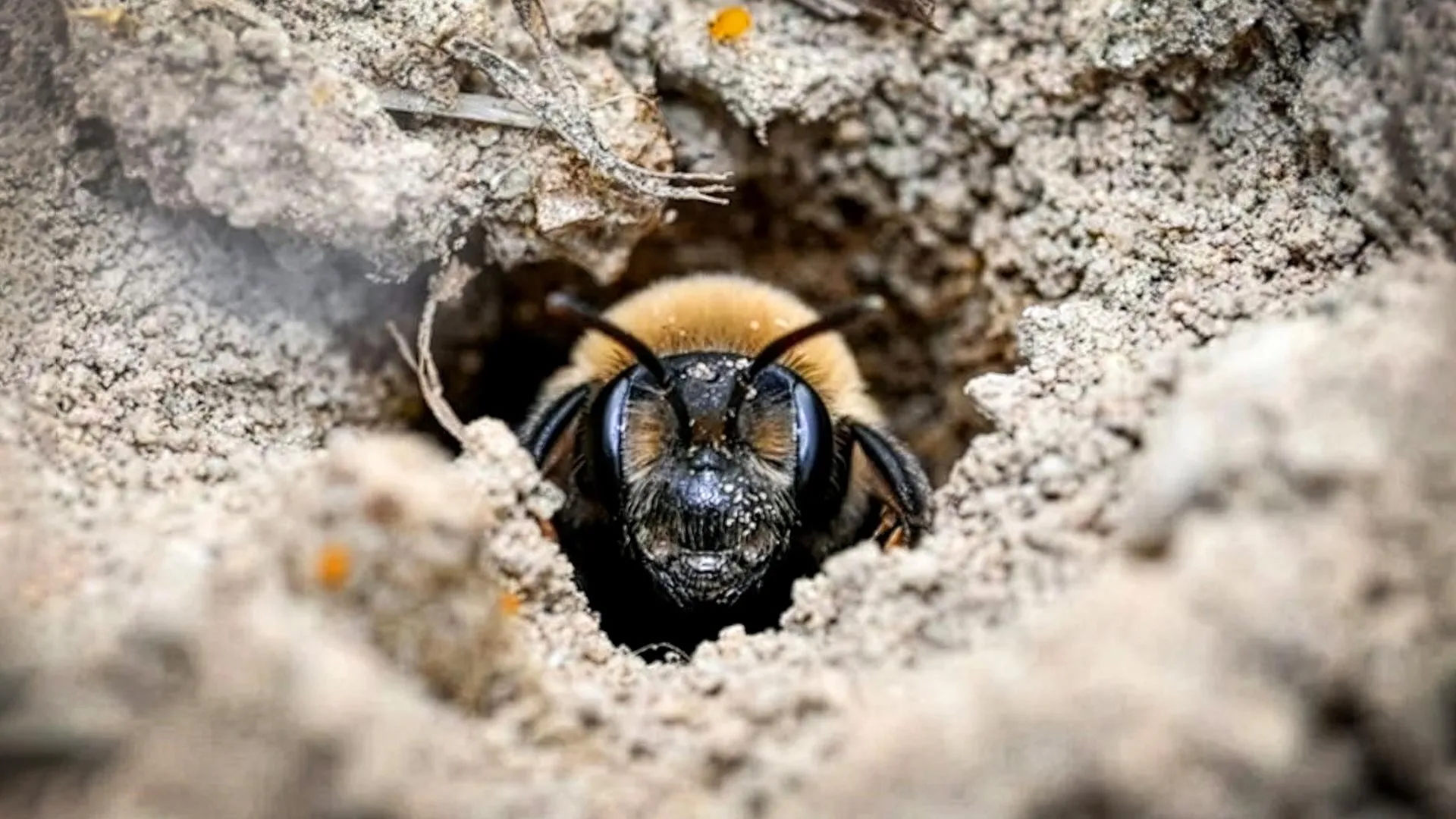
Rachel Fordyce was walking through East Lawn Cemetery in Ithaca one spring morning in 2022 when she noticed bees everywhere—so many that she stopped to collect some in a jar and brought them to her supervisor, Bryan Danforth, a professor of entomology at Cornell University. That casual observation would lead to an extraordinary discovery: a cemetery in upstate New York is home to roughly 5.5 million individual bees, one of the largest documented aggregations of ground-nesting bees ever recorded.
The bees are Andrena regularis, commonly called "regular mining bees," solitary wild insects that tunnel into the soil to lay their eggs in chambers filled with pollen and nectar. Though honeybees capture public imagination, about 75 percent of all bee species are solitary ground nesters like these. What makes East Lawn Cemetery so remarkable is not just the sheer abundance—5.5 million bees concentrated within 1.5 acres is roughly equivalent to more than 200 honeybee hives and exceeds Manhattan's entire human population by threefold—but also that historical records show A. regularis has been nesting there since at least the early 1900s. "In terms of what is in the literature, this is one of the largest," said Steve Hoge, the Cornell undergraduate who led the research published in April in the journal Apidologie.
The discovery highlights a surprising truth about cemeteries: they can be crucial refuges for biodiversity. Older cemeteries, especially in cities, already shelter uncommon plants, insects, birds, and mammals. East Lawn Cemetery, which dates back to 1878, provided ideal conditions. The land is peaceful, rarely disturbed, and largely free of pesticides. The cemetery's sandy soil suits the bees perfectly, and Cornell Orchards, just a third of a mile away, offers abundant spring flowers. Keven Morse, the cemetery's superintendent, has managed the nonprofit property with his family for 46 years and has witnessed the rich wildlife—deer, geese, hawks, foxes, coyotes, and countless bees. "I just felt bad having to mow in certain areas," Morse said. "There's probably three or four sections where they really migrate heavy, there's a lot of them."
What makes A. regularis particularly valuable is their role as crop pollinators, especially for apples, one of New York's signature agricultural products. The bees emerge in April, precisely timed to apple bloom—a rare trait that happens because this species overwinters as adults, an unusual survival strategy. They feed on fruit trees and early wildflowers before retreating underground to complete their life cycle.
To count the millions of bees, researchers used emergence traps—small mesh tents that funnel emerging insects into glass jars. Between late March and mid-May 2023, ten traps throughout the cemetery captured 3,251 insects representing 16 species. A. regularis overwhelmingly dominated the samples, allowing scientists to calculate population density across the cemetery's approximately 6,000 square meters and estimate a total population ranging from 3 million to 8 million bees. The research fills a striking gap: when undergraduate Hoge began studying the species, he found surprisingly little scientific information available, with the most detailed reference dating back to 1978.
The discovery underscores what entomologists have long known but the public often misses: most bee work happens underground, out of sight, in service of crops and ecosystems we depend on. "The research elevates the value of solitary ground-nesting bees and shows just how abundant these bees are, how important they are as crop pollinators, and that we need to be aware of these nest sites and preserve them," Danforth said. In preserving a cemetery, Ithaca has inadvertently protected one of the world's most significant bee populations.