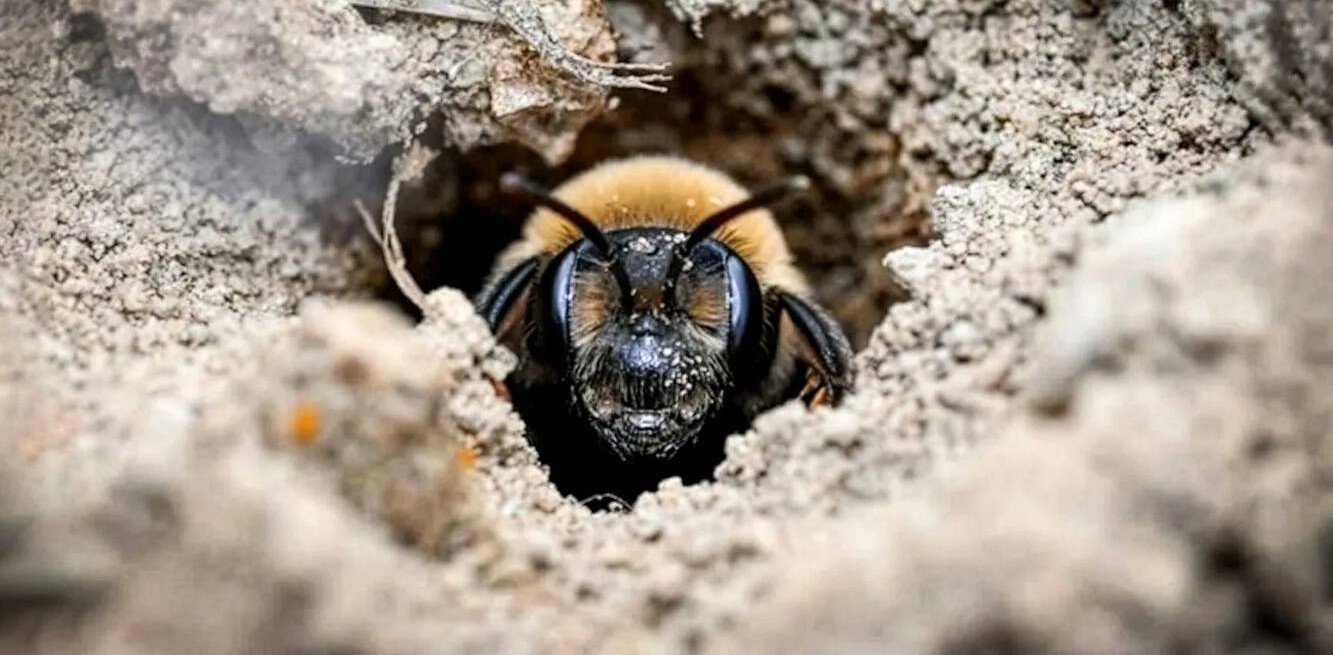
Rachel Fordyce noticed them first—bees everywhere—during a spring 2022 shortcut through East Lawn Cemetery on her way to work at Cornell University's entomology lab. She collected a few in a jar and brought them to her supervisor, Bryan Danforth, professor of entomology at Cornell's College of Agriculture and Life Sciences. "These are all over the cemetery," she said. That casual observation would unlock one of the most remarkable discoveries in recent bee science: a 5.5 million-strong colony of solitary bees thriving beneath the cemetery's undisturbed sandy soil for more than 100 years.
The bees were identified as Andrena regularis, commonly called "regular mining bees"—solitary wild bees that nest underground and pollinate crops and wild plants. To understand the scale of what was happening at East Lawn, researchers deployed a deceptively simple tool: emergence traps, small mesh tents covering less than a square meter of ground that funnel emerging insects into glass jars. Between March 30th and May 16th, 2023, the team placed 10 traps throughout the cemetery and collected 3,251 insects representing 16 species of bees, beetles, and flies. Andrena regularis overwhelmingly dominated the samples. Using the density data from those traps, researchers calculated that the cemetery harbored between 3 million and 8 million bees—with 5.5 million as the central estimate.
The numbers are staggering in their own right. The colony is comparable to more than 200 honeybee hives. It exceeds Manhattan's human population by more than threefold. "I'm sure there are other large bee aggregations that exist around the world that we just haven't identified, but in terms of what is in the literature, this is one of the largest," said Steve Hoge, lead author of the study published April 13th in the journal Apidologie. Historical records showed that A. regularis has been present at East Lawn Cemetery since at least the early 1900s, meaning this population has persisted through a century of urban development and agricultural change.
This discovery matters far beyond the cemetery gates. Andrena regularis is a critical pollinator for valuable agricultural crops, including apples—one of New York's signature commodities. The research elevates the value of solitary ground-nesting bees while highlighting how abundant and ecologically important these poorly understood species truly are. "These populations are huge, and they need protection," Danforth said. "If we don't preserve nest sites, and someone paves over them, we could lose in an instant 5.5 million bees that are important pollinators."
The findings strengthen a broader insight: cemeteries can serve as vital refuges for biodiversity. Older cemeteries, especially in cities, are already known to shelter uncommon plants, insects, birds, and mammals. East Lawn Cemetery, established in 1878, provides ideal conditions—peaceful, rarely disturbed, and largely free of pesticides. The sandy soil the bees prefer exists in abundance. Cornell Orchards, located about one third of a mile away, likely helps support the population with abundant spring flowers. Keven Morse, the cemetery's superintendent for 46 years, has witnessed the ecosystem firsthand: deer, geese, hawks, foxes, coyotes, and countless bees. "I just felt bad having to mow in certain areas," he said. "There's probably three or four sections where they really migrate heavy, there's a lot of them."
As cities expand and agricultural lands intensify, places like East Lawn Cemetery remind us that refuges for life exist in unexpected corners—if we choose to protect them. The discovery of one of the world's largest bee aggregations wasn't made in a pristine wilderness, but in a quiet cemetery where science and stewardship intersect.