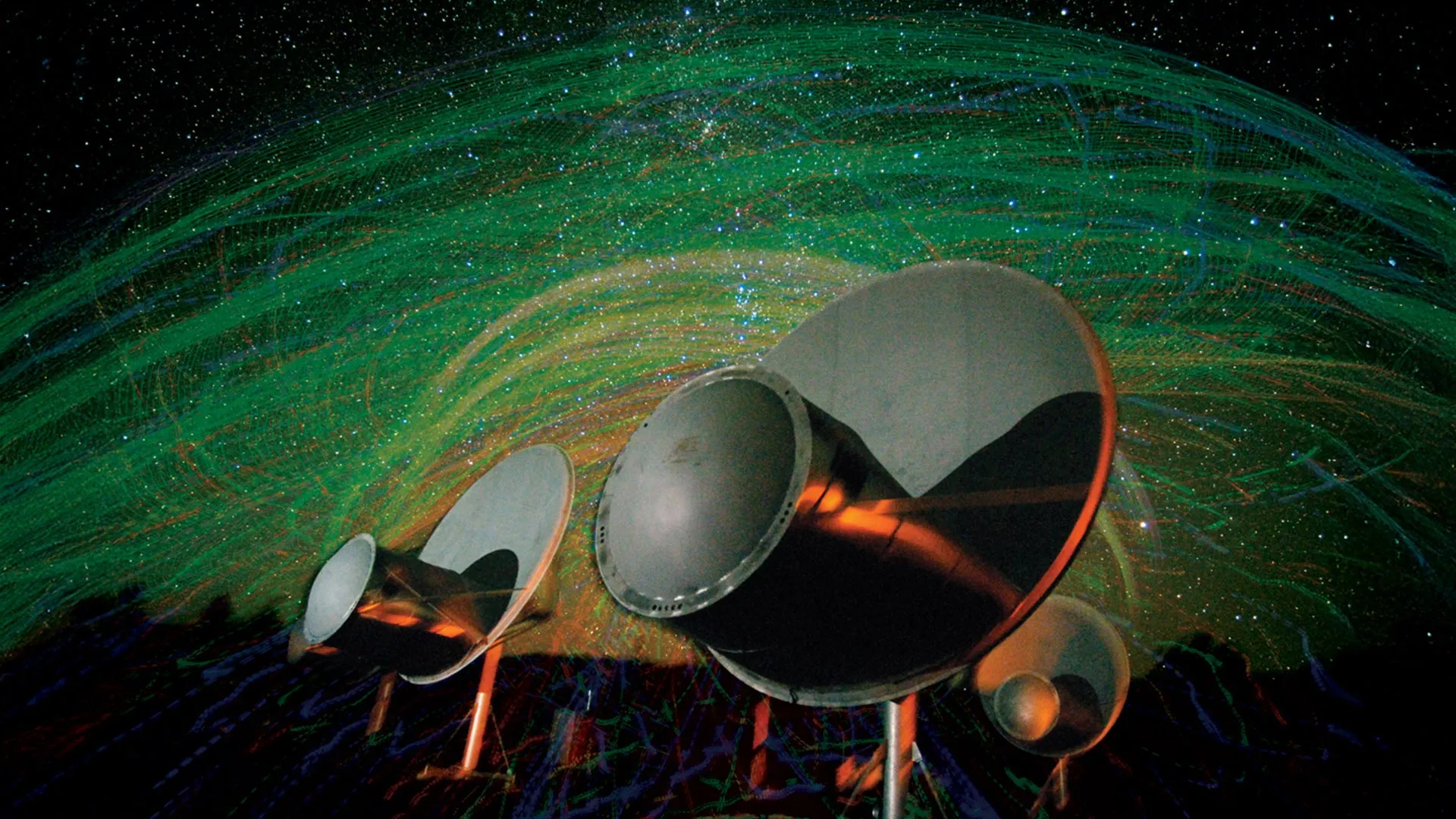
When the interstellar comet 3I/ATLAS streaked through our Solar System in July 2025, astronomers at the Hat Creek Radio Observatory in Northern California sprang into action. Within 24 hours of its discovery, the Allen Telescope Array (ATA) was trained on the distant traveler, scanning for any whisper of artificial radio signals that might hint at alien technology. Led by Dr. Sofia Sheikh of the SETI Institute, the team spent more than seven hours probing frequencies from 1 to 9 gigahertz—bands where natural cosmic phenomena rarely intrude, making them ideal for spotting the fingerprints of intelligence. What they found was silence, but not emptiness: nearly 74 million signals, all traced back to Earth. After rigorous filtering, only about 200 candidates remained that matched the comet’s motion, yet each was ultimately linked to human satellites or terrestrial transmitters. The result? No technosignatures, but a powerful affirmation of scientific readiness.
3I/ATLAS is only the third confirmed interstellar object ever detected, following 1I/'Oumuamua and 2I/Borisov. Unlike asteroids born in our own cosmic neighborhood, these visitors formed around distant stars, carrying clues about planetary formation across the galaxy. While all evidence confirms 3I/ATLAS as a natural, comet-like body, its passage represents more than just an astronomical curiosity—it’s a test run for how we might one day detect alien technology. "Eventually, our own Voyager spacecraft will be extraterrestrial artifacts in other stellar systems," Dr. Sheikh noted, underscoring the importance of understanding what natural interstellar objects look like so we can recognize the unnatural when it appears.
The study didn’t just rule out alien broadcasts—it set hard limits on what could have been hiding in the dark. The ATA observations showed that no transmitter stronger than 10 to 110 watts—about the power of a refrigerator or a bright incandescent bulb—could exist on or near 3I/ATLAS without being detected. That sensitivity means today’s instruments are already capable of catching faint artificial signals across interstellar distances, provided we’re looking in the right place at the right time.
What makes this search remarkable isn’t just its precision, but its speed. The ability to mobilize within a day highlights how far technosignature science has come. As new interstellar objects are discovered—likely more frequently in the coming decades thanks to advanced sky surveys—each will offer another chance to listen. The silence from 3I/ATLAS teaches us that nature remains the dominant author of cosmic stories, but it also sharpens our tools for the day that changes.