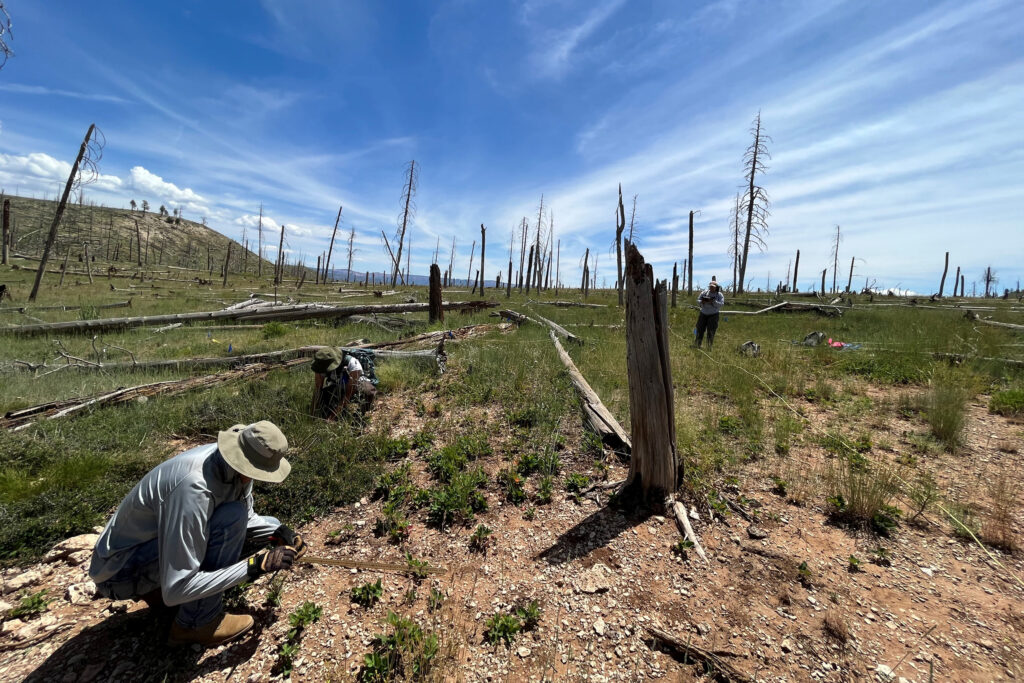
Four years after the Calf Canyon/Hermits Peak Fire blackened 341,471 acres in northern New Mexico, the state's largest wildfire in history has left behind vast stretches of leafless, charred trees—a landscape that researchers are now learning to reclaim, one carefully conditioned seedling at a time. Across New Mexico, wildland fires have scorched more than 5.45 million acres over the past two decades, creating both an urgent need and an unprecedented opportunity to reimagine how forests recover after catastrophe.
The state's challenge is not simply wanting to plant trees; it's figuring out how to make them actually survive. When New Mexico purchased seedlings from Idaho nurseries, the long-distance travel stressed the young trees, and survival rates languished. That brutal question—asked by Jenn Auchter, director of the New Mexico Reforestation Center—cut to the heart of the problem: "So yes, we're planting, but are we actually reforesting?"
The answer begins in spring, when researchers from New Mexico Highlands University scout forests statewide for what they call the "best trees on the worst site"—mature pine cones from trees that have already survived drought, wildfire, and temperature extremes. In 2024, contractors collected 12 million seeds from these hardy trees. After drying, separation, and genetic certification by the US Forest Service National Seed Laboratory, those seeds reach the John T. Harrington Forestry Research Center in Mora, where the real transformation begins.
Andrei Toca, a research scientist at the center, deliberately stresses seedlings in ways that seem counterintuitive. He exposes them to controlled drought, forcing them to develop larger root systems that can absorb more groundwater, and strategically subjects them to warmer temperatures. The reasoning is direct: ground temperatures on burn scars can reach 150 degrees, and the dark, charred surface absorbs far more solar radiation than lighter terrain. Meanwhile, approximately 94 percent of New Mexico was experiencing drought conditions as of May, creating drier winters that rob seedlings of insulating snow. Toca's approach is to harden seedlings in the nursery so they recognize the stress ahead as familiar rather than fatal. "What we are trying to do," Toca explained, "is introduce those seedlings to the very stress factors that they will face later on."
This integrated approach—what researchers are calling a "reforestation pipeline"—brings together EMNRD, New Mexico Highlands University, New Mexico State University, and the University of New Mexico. It's a deliberate chain from seed to survival, differentiating New Mexico's strategy from other states. Currently, the Harrington Center produces about 300,000 seedlings annually. The new Reforestation Center, which broke ground on April 27 in Mora County, is projected to produce 1 million seedlings by fall 2028 and 5 million annually thereafter—seedlings born and bred for a hotter, drier world.
Matt Hurteau, a University of New Mexico professor leading site selection efforts, notes that plant survival in wildfire footprints across the Southwest has historically averaged just 25 percent. That dismal statistic reflects not just the challenge of reforestation, but the scale of transformation ahead. With New Mexico's 5.45 million burned acres and a new generation of climate-resilient seedlings emerging from Mora, the state is moving beyond survival toward genuine restoration—proving that even landscapes laid bare by fire can be coaxed back to life, one hardened tree at a time.