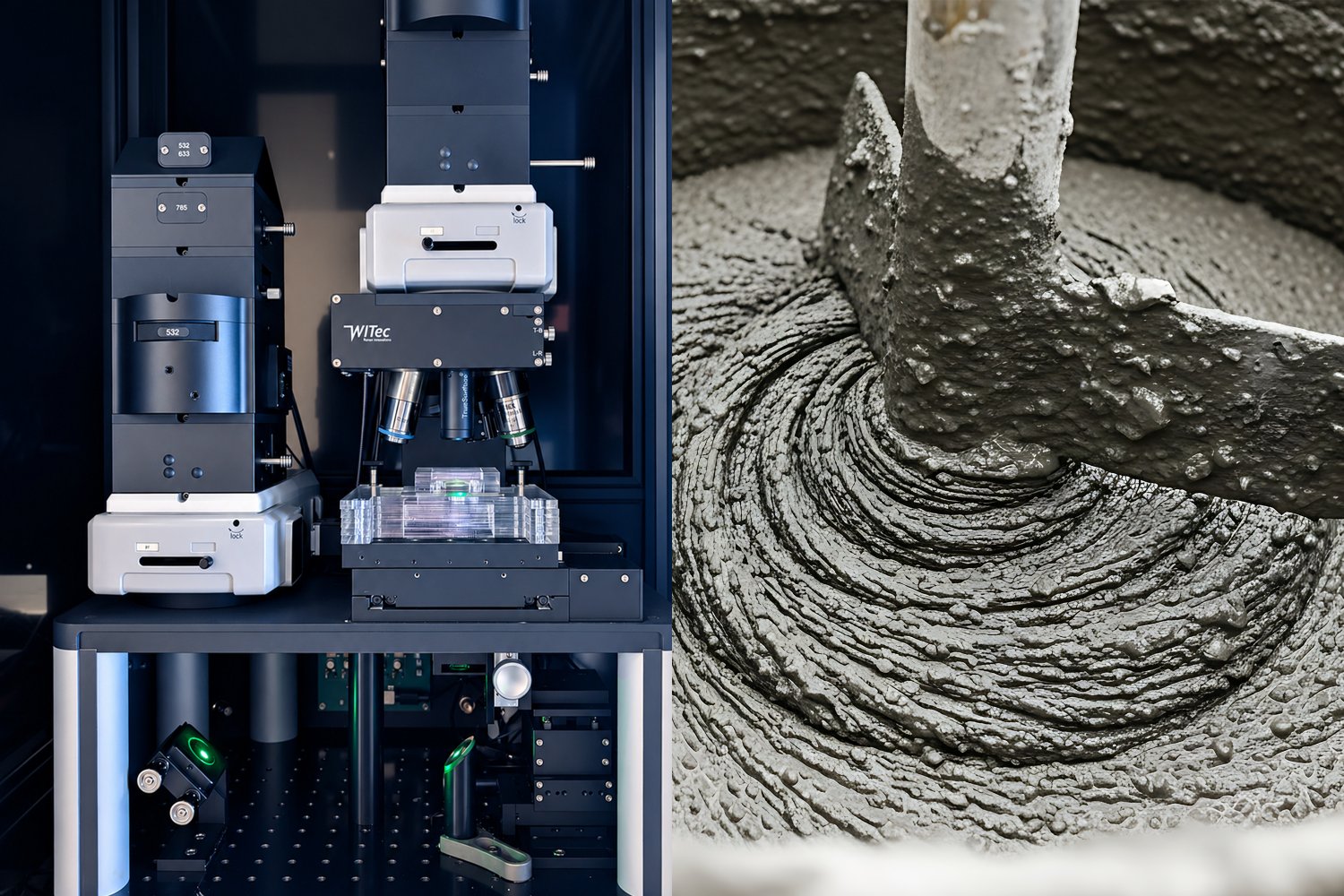
One September day, it started to snow inside MIT's Pierce Laboratory. Researchers depressurized a tank of liquid carbon dioxide, instantly freezing it into solid flakes that were blended into cement paste and pressed into dime-sized discs. Then they did something no one had done before: they pointed a laser directly at the CO2-injected cement as it hardened, watching in real time as the chemistry unfolded over 24 hours. What Associate Professor Admir Masic's team discovered could explain why injecting carbon dioxide into concrete makes it stronger, faster — and it might help unlock a new way to store CO2 and keep it out of the atmosphere.
Injecting CO2 into cement and concrete products has attracted commercial interest in recent years, with a growing number of companies offering CO2-infused mixes. The appeal is twofold: the process locks carbon away from the atmosphere, and it seems to accelerate strength gain. But until now, the underlying chemistry had remained invisible. Previous studies had pieced together the story from theory and indirect evidence, but the reactions moved too fast and disappeared too completely for conventional techniques to catch them in action. Raman confocal microscopy changed that. The technique works on an elegant principle: illuminate a molecule with a laser, and the scattered light reveals its chemical identity through a distinct spectral "fingerprint." Even fleeting, shapeless phases leave a readable trace.
The team — led by first-author Marcin Hajduczek, a graduate student at the MIT Concrete Sustainability Hub, and joined by colleagues from MIT, IIT Jodhpur, and CarbonCure Technologies — observed a three-act chemical sequence unfold in their samples. Act One happened within the first hour. The moment CO2 was added to fresh cement paste, it dissolved into the pore solution and reacted with calcium released by dissolving clinker, precipitating as calcium carbonate. This temporarily starved the normal hydration reaction of the calcium it needed to proceed. Without that calcium nearby, silicates released by the clinker dissolved into the pore solution and precipitated far away, linking together into chains that formed an interconnected silica gel network throughout the paste — a ghostly, amorphous structure that set the stage for what came next.
Four to five hours after mixing, the injected CO2 was fully mineralized and normal hydration resumed. Calcium hydroxide began to precipitate, and when it encountered the waiting silica gel network, the two phases reacted immediately to produce calcium silicate hydrate, the compound that gives cement its binding strength. What made this reaction remarkable was where it happened: not clustered tightly around clinker particles as in conventional cement, but distributed evenly throughout the entire matrix, wherever the silica gel had spread. "At first, the fleeting nature of the silica gel looked like a fluke in the Raman data," says Hajduczek. "But it quickly became clear that its sudden disappearance was a consistent, undeniable feature of every CO2-injected sample."
Within eight hours, the silica gel was almost entirely consumed, transformed rapidly into additional calcium silicate hydrate during this critical early window. With that gel consumed, the paste settled into conventional hydration, but what remained was measurably different: a more evenly distributed binder network that explained the faster strength gain. The research, published open-access in the Journal of the American Ceramic Society, represents the first direct visualization of this chemistry — a landmark moment that could accelerate development of CO2-injected concrete products and help companies refine formulations for real-world use.