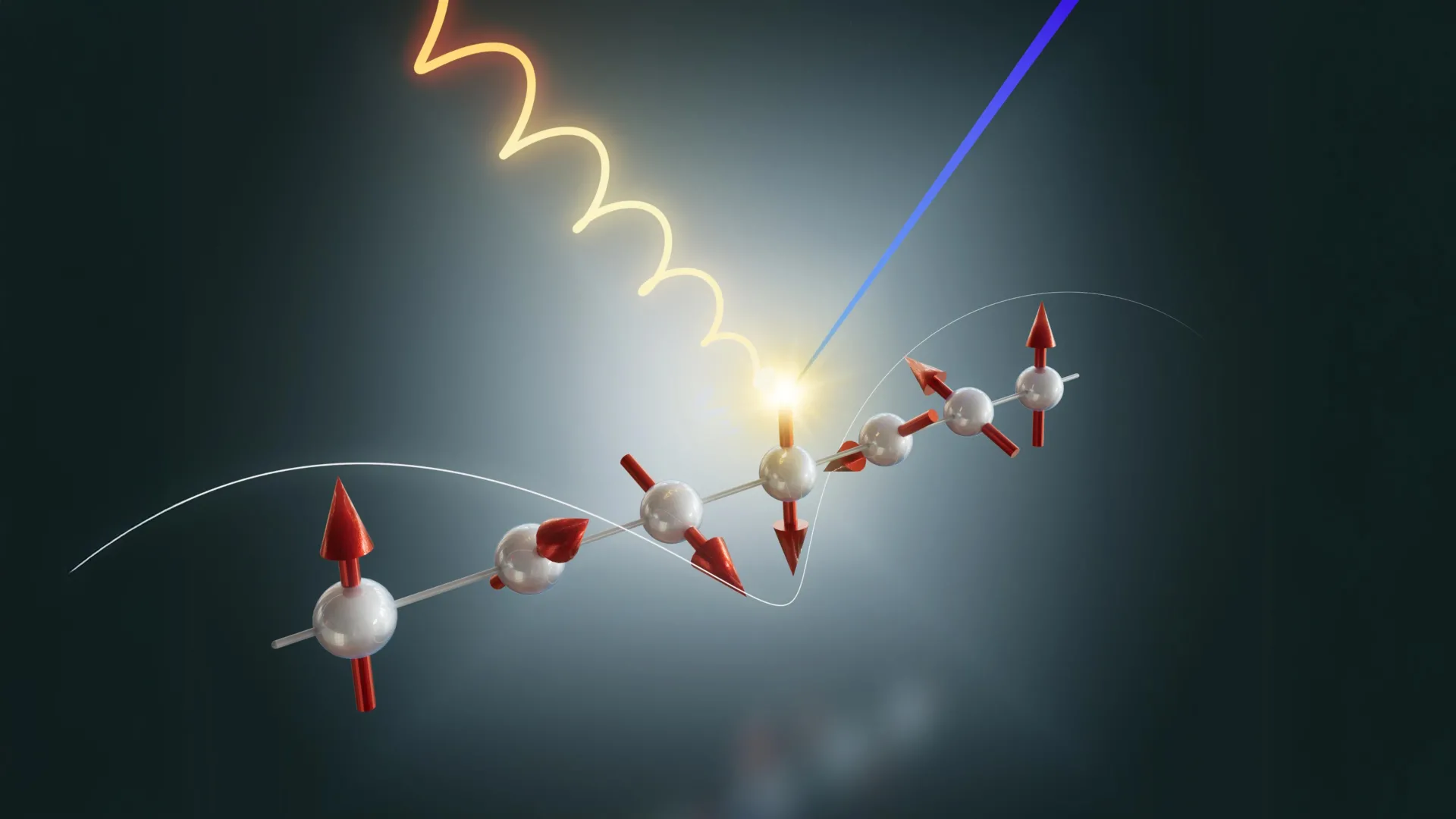
At temperatures as low as minus 400 degrees Fahrenheit, europium silicide turns its atoms into a spiral—then cancels out its own overall magnetism. That strange behavior, found by researchers in Dresden, Germany, offers a rare look at a type of magnetism that may one day help scientists shape electronic behavior for quantum technology.
The metal, known as europium silicide or EuSi, is a relatively simple compound. That makes the finding useful: scientists can study its unusual magnetic state without the added complexity of many other materials considered for the same research. The work provides compelling evidence for p-wave magnetism, an emerging field focused on how an electron’s spin relates to the direction it moves.
The research began about three years ago at the Max Planck Institute for Chemical Physics of Solids in Dresden. Dr. Erjian Cheng grew high-quality single crystals of EuSi, giving the team material suitable for detailed tests. When researchers first measured the crystals with photoemission methods, they saw that the magnetic arrangement had an exceptionally strong effect on the electrons’ energy levels.
That surprise led to a broader investigation involving 38 scientists from 19 institutions. The collaborators included ShanghaiTech University, the Hong Kong University of Science and Technology, the Max Planck Institute for the Physics of Complex Systems and Oak Ridge National Laboratory.
The team found that between about 33 and 62 kelvin—roughly minus 400 to minus 348 degrees Fahrenheit—the magnetic moments of europium atoms form a repeating spiral. Each atom has a substantial magnetic moment, but the directions balance across the pattern. The result is no net magnetization, unlike a refrigerator magnet, where many spins line up and create an overall magnetic field.
Yet the lack of a total magnetic field does not mean the spiral has no effect. The researchers found evidence that electrons moving in opposite directions have opposite spin polarizations. Spin is a quantum property that gives electrons magnetic characteristics; it does not mean they spin like tiny balls. The link between movement and spin is known as an odd-parity spin texture: reverse an electron’s direction, and its associated spin polarization reverses too.
To test the idea, scientists combined neutron diffraction, which reveals how atoms and magnetic moments are arranged, with electron measurements and theoretical calculations. Neutron diffraction confirmed a spiral pattern with the symmetry needed for p-wave magnetism. The team also used angle-resolved photoemission spectroscopy, a method that measures electron energies and momenta. The source account describes these methods as providing compelling evidence, rather than presenting the finding as a finished route to a new device.
In many materials, spin-dependent effects come from spin-orbit coupling, which links an electron’s motion to its spin. In EuSi, the unusual pattern appears to arise mainly from interactions among magnetic moments and the symmetry of their spiral. Understanding that mechanism could give researchers another way to investigate and eventually control electronic properties.
For now, EuSi is a promising place to study the physics, not a ready-made quantum technology. Its simple composition and unusual behavior give scientists a clearer setting in which to ask how magnetism can guide electrons—even when the material’s magnetism cancels out overall.