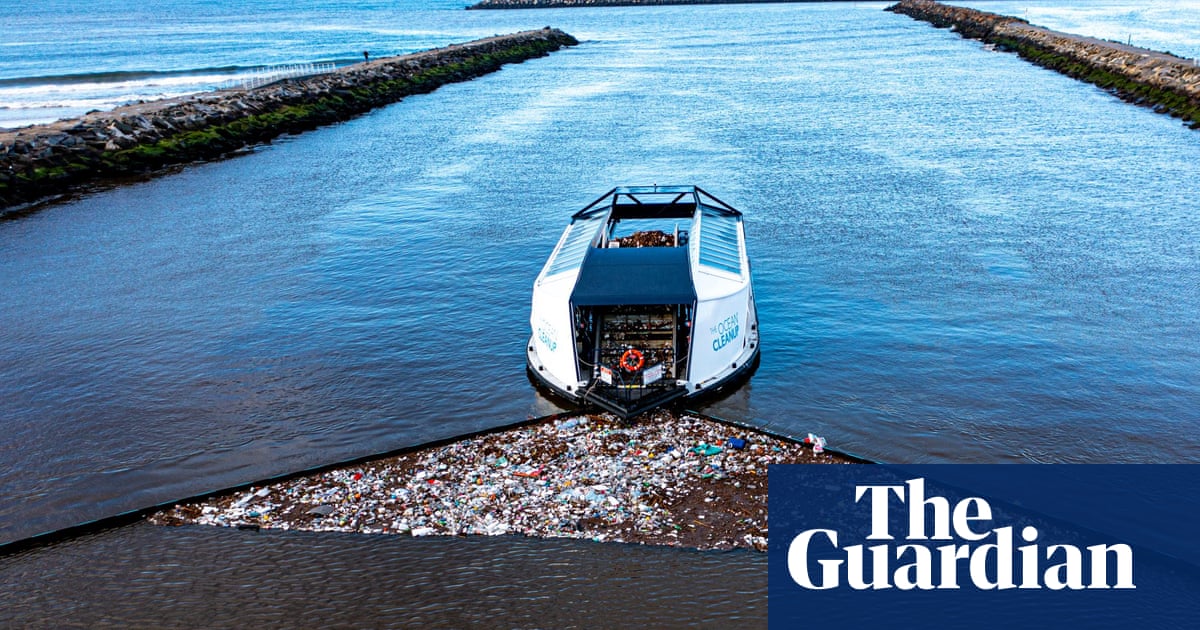
On an overcast June morning, a solar-powered barge floats at the mouth of Ballona Creek where it meets Santa Monica Bay on Los Angeles's west side, its six giant waste bins sitting silently atop a tennis court-sized platform. There is no garbage smell—only salty ocean air—despite the river's steady flow of human refuse: polystyrene takeaway containers, noodle cups, bottle caps, a yellow pencil, a palm frond dotted with colorful microplastics. All of it is being captured by a conveyor belt that scoops waste from the water, a quiet revolution in how we stop pollution before it reaches the sea.
This is the Interceptor, created by Ocean Cleanup, a nonprofit that has reframed the battle against ocean plastic. Rather than attempting to clean up garbage patches already swirling in the sea, founder Boyan Slat and his team pivoted to rivers—the arteries that carry rubbish into the world's oceans. Research by Ocean Cleanup has shown that just 1,000 of the world's rivers are responsible for nearly 80% of plastic emissions into the ocean, and 90% of all pollution in the ocean comes from rivers. "We have to turn the faucet off before we can scoop the ocean, or else all we're doing is taking out legacy trash to replace it with new trash," says James Patterson, the operations manager at Ocean Cleanup.
The Ballona Creek barge operates through elegant simplicity: a floating barrier directs waste onto the platform, where a conveyor belt scoops it up. An automated shuttle then distributes the captured waste into six dumpsters on a separate barge, sending an alert to crews when full. Solar panels power the entire system, eliminating fuel costs and emissions. The whole system can hold about 20,000 pounds of rubbish—the equivalent of one fully loaded truck. What arrives is a snapshot of urban disposal: mostly bottles, cups, and to-go containers from restaurants and takeout establishments, the mundane detritus of coastal city life.
The impact has been immediate and measurable. In 2025, this single Interceptor in Los Angeles captured 143,710 pounds of rubbish from entering the ocean. The results are visible on nearby beaches: cities south of the project have already lowered their budgets for beach grooming because there is simply less waste washing ashore, requiring fewer cleaning cycles. It is a tangible sign that upstream intervention works.
Ocean Cleanup now operates 21 Interceptor systems across 10 locations globally, with installations in Malaysia, Indonesia, Vietnam, Guatemala, Jamaica, and the Dominican Republic. The organization aims to clean up the 30 most-polluted cities by 2030. The LA deployment began in 2022, following design work that started in 2017. The system cost approximately $1.3 million to design and permit, plus another $1.5 million to secure the boats and booms in place. Maintenance runs $650,000 annually—a figure the nonprofit absorbs by providing the Interceptor free to LA County.
The system is not without limitations. Large logs prove especially difficult to capture, and the occasional piece of waste escapes the floating barrier, a reality that visibly troubles Patterson. Seagulls, meanwhile, have discovered the barge as a comfortable perch, their corrosive droppings posing unexpected maintenance challenges. Yet Ocean Cleanup recognizes that each river demands its own approach. "There's no one size fits all," Patterson explains. "Every river is different in how they act, where you can deploy, what the local government and permitting timelines look like, and just the conditions of nature." Two more Interceptors are scheduled to launch in the LA area—in the San Gabriel River and Los Angeles River—expanding the region's defense against marine pollution.