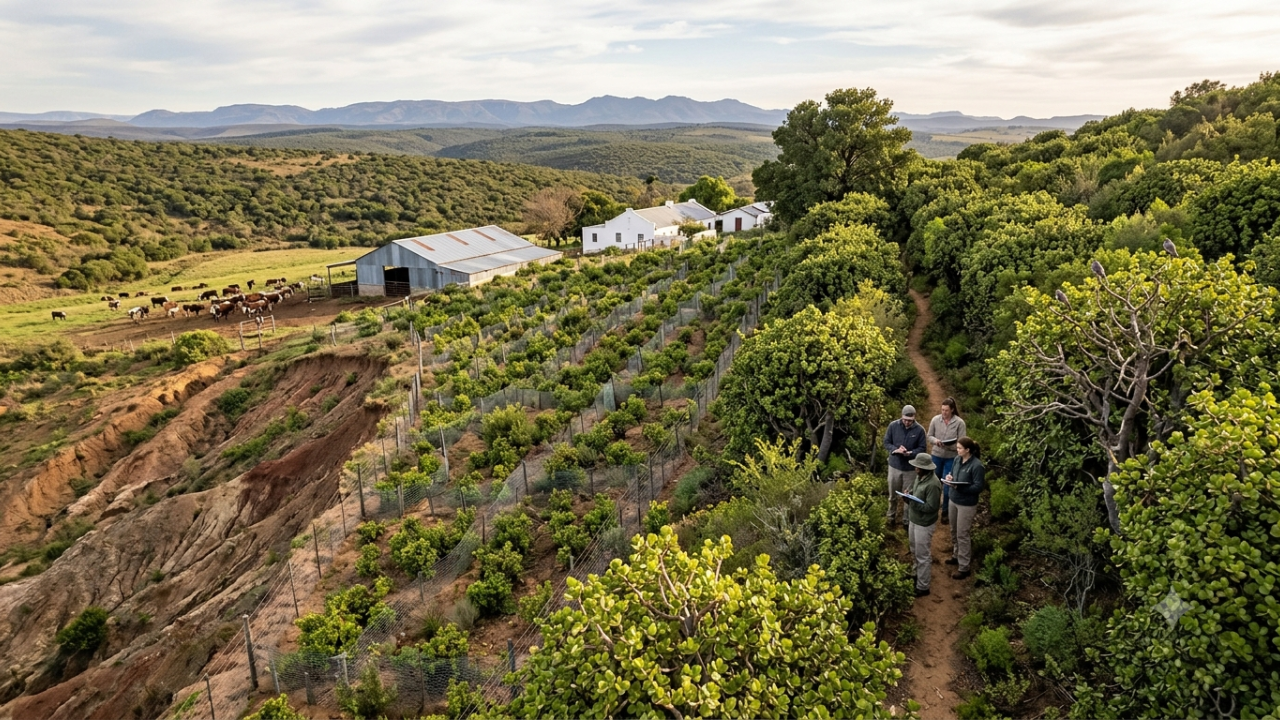
In 1976, behind a farm barn in the Eastern Cape of South Africa, a farmer pushed cuttings of a leafy desert plant into bare, eroding soil. He was not trying to save the planet. He just wanted to stop floodwater from washing away his land and threatening his livestock. Half a century later, that small hillside at Kromport has become one of the most valuable clues scientists have for rebuilding broken landscapes across the province.
The cuttings were spekboom, a succulent native to South Africa whose fleshy leaves and stems let it survive long dry spells. It also grows easily from cuttings, which made it a simple, clever fix. The flooding eased, and — crucially — the plants were left alone. Some grew for more than forty years. And then something remarkable happened. Other vegetation began to appear around them. Birds and wildlife returned to ground that had once been heavily disturbed. The hillside started to look, again, like the dense thicket that had covered the region for centuries.
The story matters because of what the Eastern Cape used to be. Spekboom is a major part of subtropical thicket, a rich and diverse ecosystem that once stretched across millions of hectares. But centuries of intensive grazing — especially by goats and sheep — removed vegetation faster than it could grow back. Vast areas became open, bare and increasingly vulnerable to erosion. Ecologists now estimate that more than 1.3 million hectares of severely degraded thicket could potentially be restored.
The problem was that no one knew how. A normal restoration project might run a few years, which is only enough time to see whether plants survive. The old Kromport planting gave scientists something far rarer: decades of real time. They could measure the carbon stored in the plants, their roots and the soil below. They could watch the whole plant community change. It became a living reference point.
That tiny farm planting helped launch one of South Africa's largest ecological experiments. In 2007, the government set up around 330 demonstration plots, each covering half a hectare, across degraded thicket land. Millions of spekboom cuttings were planted to test which techniques worked under different conditions. The results were encouraging but taught a humbling lesson: planting alone was not enough. Young spekboom needed fences and protection from grazing animals to take hold.
What began as one farmer's way to hold his soil together has grown into proof that damaged land can, given time and care, come back to life. It is a quiet reminder that the smallest, simplest acts — a few cuttings planted behind a barn — can ripple across decades and across millions of hectares.