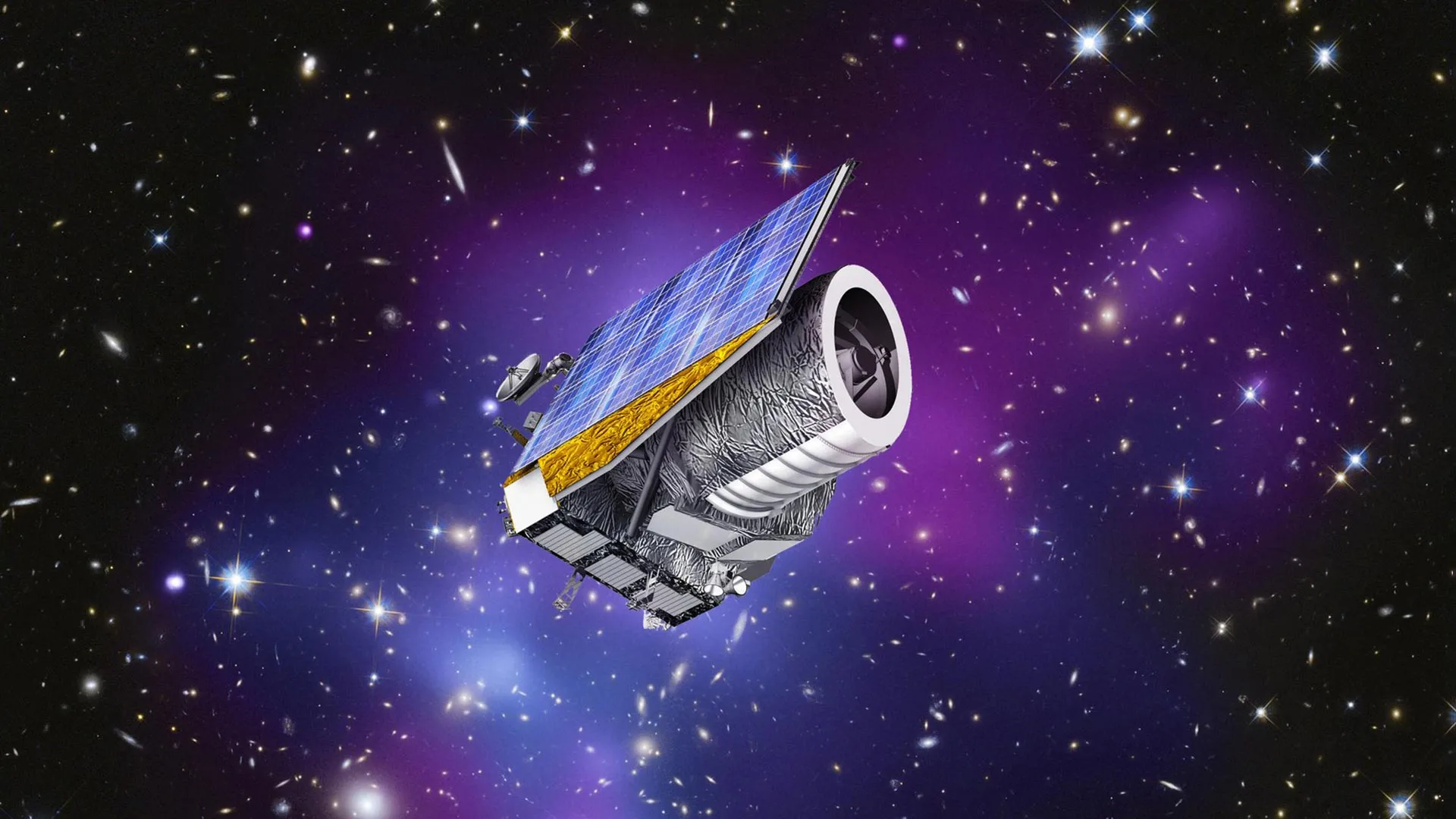
Across five patches of sky, a faint streak appeared in images from a telescope built to study galaxies. The European Space Agency’s Euclid space telescope had found its first previously unknown comet.
The discovery shows how a mission designed to map the distant universe can also reveal something much closer to home. Euclid’s main task is to capture detailed images of faraway galaxies, not to follow fast-moving objects in our solar system. Yet the new comet was spotted while it was still about 1.3 billion kilometers from Earth, a distance comparable to the gap between the Sun and a point between Jupiter and Saturn.
Mikko Pöntinen, a PhD student at the University of Helsinki, found the object using software he had developed to search Euclid images for small solar system bodies. Working with the Solar System Objects Science Working Group of the Euclid Consortium, he noticed a streak smeared across several images. He predicted where the object would appear next and found it in five image sets.
Closer inspection showed a fuzzy cloud around the streak. That haze was a sign that the object was active, shedding dust and gas as comets do. Euclid observed it in the Euclid Deep Field North between September 16 and 24, 2026. The telescope recorded 16 exposures across the five fields of view.
Pöntinen and colleagues checked catalogs of known asteroids and comets but found no match. He then sent the observations to the International Astronomical Union’s Minor Planet Center, the international clearinghouse that checks reports and assigns official names. Observers on Earth were able to follow up, and on October 8 the center confirmed the discovery. The comet’s official designation is C/2026 S1 (Euclid).
Its path is unusual. The comet is far above the relatively flat plane where the planets circle the Sun, and it is moving along a broad route across the solar system that will take thousands of years to complete. More observations should help astronomers work out its orbit and how long it takes to travel around the Sun.
Finding it was not a likely outcome. Euclid usually avoids the crowded plane of the solar system because dust there can add unwanted light to images of distant galaxies. It also uses a “step-and-stare” approach, generally imaging each patch of sky only once, so it cannot simply return to a new comet for more observations. The team’s success came from an unusual mix of the comet’s path and the telescope’s scan pattern.
The finding also offers a practical lesson for ESA’s future Comet Interceptor mission, which is intended to study a comet up close. C/2026 S1 is not a suitable target, but the discovery and alert process gives teams a real example of how they might coordinate to identify a future one. As more observations come in, Euclid’s first comet will help scientists refine its route—and show what else a galaxy-mapping telescope might happen to catch.