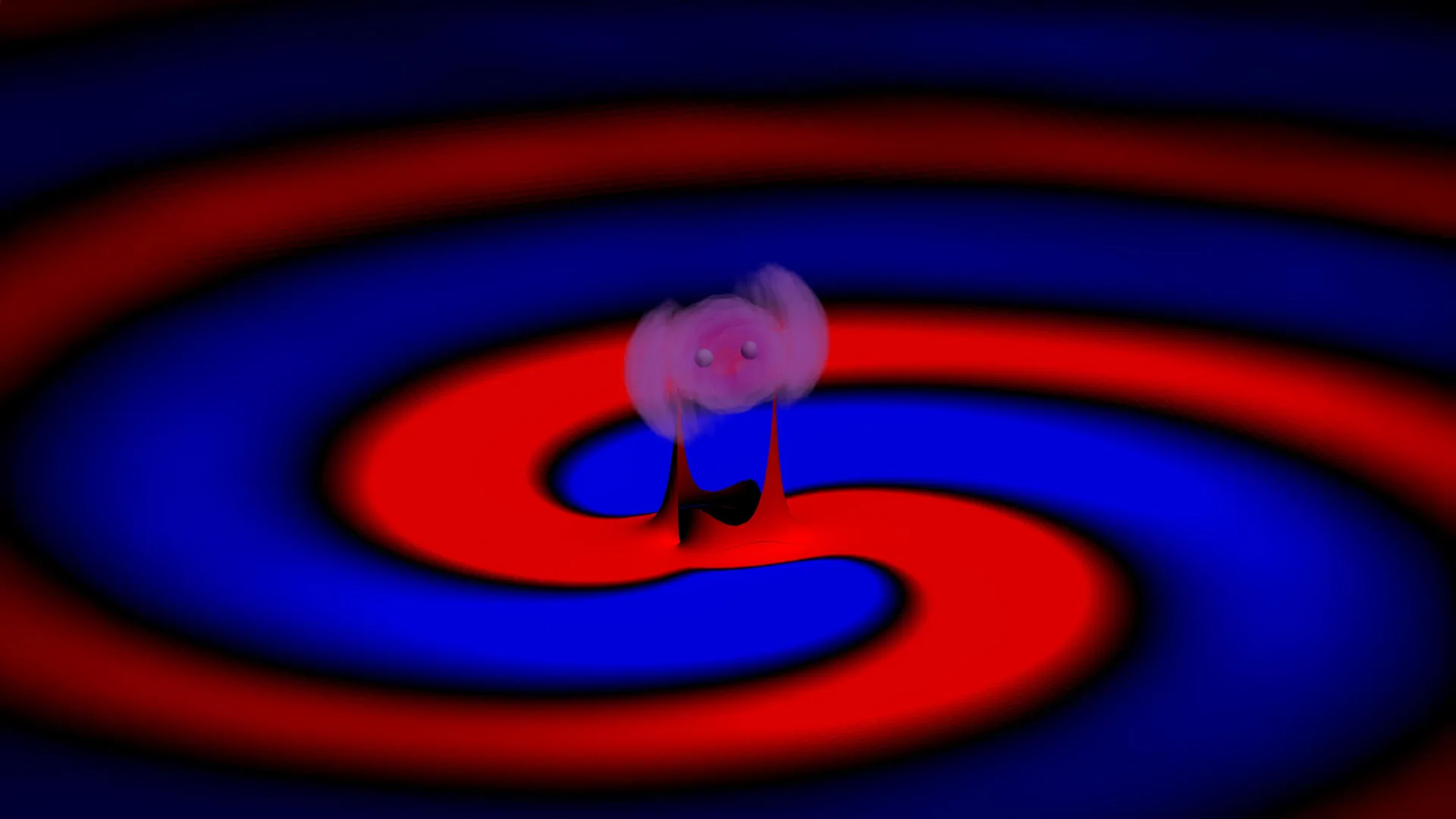
On July 28, 2019, gravitational wave detectors captured a subtle distortion in spacetime that may hold the first tangled fingerprints of dark matter itself. Now, physicists have developed a method to search for those hidden signatures—and they've found one promising candidate lurking in the data from nearly three decades of cosmic collisions.
Dark matter remains one of the universe's greatest unsolved mysteries. Scientists know it exists because galaxies spin too fast and bend light too strongly for visible matter alone to explain—estimates suggest it makes up more than 85 percent of all matter in the universe. Yet it cannot be seen directly, since it does not interact with light or electromagnetic forces. Gravity remains the only known window into this invisible substance, which is why a new approach using colliding black holes could reshape how scientists hunt for it.
Physicists at MIT and several European institutions have devised a method to detect possible dark matter signatures hidden within gravitational waves—those ripples in space and time created when massive objects spiral together and merge. If black holes travel through dense clouds of dark matter before colliding, the resulting gravitational waves could carry subtle traces of that interaction, like fingerprints left on a cosmic crime scene.
The team tested their approach using data from LIGO-Virgo-KAGRA, the international network of gravitational wave observatories, analyzing 28 of the clearest black hole merger signals detected so far. Twenty-seven matched what scientists would expect from ordinary mergers in empty space. But one signal, detected on July 28, 2019, and labeled GW190728, appeared different. According to the team's analysis, the pattern of that gravitational wave may contain evidence of an interaction with dark matter—the signal came from two black holes with a combined mass about 20 times that of the sun, and they may have merged within a dense dark matter cloud.
The mechanism behind this detection hinges on a phenomenon called superradiance. Theorists propose that dark matter may consist partly of extremely lightweight particles called "light scalar" particles, which behave like coordinated waves near black holes. When these waves encounter a rapidly spinning black hole, the black hole's rotational energy can transfer into the dark matter waves, dramatically increasing their density—much like whipping cream into butter. If the density becomes high enough, the dark matter could alter the gravitational wave signature produced when black holes collide.
Josu Aurrekoetxea, a postdoc in the MIT Department of Physics, led the work alongside collaborators from Université Catholique de Louvain in Belgium, the University of Amsterdam, Queen Mary University of London, and Oxford University. The team built detailed simulations of black hole mergers under many different conditions, varying the masses and sizes of the black holes, the amount of surrounding dark matter, and its density. They then compared their predictions with actual observations.
The researchers emphasize that this does not amount to a confirmed discovery of dark matter. Instead, their new technique provides a promising tool to scan gravitational wave data for signals that warrant further investigation. As Aurrekoetxea notes, without such models, astronomers could easily miss dark matter signatures hiding in plain sight. The findings, published in Physical Review Letters, suggest that black holes may finally offer humanity a way to see the unseeable, and that the universe's greatest mystery may soon reveal itself through the smallest disturbances in spacetime.