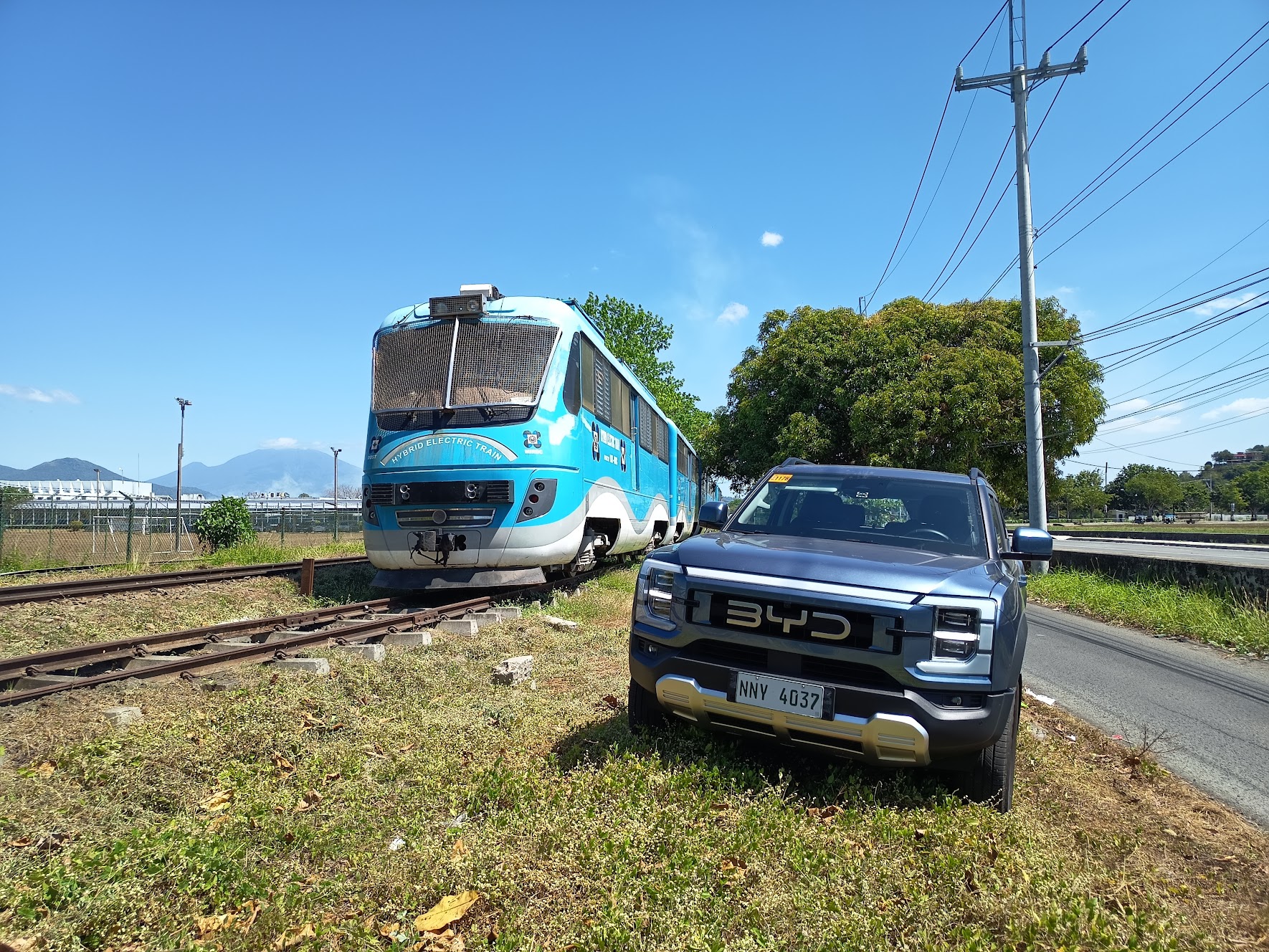
On a dusty siding in Laguna, two machines sit within metres of each other—separated by years, battery chemistry, and an unfinished revolution in clean transport. The DOST Hybrid Electric Train, a five-car prototype engineered by the Philippines' Department of Science and Technology, has stood nearly motionless since 2016 in front of the International Rice Research Institute. A few metres away, the BYD Shark—a nimble hybrid SUV—idles with the ease of something built for a future that finally arrived. Together, they tell the story of why battery innovation matters more than engineering ambition alone.
The HET represents genuine Filipino ingenuity. Designed by the Metals Industry Research and Development Center, it uses a series hybrid architecture where a diesel generator runs at constant, optimised RPM to charge a battery bank that powers electric traction motors—the engine never directly drives the wheels. Regenerative braking recovers kinetic energy on deceleration. On paper, it is sound engineering. But the battery bank holding all that energy consists of 260 lead-acid cells, delivering roughly 30–40 watt-hours per kilogram of energy density. The train carries an enormous mass of electrochemical dead weight just to move itself, burdened by 19th-century battery logic in a 21st-century design.
Lead-acid was pragmatic for 2016—cheaper, locally serviceable, well-understood. But pragmatism froze the HET in time.
The BYD Shark arrives from a different timeline entirely. Its 29.6 kilowatt-hour lithium iron phosphate battery delivers approximately 150 watt-hours per kilogram—nearly four times the energy density of lead-acid. The Shark's combined system output reaches 430 horsepower and 650 newton-metres of torque. It accelerates from 0 to 100 kilometres per hour in 5.7 seconds and travels roughly 100 kilometres on electric power alone, despite weighing over two tonnes and maintaining the capability to ford a river. Like the HET, it uses an internal combustion engine as a generator feeding electric motors. The difference is entirely in the battery—and that difference is everything.
Yet the story extends far beyond consumer vehicles. BYD is not merely an automaker but one of the world's largest integrated battery and rail technology companies. In March 2026, the company launched its first overseas SkyRail project in São Paulo, Brazil, where LFP battery packs allow trains to travel up to eight kilometres autonomously during grid failures, ensuring passengers are never stranded mid-route. On the heavy-freight side, BYD's battery subsidiary FinDreams has signed agreements with mining giant BHP to develop battery technology for heavy-haul locomotives operating in Australia's Pilbara iron ore corridors—positioning its technology inside some of the planet's most demanding rail applications.
The irony cuts deep. The HET's series hybrid drivetrain is elegant and already proven. The electric traction motors are ready. What the train lacks is what the Shark possesses: the battery chemistry that turned a 2016 prototype into a stranded vision. The question hanging over that siding in Laguna is not whether Philippine engineers can build clean trains—they already have. It is whether the battery revolution that has transformed consumer vehicles will reach the machines that need it most. The gap visible in that photograph measures not just the distance between two machines, but the unfinished work of the energy transition itself.