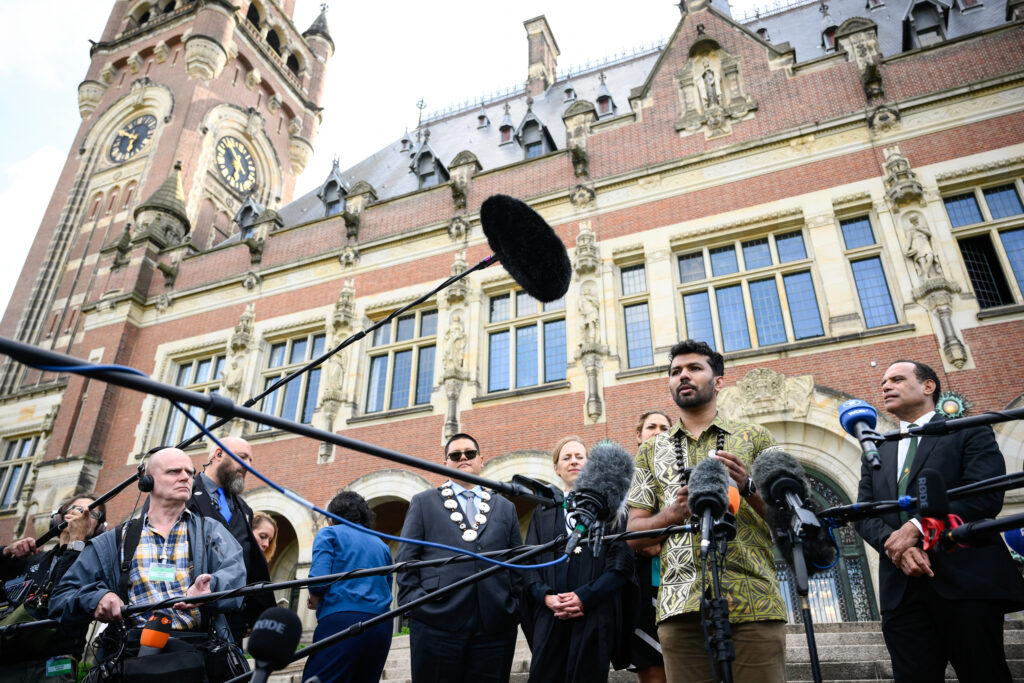
In Fiji, Vishal Prasad watched Tropical Cyclone Winston tear across his island nation with 175-mph winds in 2016—the strongest storm ever recorded in the Southern Hemisphere—and decided the world needed a different kind of climate action. Rather than wait for annual climate conferences to deliver promises, the young Pacific Island activist and his peers at Pacific Islands Students Fighting Climate Change chose an audacious path: they would ask the International Court of Justice to weigh in on whether fossil fuels violate human rights.
This week, that seed planted by students in 2019—during the peak of mass climate demonstrations—bore unexpected fruit. At the United Nations General Assembly, 141 countries passed a resolution embracing an advisory opinion from the ICJ that explicitly connects climate change to human rights violations, and pledging to "translate the Court's findings into enhanced multilateral cooperation and accelerated climate action at all levels, consistent with international law."
The scale of this moment may not be immediately obvious. The advisory opinion itself, issued last year, is nonbinding. The UN resolution, too, carries no enforcement mechanism. But what matters is what happens when the world's courts and governments finally speak in alignment. Prasad, now director of Pacific Islands Students Fighting Climate Change, described the resolution as "a huge step forward" precisely because it legitimizes a legal framework that treats climate action not as a favor nations grant each other, but as an obligation rooted in existing international law and human rights protections.
"Young people are competent enough to deal with serious issues and competent to deal with the technical, legal issues," Prasad said in an interview about the campaign. The observation cuts to something crucial: this victory belongs to teenagers and twenty-somethings who refused to be dismissed as protesters with signs, and instead taught themselves international law, built coalitions across continents, and convinced island nation governments to champion their cause at the UN.
The ICJ opinion itself weaves climate change together with human rights in a way that reframes the entire debate. It shows, as Prasad noted, that "the fight for climate justice is just a manifestation of decades, even centuries, of injustice that people faced. It's a direct product of colonialism and exploitative capitalism." By grounding climate action in human rights, the opinion opens pathways for vulnerable populations—island nations facing rising seas, Indigenous peoples watching their ancestral lands change, youth inheriting a destabilized planet—to demand accountability through courts and international bodies.
The student activists came to the ICJ strategy after growing frustrated with the annual climate conferences, known as COPs, which Prasad said "had failed" to address the human rights dimensions of climate breakdown. Where official UN climate negotiations treated the crisis as a technical problem to be solved through incremental deals, the ICJ approach asks a sharper question: Do nations have a legal obligation to their people not to destroy the conditions necessary for human flourishing?
One-third of the world's population is younger than 19, noted Jule Schnakenberg, executive director of World Youth for Climate Justice. These young people have marched in the streets, painted banners, run climate clubs at schools, and lobbied politicians to declare climate emergencies. Now they have a new tool: a UN-backed court opinion that transforms climate action from an act of goodwill into a matter of international legal obligation. The currents around the world's climate crisis have begun to shift.