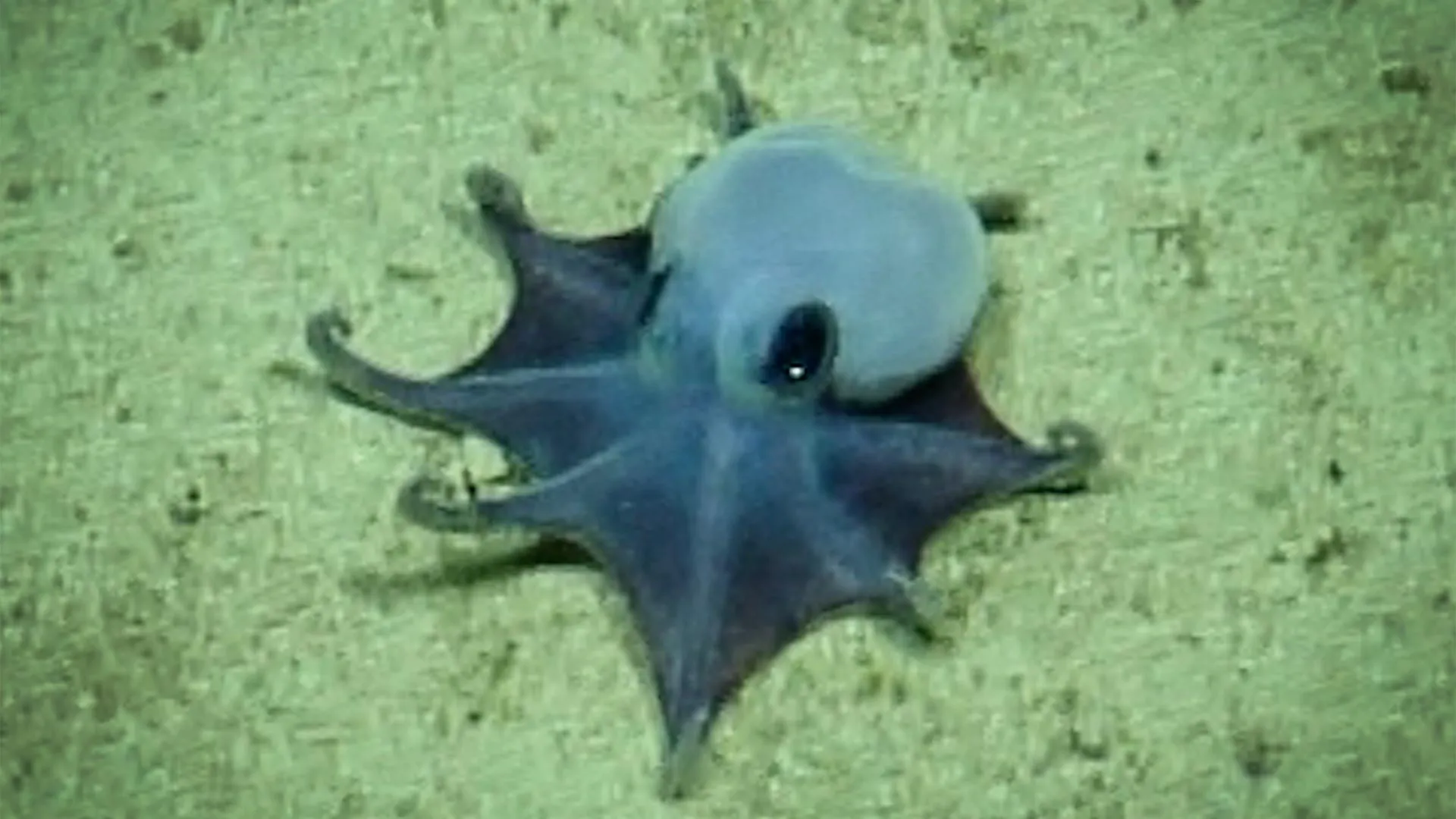
Nearly 6,000 feet beneath the surface of the Pacific, in the darkness surrounding Darwin Island, a remotely operated vehicle captured footage of something that stopped the entire research team: a creature the size of a golf ball, glowing an impossible shade of blue. That chance encounter during a 2015 expedition has now led to the official recognition of Microeledone galapagensis, a tiny octopus species previously unknown to science—and a reminder that the ocean still holds wonders we've barely begun to understand.
The Galápagos Islands have long captivated naturalists as a living laboratory of evolutionary oddities: giant tortoises found nowhere else, marine iguanas unlike any other reptile on Earth. Yet the islands' secrets extend far beyond the visible surface. When the research vessel E/V Nautilus ventured into partnership with the Charles Darwin Foundation and the Galápagos National Park Directorate to explore the seafloor around the archipelago's northern reaches, scientists were prepared for discovery—but perhaps not for something quite so vivid or small. As their ROV glided across the rocky bottom roughly 1,773 meters down, the team spotted the specimen moving across the seafloor. The audio recordings captured their genuine amazement: "He's tiny!" "It's blue!"
The researchers managed to collect one specimen and recorded video of two others, bringing dozens of deep-sea creatures back to the Charles Darwin Research Station for study. Among them all, this little octopus stood out immediately—not just for its striking coloration and diminutive size, but because it resembled nothing in any existing reference library. When photographs reached Janet Voight, the curator emerita of invertebrates at Chicago's Field Museum and a veteran of more than four decades studying octopus evolution, her reaction was immediate: "Right away, I knew it was something really special. I'd never seen anything like it."
Naming a new octopus species traditionally demands dissection—careful examination of the mouth, beak, and teeth. But with only a single specimen, destroying it to study its anatomy felt unconscionable. Instead, Voight's team turned to an elegant alternative: micro CT scanning, the same technology that combines thousands of X-ray images into a detailed three-dimensional model. Stephanie Smith, manager of the Field Museum's imaging laboratory, created scans so precise they revealed the octopus's internal organs without a single incision. Alexander Ziegler, a researcher at the University of Bonn in Germany, noted the remarkable clarity: the scans yielded organ-system details that would normally require heavy-metal contrast agents—agents that would have been unthinkable to introduce into such a rare specimen.
The discovery marks a milestone for Voight, whose life's work studying octopus evolution culminates here in the formal description of a new species. But beyond her personal achievement, the finding underscores a humbling truth about our world. The ocean remains so vast, so unexplored, that researchers continue to encounter creatures never before documented by humans. As Voight reflects: "If you took all the land on Earth and pieced it together, you would not cover the Pacific Ocean. The oceans are so big, and there's so much left to explore." In an era when we often feel we've mapped and measured everything, a tiny blue octopus reminds us otherwise—and underscores the urgency of protecting deep-sea ecosystems we are only beginning to understand.