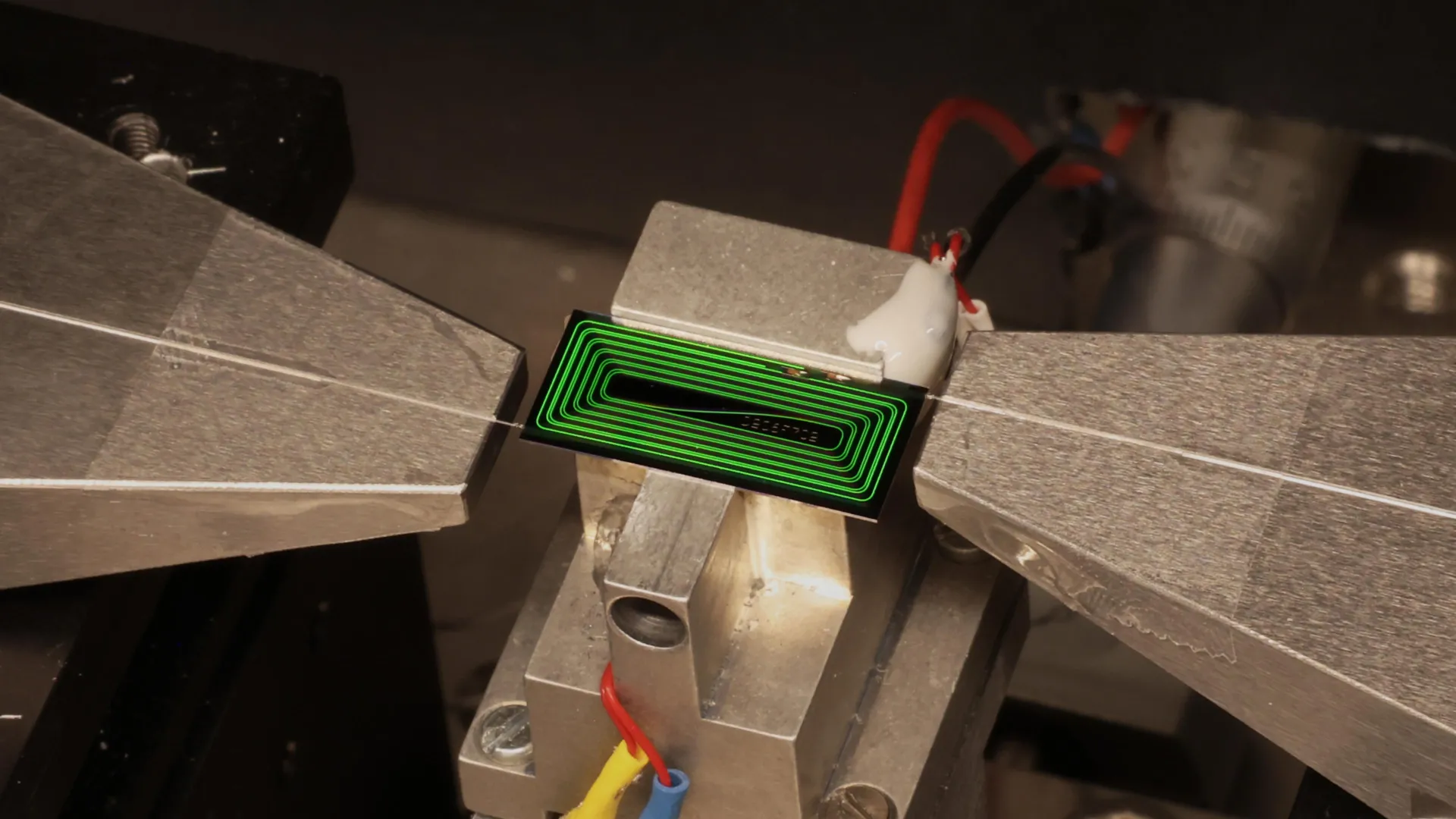
After more than twenty years of chasing what seemed like an impossible dream, scientists at EPFL have finally squeezed one of optics' most powerful tools onto a chip no larger than a match head. The achievement, published in Nature by a team led by Professor Tobias J. Kippenberg, delivers ultrafast laser pulses that rival the performance of equipment that once filled entire laboratory tables—but now fit in your palm.
Ultrafast lasers have long been the workhorses of precision science. Their pulses last mere hundreds of femtoseconds—quadrillionths of a second—fast enough to enable eye surgery, precision manufacturing, and even the optical frequency combs that won a Nobel Prize for measuring time with extraordinary accuracy. Yet despite their transformative power, these lasers have remained expensive, bulky systems, their size and cost limiting access to research labs and specialized medical facilities. Shrinking this technology onto a photonic chip would democratize tools that have shaped modern optics.
The EPFL team's solution lay in dusting off a laser design that had been largely overlooked: the Mamyshev oscillator. Rather than trying to force existing chip-based approaches to work at ultrafast scales, the researchers recognized that this particular architecture—with its elegant simplicity—was especially suited to the constraints of integrated photonics. The system works by threading intense laser light through a nonlinear waveguide sandwiched between two optical filters that each transmit different wavelengths. As the light intensifies and travels through the waveguide, it broadens into a wider spectrum. Only the strongest pulses broaden enough to pass through both filters and keep circulating; weaker light gets blocked and removed.
"For more than twenty years, a high-pulse-energy femtosecond laser on chip was widely regarded as a holy grail of integrated photonics," Kippenberg explained. "Our result shows that it is not only possible, but that it can be achieved with a surprisingly elegant architecture that the integrated-photonics community had overlooked."
The numbers tell the story of the breakthrough. The laser cavity, which would stretch 42 centimeters if laid flat, folds onto a chip about the size of a match head. The device delivers pulse energies of 1.05 nanojoules with durations as short as 147 femtoseconds—performance that matches traditional tabletop lasers. What makes this especially significant is the manufacturing pathway. Unlike fiber-based ultrafast lasers that require painstaking assembly, photonic chips can be mass-produced using techniques borrowed from the semiconductor industry. More than 1,000 laser cavities could theoretically be manufactured simultaneously on a single wafer, a shift that could dramatically lower costs while expanding availability.
The implications ripple outward. With kilowatt-level peak powers despite its miniature size, the chip opens doors to applications that have long depended on expensive laboratory equipment: detecting environmental pollutants with new sensitivity, identifying hidden material defects, performing medical diagnostics at the point of care. The researchers envision compact optical atomic clocks that could revolutionize future communications and navigation systems—the kind of infrastructure shift that typically arrives quietly but changes everything.
For now, the breakthrough validates what Kippenberg's team suspected all along: sometimes the path forward isn't about forcing new solutions, but recognizing the overlooked wisdom of the past and applying it in a radically different context. A technology that seemed impossibly large has finally found its proper scale.