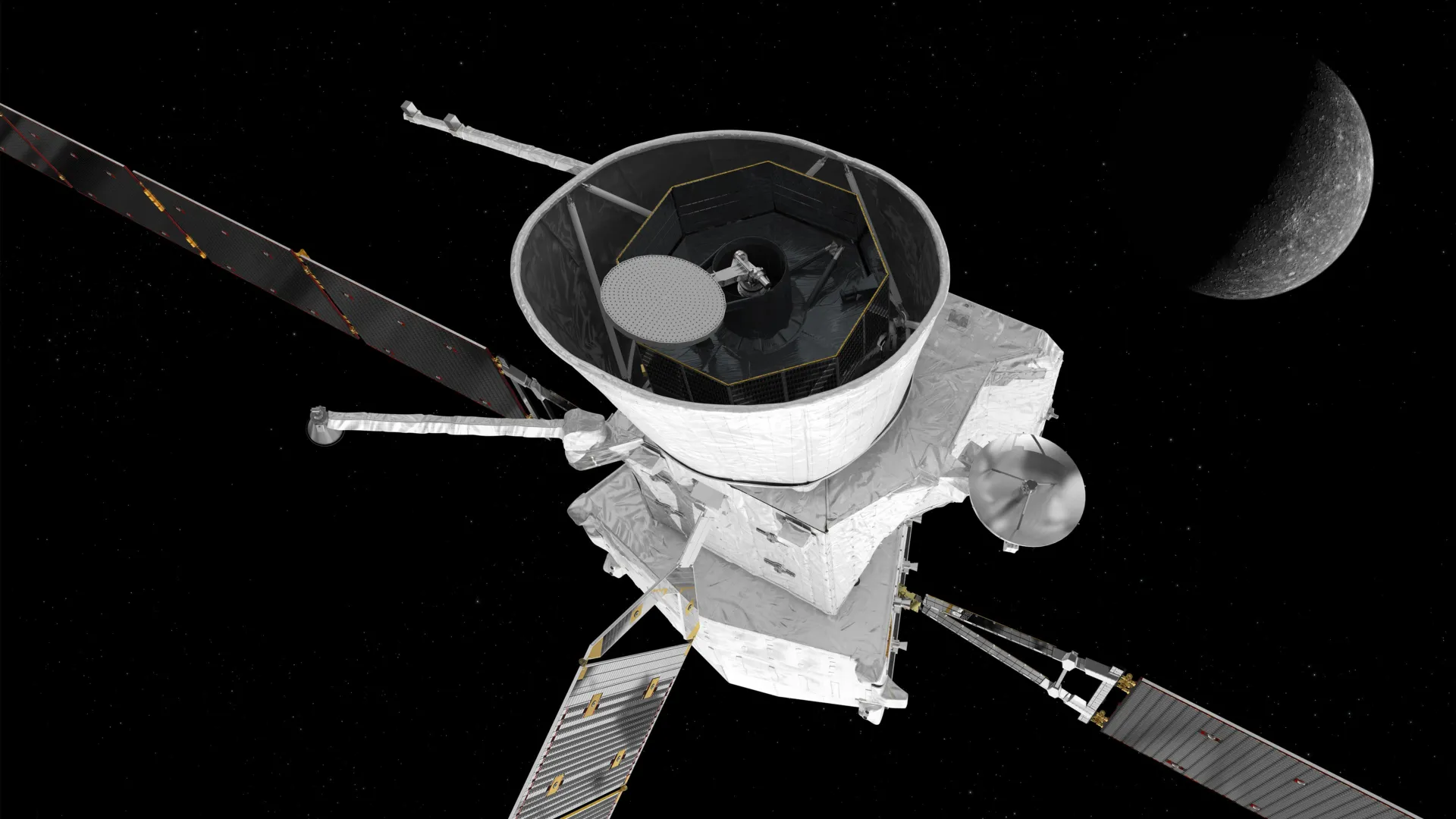
After eight years and 10 billion kilometers in space, the UK-built MIXS telescope has finally had a clear view of the stars—and its first target was the Crab Nebula, about 6,500 light-years from Earth. Its first X-ray measurements show that the instrument is working at least as well as it did before launch, and in one key test, a little better.
MIXS, short for Mercury Imaging X-ray Spectrometer, is part of BepiColombo, a joint mission by the European Space Agency and Japan Aerospace Exploration Agency. The mission’s two science orbiters are traveling toward Mercury, where MIXS will use X-rays to help study what the planet’s surface is made of. After such a long trip through space, scientists needed to check that the telescope’s delicate parts had survived before relying on it for that work.
Engineers had monitored MIXS during the journey, but it could not look directly into space until September, when the Mercury Transfer Module separated from the science orbiters: the Mercury Planetary Orbiter and the Mercury Magnetosphere Orbiter, also called Mio. With its view clear, the team could begin tests ahead of BepiColombo’s planned arrival in orbit around Mercury on November 21.
The Crab Nebula was chosen because it is one of the sky’s brightest X-ray sources and produces a strong, well-known signal. That made it a useful standard for checking MIXS and comparing its performance with laboratory measurements from 2015, the last time the telescope was tested on Earth.
The main observations took place on September 11 and 12. Across 39 hours, the spacecraft made 55 carefully controlled changes in direction so MIXS could collect data. Researchers used the nebula’s image to measure angular resolution—the instrument’s ability to distinguish fine detail. MIXS produced a slightly sharper image than it had in the 2015 lab tests, an encouraging result for a telescope that has spent years exposed to the space environment.
Professor Emma Bunce, MIXS principal investigator and director of the Institute for Space at the University of Leicester, said the instrument was “operating brilliantly in space.” She also noted that 80% of MIXS’s technology is new, making the successful test a significant achievement for the engineering team and its international partners.
The checks have found no unwanted visible light interfering with the images and no radiation damage to the detector. Galactic cosmic rays still leave effects, but scientists understand them and can filter them from the data. Sunlight also causes a small amount of X-ray emission within the instrument, though the team does not expect this to affect observations of Mercury’s sunlit surface.
Some effects are still being studied, and the team expects to fine-tune MIXS during the spacecraft’s commissioning at Mercury. The first tests suggest the telescope has made the long journey in strong shape. Its next task is to turn that tested X-ray vision toward a planet whose surface chemistry remains to be explored.