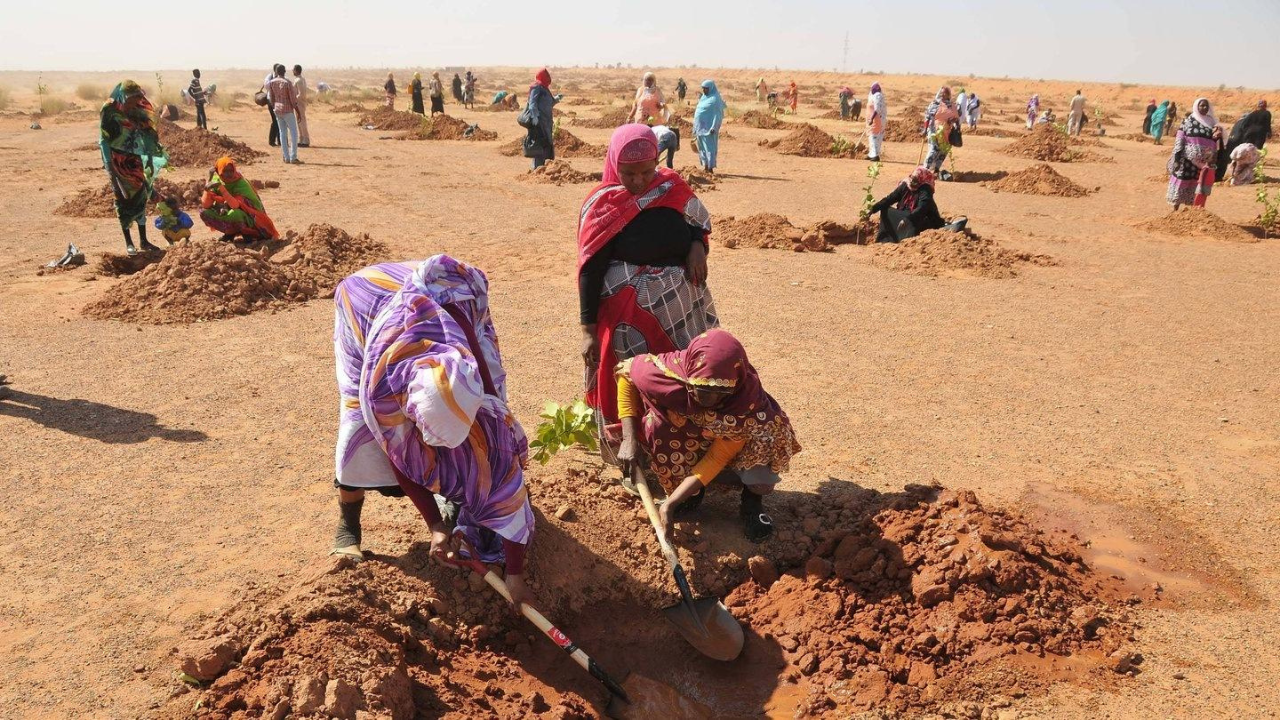
In the village of Fakki, deep in Niger's parched terrain, farmers gather each year to dig small pits into cracked, hardpan earth. They fill those pits with manure, wait for the termites to do their work, and then plant their seeds. Months later, crops grow where nothing should survive. This ancient technique, called the zai pit, is at the heart of one of Africa's most hopeful environmental stories.
The Sahel is a semi-arid strip of land stretching nearly 5,900 kilometers across Africa, from Senegal on the Atlantic coast all the way to Sudan on the Red Sea. For decades, starting in the 1970s, this region has battled relentless droughts, creeping desertification, and repeated crop failures. Once-fertile farmland turned to dust. Families left their villages. The outlook seemed grim.
But something unexpected is now happening. In parts of Burkina Faso, Niger, and beyond, degraded land is turning green again. Soils are holding moisture longer. Farmers are harvesting crops from land that experts once dismissed as beyond recovery.
The revival traces its roots to practices developed over centuries by Sahelian communities, many of which were abandoned as droughts worsened and populations grew. Today, organizations and scientists are helping bring these techniques back, combining them with the ambitious Great Green Wall initiative, a pan-African effort to restore land across the continent.
The zai pit is a cornerstone of this movement. By digging shallow basins and filling them with organic matter, farmers attract termites that naturally break up compacted soil. When rain falls, the pits capture water around seeds instead of letting it rush away. According to the United Nations Convention to Combat Desertification, degraded soils can lose up to 80 percent of rainfall as surface runoff. Restored soils, by contrast, absorb far more water, replenishing underground reserves and sustaining crops well into dry periods.
Other traditional methods are proving equally powerful. Stone bunds, rows of rocks laid across slopes, slow rainwater and reduce erosion. Half-moons, semicircular earth mounds, collect runoff over larger areas and encourage grasses and shrubs to return. And then there is Farmer-Managed Natural Regeneration, or FMNR.
Australian agronomist Tony Rinaudo, who helped spread FMNR across Niger, compares degraded farmland to a dormant forest waiting underground. Rather than planting millions of new seedlings, farmers protect and prune tree stumps already hidden beneath the soil. These root systems regenerate rapidly, producing trees that enrich the earth, shade crops, and shield fields from harsh winds.
"You don't need to plant a forest," Rinaudo has said. "You just need to manage the forest that is already there."
Researchers now have satellite data and peer-reviewed studies to back what communities have observed for years. The FAO estimates that over 166 million hectares within the Great Green Wall zone are benefiting from restoration efforts. Scientists caution that recovery varies widely and that the Sahara Desert itself is not retreating. But in places where traditional land management has taken hold, the land is visibly rebounding.
For millions of Sahelian farmers, the message is simple: you do not need high-tech solutions to bring water back. Sometimes, you just need to help the land help itself.