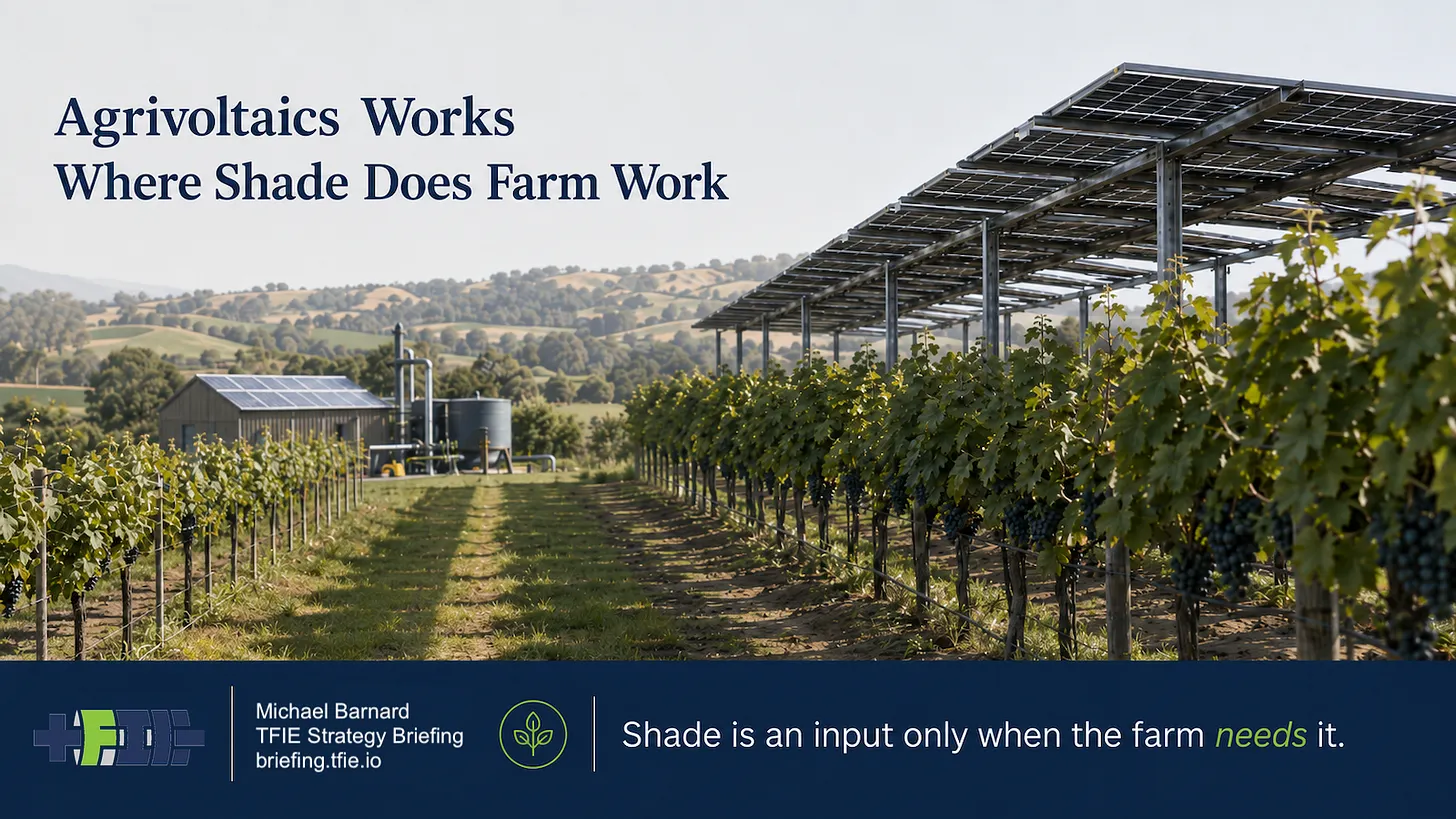
On farms in Australia, Europe, and North America, a quiet experiment is underway. Sheep graze beneath solar panels while the panels generate electricity above. The sheep keep grass trimmed so mowers stay idle, farmers earn extra income, and clean power flows to the grid. No land is sacrificed. It sounds almost too good to be true — and for agrivoltaics, a term for combining farming with solar energy, the gap between theory and reality is where everything gets interesting.
A new analysis of agrivoltaic projects around the world has found that the approach only works when solar panels actually do farm work — not just existed beside it. Shade becomes valuable when it solves a real problem: protecting delicate crops from hail or sunburn, keeping livestock comfortable, preserving precious water in drought-prone regions, or replacing expensive infrastructure farms already buy. When panels just sit there while crops grow alongside them, the setup struggles to justify itself.
Sheep grazing under standard solar arrays has emerged as the clearest success story. The panels do not need to be redesigned as farm buildings — sheep simply fit underneath many existing systems. Vegetation management becomes easier, mowing costs drop, and farmers earn income from grazing contracts. It is less dramatic than solar glass over vineyards, but it asks less of both the technology and the budget.
Higher-value crops like berries, orchards, and vineyards tell a different but equally promising story. These farms already spend money on shade cloth, hail netting, and other protection systems. When solar structures replace or supplement that existing infrastructure, the economics start to make sense. The electricity becomes part of a farm-protection package rather than a bonus added on top.
Perhaps surprisingly, full sun is not always a farmer's friend. In hot, dry regions where heat and radiation already limit production, partial shade from panels can actually reduce plant stress and preserve crops that would otherwise suffer. Irrigation pumps and cooling systems powered by the same panels create a tidy cycle: shade protects plants, panels run the water pumps, and farms keep producing in conditions that would otherwise push yields down.
The analysis draws a careful line around one type of project that remains difficult: tall overhead structures over large grain or corn fields. Commodity crops typically fetch lower prices per hectare, need lots of sunlight, and require heavy machinery that pushes structures higher and more expensive. Technically possible, yes. But the numbers rarely work without special circumstances.
The researchers caution against a common shortcut in evaluating these projects: a measurement called the Land Equivalent Ratio, or LER. LER asks how much land would be needed to produce the same crops and electricity separately, and it can make combined systems look impressive. But a project can score well on LER while still reducing how much farmers actually harvest. That trade-off might be worth it when the electricity benefits and water savings are real — but only if those benefits are honestly counted.
The bigger question is what agrivoltaics should be compared against. The researchers argue it should not be measured against a farm running on diesel with no solar at all. The fair comparison is an electrifying farm with access to rooftop panels, barn installations, ordinary ground-mounted arrays, and existing crop protection. If the same electricity can come cheaper from a barn roof, the agrivoltaic only earns credit for whatever extra farm value it creates.
That discipline, the researchers suggest, is what will separate the projects that endure from the ones that fade once the subsidies run out.