Adrian Bayer had a simple metaphor for the problem cosmologists face: it's like being handed two textbooks on medicine, then asked which one contains the answer to a rare disease that mimics a common condition. In the hunt for physics beyond our current understanding of the universe, researchers at Princeton University and the Flatiron Institute discovered that artificial intelligence faces exactly this dilemma—and sometimes gets it wrong in ways that could matter deeply.
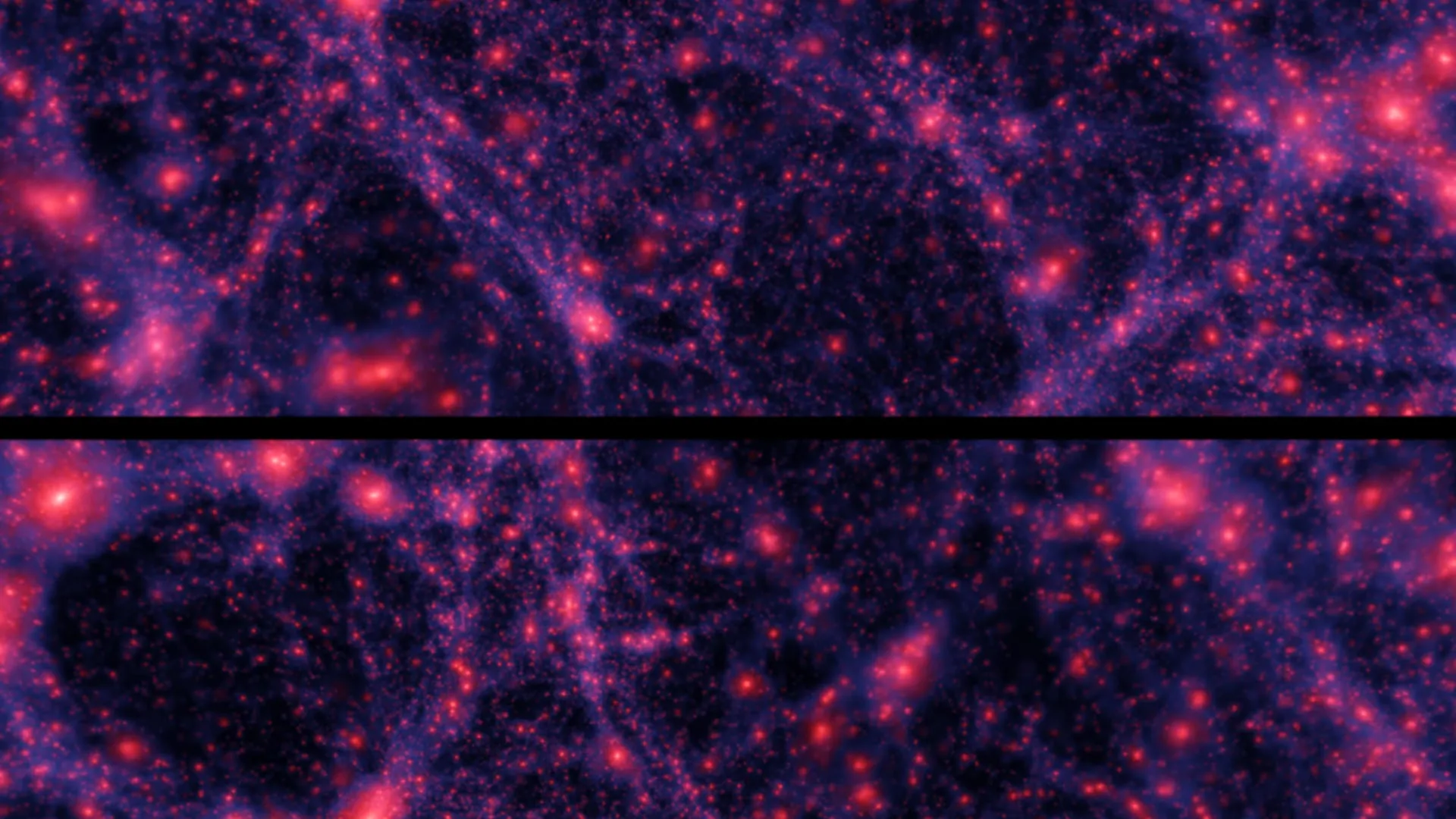
The universe continues to puzzle scientists. The standard cosmological model, called ΛCDM, brilliantly explains the cosmos's large-scale structure and expansion, yet researchers know it's incomplete. Recent observations hint at massive neutrinos, modified gravity, and evolving dark energy—phenomena that could reshape our understanding of reality. But investigating these possibilities requires something computationally brutal: generating thousands upon thousands of detailed simulations, each one a virtual universe built with different physical assumptions. The computational cost is enormous.
Enter transfer learning, a machine learning technique that researchers at Princeton have now tested in a new study published in the Journal of Cosmology and Astroparticle Physics. The team, led by undergraduate student Veena Krishnaraj with co-author Adrian Bayer, found that by teaching an AI system to recognize patterns in simpler, less expensive simulations first—those based on the standard ΛCDM model—they could then move to more complex models without starting from scratch. Think of it as scaffolding: build the foundation with basic material, then add the finer details.
The results were striking. Transfer learning reduced the number of expensive simulations needed by more than a factor of ten. In some cases, the approach shortened the process dramatically, potentially accelerating the search for physics that lies beyond our current models. "It's basically a shortcut," Bayer explains. "Usually people train the AI directly on the most computationally expensive simulations. What we do instead is first use simpler and less expensive ΛCDM simulations to give the AI an idea of what's happening, and only afterward move to the more complex models."
Yet the research revealed a troubling shadow side. The same technique that speeds up learning can also blind an AI system to genuine discoveries—a phenomenon called negative transfer. When the researchers tested their approach on simulations involving massive neutrinos, something unexpected happened. The observable signatures of neutrino mass closely resemble patterns already associated with a well-known parameter called σ8, which measures how strongly matter clusters throughout the universe. Because the pretrained network had learned to recognize σ8's patterns during the initial training phase, it struggled to distinguish between the two effects. The familiar pattern overwhelmed the novel signal.
"The negative transfer is not random. It is driven by underlying physical degeneracies in the model," Krishnaraj notes. In other words, different physics can produce nearly identical signatures—a challenge that confronts both human researchers and machines.
So far, the team's work exists entirely in the realm of simulation. The real test comes next: applying transfer learning to actual astronomical observations from upcoming cosmological surveys. The technique promises genuine acceleration in the search for new physics, but scientists must now grapple with how to prevent AI's reliance on familiar patterns from obscuring the discoveries they're hunting for. The potential is real. So are the pitfalls.