At the University of Cambridge and Southampton, 39 healthy volunteers became the first humans to receive a vaccine designed entirely by artificial intelligence — and it worked without a single significant side effect. This landmark clinical trial represents a fundamental shift in how we build protection against viruses that refuse to stand still.
The vaccine, developed by University of Cambridge researchers and the spinout company DIOSynVax (DVX) Ltd, targets not one coronavirus strain but an entire family: the Sarbeco group. This family includes SARS-CoV-2, the culprit behind COVID-19, as well as SARS and several bat coronaviruses that could potentially jump to humans in the future. Most strikingly, when volunteers received the vaccine, their immune systems mounted responses not just against known viruses like SARS-CoV-2 and SARS, but also against related bat viruses that haven't yet infected people — a sign the vaccine is thinking ahead.
The innovation lies in how the vaccine was engineered. Rather than targeting a single strain, AI and machine learning analyzed genetic data from Sarbeco coronaviruses collected through global surveillance programs. The system identified features shared across the entire virus group and wove them into what researchers call a "super-antigen" — a single vaccine component that teaches the immune system to recognize a whole family of threats, not just today's enemy. It's the first time such an AI-designed vaccine component has ever been tested in humans.
Professor Jonathan Heeney, who led the scientific research at Cambridge's Lab of Viral Zoonotics, explains the shift this represents: "We've converted vaccine development from being reactive to being future proof. Our vaccines will continue to provide protection against viruses even as they mutate into new strains." For years, we've been trapped in what Heeney calls the endless cycle of "chasing the virus variants circulating in humans and updating the vaccines to try to catch up, like a dog chasing its tail." Annual flu shots, repeatedly reformulated COVID boosters — this approach is exhausting and perpetually behind. By targeting features shared across an entire virus family, the vaccine should remain effective even as new variants emerge.
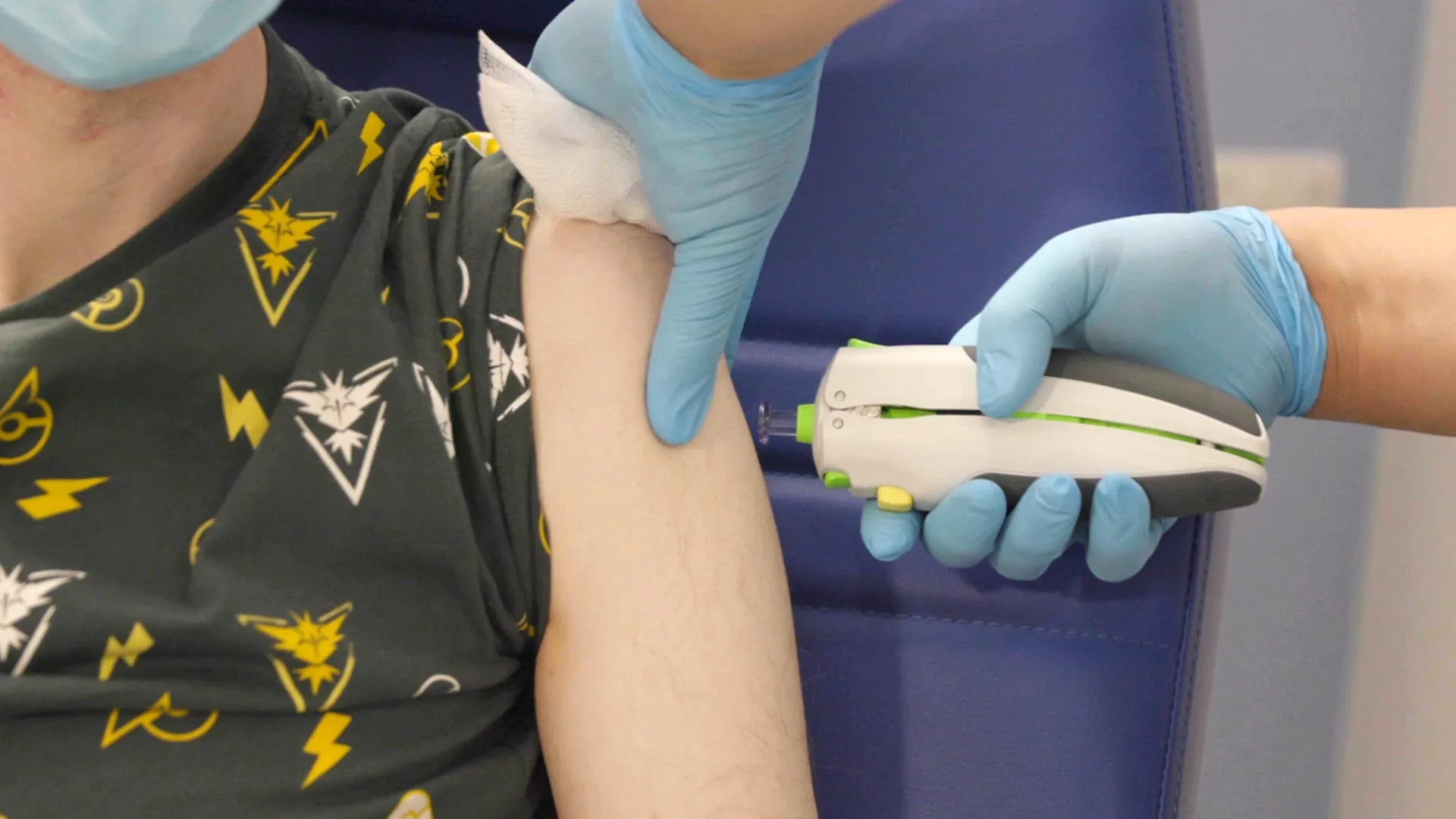
The delivery method matters too. In this trial, researchers used a needle-free micro fluid jet system to administer the DNA vaccine, opening possibilities for easier vaccination campaigns, especially in settings where needles are impractical. For people uncomfortable with injections, this could be genuinely welcome news.
The trial, sponsored by University Hospital Southampton NHS Foundation Trust and conducted at NIHR Clinical Research Facilities in both cities, was deliberately cautious. Before any human received the vaccine, animal studies confirmed it could generate strong immune responses against multiple coronaviruses. Now researchers are planning a larger Phase 2 trial to test the vaccine in a broader, more diverse population and confirm its wide-ranging protective power.
Why does this matter now? Because viruses like influenza, coronaviruses, and Ebola continue circling the globe in animal populations, evolving continuously. By the time traditional vaccines are rolled out to match a circulating strain, that strain has often already changed. The Sarbeco coronavirus family alone represents a perpetual threat; any member could spark the next pandemic. An AI-designed vaccine that can anticipate mutations across an entire family could finally break this cycle — transforming vaccination from a reactive scramble into genuine pandemic prevention.