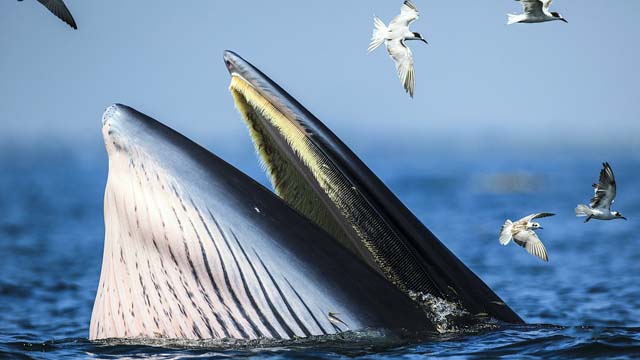
A seismometer perched on Xieyang Island in the Beibu Gulf has been quietly listening to the ocean — and catching something unexpected. In data meant to detect earthquakes, researchers from Guangxi Minzu University have found Bryde's whale calls hiding in plain sight, identified by an AI model that had never been trained on a single whale sound.
The researchers, led by Zhuo Xiao, repurposed the Segment Anything Model — a foundation AI model originally built for visual tasks like identifying objects in images — to analyze spectrograms, the visual representations of sound. Whale calls appear as clear, repeating patterns on these acoustic snapshots. That structure, Xiao explained, turns call detection into an image segmentation task, which SAM excels at.
The results were striking. The system identified whale calls with more than 96% precision, even catching calls that human analysts had missed. To validate the approach, the team tested the model on fin whale recordings from Ireland and blue whale recordings from Canada — and it performed well on both, suggesting the method could travel far beyond the South China Sea.
"We were pleasantly surprised by the strong performance," Xiao said. "I think this reflects the power of foundation models that are pre-trained on massive generic image datasets. They generalize remarkably well to new domains without major workflow changes."
The data, collected on January 26 and July 11, 2021, also revealed something new about Bryde's whale behavior. The interval between acoustic pulses in their calls was shorter in winter and longer in summer — a pattern the researchers believe reflects more coordinated group calling in the colder months and more solitary vocalizations when the whales are dispersed during foraging season. The Beibu Gulf serves as a key shallow-water feeding grounds for the species.
The method isn't perfect yet. Distinguishing whale calls from other environmental noise remains challenging, and the library of known whale call spectrograms is still incomplete. But the team is already planning next steps: incorporating additional sensing data, fine-tuning a model specifically adapted to cetacean calls, and testing the approach across multiple stations including an ocean bottom seismometer and a fiber optic distributed acoustic sensing array.
For marine scientists studying whales that are difficult to track visually, this work represents a meaningful step toward scalable, non-invasive monitoring of these animals in their ocean home.