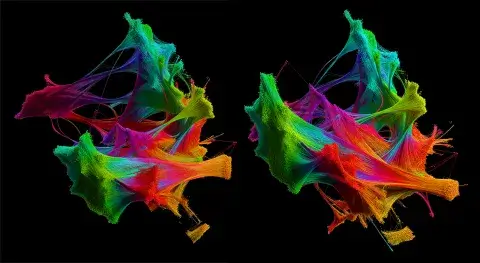
At Google DeepMind, researchers have stopped simply observing nature and started becoming architects of discovery itself. A new era of artificial intelligence is reshaping how scientists pursue answers across biology, chemistry, medicine, and materials science—not by replacing human intuition, but by extending it at digital speed and scale. The American Academy of Arts and Sciences has dedicated a special issue to exploring this transformation, bringing together leading researchers to chart what may be the most consequential shift in the scientific method since the invention of the microscope.
The shift is profound because it touches three interwoven dimensions of science: matter (the chemicals and materials we study), minds (both human and artificial intelligence), and tools (the technologies we use to understand and manipulate reality). Historically, scientific progress has been defined by the tools we build to extend our perception—telescopes, microscopes, laboratory equipment. Today, AI has become that newest instrument, functioning as a lens for deciphering the nature of reality itself.
The breakthroughs are already visible. AlphaFold solved the grand challenge of protein folding, a problem that had resisted solution for decades. GNoME, another AI system, charted entirely new universes of stable materials that humans had never predicted. These aren't incremental gains—they represent fundamental bottlenecks in scientific discovery being overcome by machine intuition working in tandem with human reasoning.
In biology, a parallel revolution is unfolding through what researchers call "virtual cells." Measurement technologies and precise genetic manipulation now allow scientists to test cells under tens of thousands of perturbations, generating extraordinary detail. AI foundation models are learning to represent, simulate, and even anticipate cellular behavior from this data. The result: cells are no longer merely observed but comprehensively modeled, queried, and predicted in computer simulations. This transforms biology from a science of observation into one of active modeling, with implications for precision medicine and biotechnology that remain only dimly visible.
Drug discovery—historically slow, costly, and failure-prone—stands to be revolutionized by combining AI with an emerging approach called nodal biology. The bottleneck has always been identifying the right drug targets. Nodal biology seeks out shared druggable mechanisms among seemingly unrelated diseases, a strategy that generates the high-quality data needed to train AI cell prediction models. One concrete example: researchers identified a cargo receptor node linking dozens of genetic diseases, yielding a new drug candidate. The synergy of human scientific intuition and AI-powered prediction could accelerate the discovery of treatments across the full spectrum of human disease.
The broader implication is a shift in human agency. Rather than solving intricate puzzles defined by nature, scientists are increasingly becoming architects of profound questions—using AI to frame which questions are worth asking and what paths might lead to answers. This represents an evolution in scientific inquiry itself. The tools have changed before, but never at such speed, or with such capacity to generate and test hypotheses at scales previously unimaginable. We are witnessing not just a new tool in the scientific toolkit, but a new kind of scientific partnership.