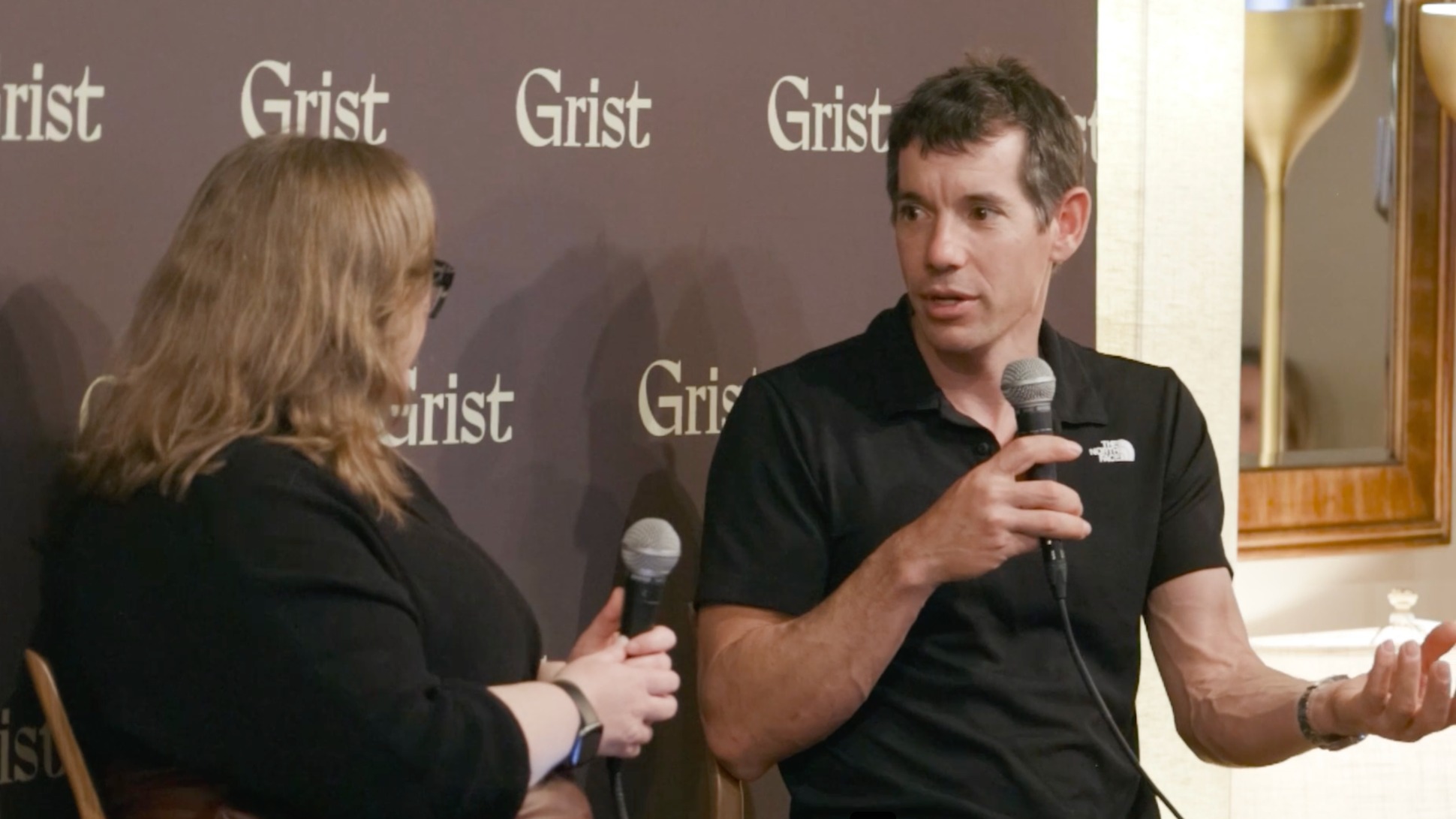
At the end of a river in the Ecuadorian Amazon, after a week of hiking through jungle, Alex Honnold found the thing that transformed him from a world-class climber into an environmental advocate: a community that needed power, and a clear way to help them keep their land intact.
Honnold is best known for his gravity-defying ascents—most recently scaling Taiwan's Taipei 101 tower for Netflix—but his more consequential work happens far from cameras. Through the Honnold Foundation, which he started, he channels his platform and resources toward community-led solar energy projects worldwide. The work emerged not from childhood environmentalism, but from the accumulated weight of seeing places change. Growing up in suburban Sacramento to two university professors, Honnold wasn't raised in an environmentally conscious household. It wasn't until his twenties, when he began traveling for climbing expeditions and reading widely about energy access, global poverty, and climate change, that the connections clicked into place. Around 2009, something shifted: the more he learned, the more it felt urgent.
Those remote climbing trips became his education. On one expedition to photograph a massive tepui—a sheer rock formation—for National Geographic in Guyana, Honnold and his team took two-stroke gas-powered boats to the end of a river, then trekked a week through the jungle. It was during that journey that the abstract became concrete. "You just see how much it matters," he reflected. The communities living in these places weren't distant abstractions; they were neighbors whose wellbeing was tied directly to land protection.
The foundation's work with Kara Solar in the Ecuadorian Amazon exemplifies this philosophy. Rather than imposing solutions from outside, the Honnold Foundation empowers local communities to lead their own energy transitions. Solar power isn't just about reducing emissions—it's a tool for sovereignty. Communities that can generate their own electricity are less dependent on extractive industries, which Honnold sees as one of the most effective forms of land protection available. "Empowering local communities is always a good way to protect the land on which they live," he explained.
His own observations of environmental change have only deepened his conviction. In places he's climbed for years, he's witnessed rapid transformation: snowy couloirs that used to be standard approaches or descents have melted away. "Big mountains you see change very quickly right now," he said. "It's pretty sobering." Yet Honnold resists the paralysis of doom. Speaking at Grist's Turning the Tide event during San Francisco Climate Week, he pushed back against environmental fatalism. "I personally am just not inspired by pessimism at all," he said. The world has been degraded and much has been lost, yes—but the natural world remains extraordinary. There is still so much life, so much to protect.
That perspective informs everything the foundation does. By supporting renewable energy projects that communities themselves design and lead, the Honnold Foundation bets on hope backed by infrastructure. Every solar panel installed in the Amazon isn't just kilowatts generated; it's a community choosing its own future. For Honnold, that choice—witnessed firsthand in remote places most people will never see—is what makes the work matter.