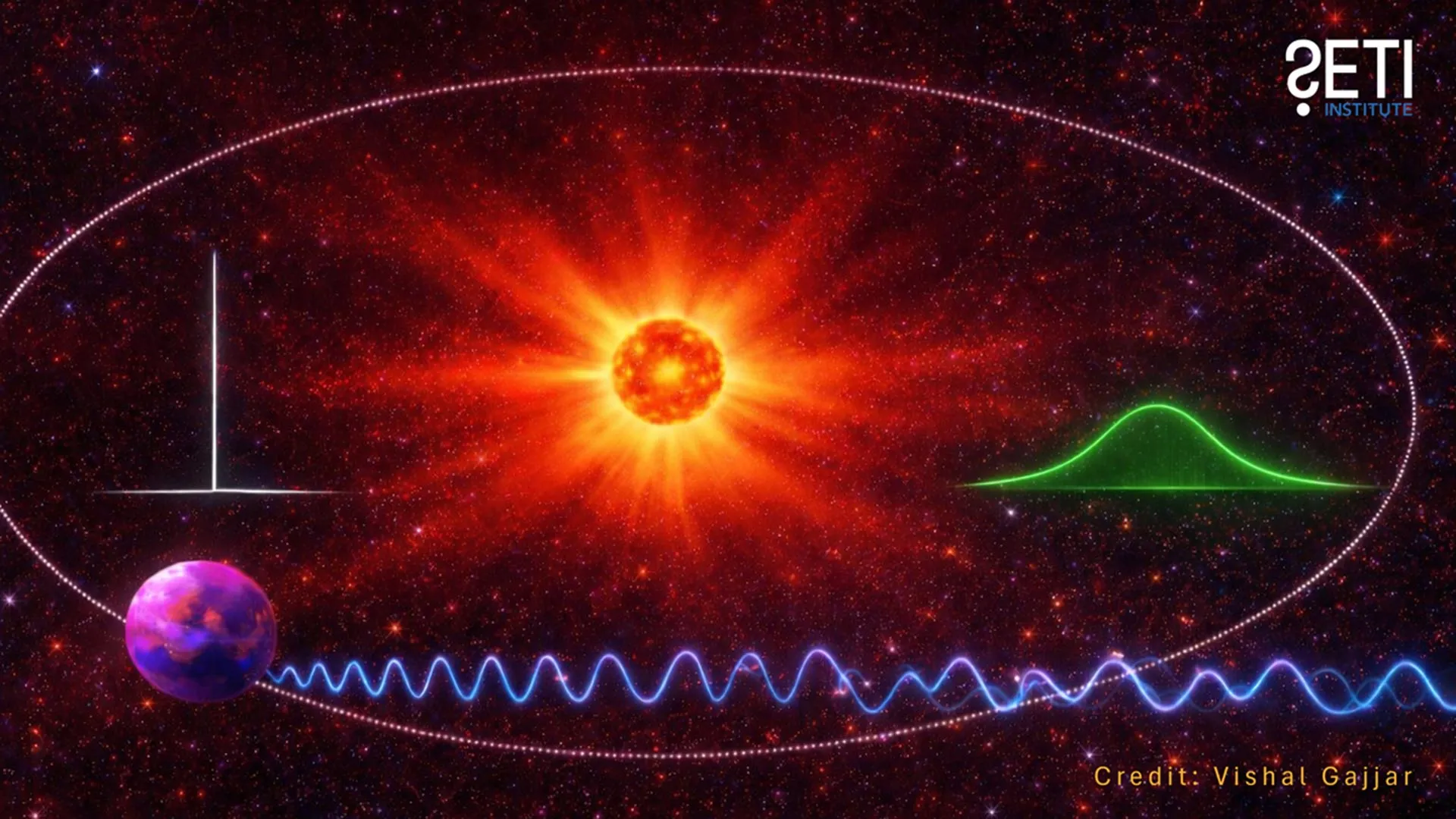
Dr. Vishal Gajjar was analyzing radio signals from deep space when he realized the silence we’ve been hearing might not mean no one’s out there—just that we’re listening for the wrong kind of whisper. A new study from the SETI Institute reveals that alien radio signals, if they exist, could be distorted beyond recognition by the very stars they orbit, slipping through our detectors unnoticed. This challenges decades of assumptions in the search for extraterrestrial intelligence, where scientists have hunted for ultra-narrow radio spikes—artificial-looking signals that stand out against natural cosmic noise. But now, researchers have found that even a perfectly focused transmission could be smeared across frequencies by the turbulent plasma and violent space weather near its home star, making it invisible to current search methods.
The breakthrough came not from distant stars, but from our own backyard. Gajjar and his team, including co-author Grayce C. Brown, studied how radio signals from spacecraft like Voyager and Parker Solar Probe were altered as they traveled through the Sun’s turbulent atmosphere. By measuring how solar plasma broadened these narrowband signals, they created a model to predict how similar effects might warp transmissions from around other stars—especially M-dwarfs, the most common stars in the galaxy. These red dwarfs, which make up about 75% of all stars in the Milky Way, are known for their intense magnetic activity and frequent solar flares, creating environments where even a strong alien signal could be scrambled before it escapes the system.
The implications are profound. For years, SETI programs have tuned their instruments to catch razor-thin signals, dismissing wider ones as natural noise. But this study shows that what we’re filtering out might actually be the only form an alien broadcast could survive in. "SETI searches are often optimized for extremely narrow signals. If a signal gets broadened by its own star's environment, it can slip below our detection thresholds, even if it's there," Gajjar explains. The team’s framework now allows astronomers to adjust their search strategies based on the type of star they’re observing, increasing the chances of catching a signal that’s been stretched, but not silenced.
This research was made possible by the SETI Institute’s STRIDE program, funded by the Franklin Antonio Bequest, which supports high-risk, high-reward science. It’s a reminder that the tools we use to explore the cosmos must evolve with our understanding of it. As Brown puts it, "By quantifying how stellar activity can reshape narrowband signals, we can design searches that are better matched to what actually arrives at Earth, not just what might be transmitted." The next generation of telescopes and signal processors may no longer just listen for whispers—they’ll know how to recognize an echo.