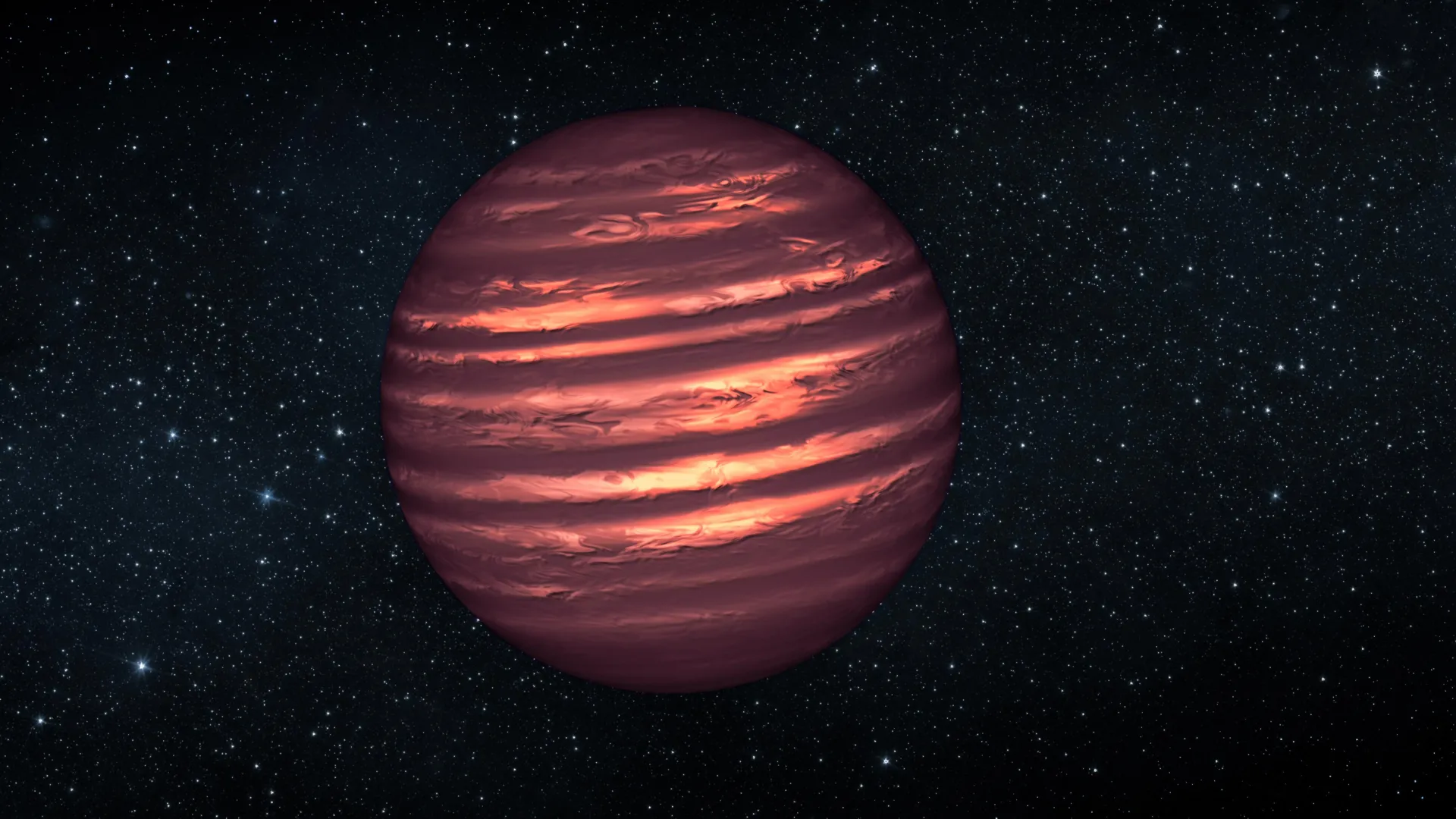
At the Keck Observatory on Maunakea, Hawai'i, astronomers have just cracked open a cosmic mystery: gas planets spin faster than brown dwarfs many times their mass. This surprising discovery, revealed by researchers at Northwestern University's Center for Interdisciplinary Exploration and Research in Astrophysics (CIERA), is rewriting what scientists thought they knew about how worlds form.
The findings matter because rotation is, in Dino Chih-Chun Hsu's elegant phrase, "a fossil record of how a planet formed." Every spin, every rotation, carries encoded information about the physical processes that shaped these worlds tens to hundreds of millions of years ago. Understanding why some objects rotate faster than others helps scientists piece together the formation mechanics of distant planetary systems—and by extension, our own Solar System.
Using the specialized Keck Planet Imager and Characterizer (KPIC), an instrument capable of isolating light coming directly from distant worlds, the international team measured how quickly 32 gas giants and brown dwarfs in other star systems rotate. They looked at planets ranging from 6 times Jupiter's mass to much smaller companions, orbiting at distances of tens to hundreds of Astronomical Units from their parent stars. As each world rotates, subtle atmospheric features cause broadening in its spectrum—a tiny fingerprint that reveals rotation speed with unprecedented precision.
The data exposed an intriguing pattern. When accounting for mass, size, and age, giant gas planets consistently spin faster than more massive brown dwarfs. One striking example comes from the HR 8799 system: a gas giant about 7 times Jupiter's mass rotates six times faster than a brown dwarf companion roughly 24 times Jupiter's mass. The answer to this puzzle appears to lie in magnetism. Researchers believe that stronger magnetic fields interact more intensely with circumplanetary disks early in a system's history, gradually slowing an object's rotation over time. The more massive brown dwarf likely lost more of its original spin because its stronger magnetic field braked it harder.
To strengthen their analysis, the team incorporated previous spin measurements from other studies, creating a dataset of 43 stellar and substellar companions plus 54 free-floating brown dwarfs and planetary-mass objects. This careful curation of data across multiple research efforts allowed them to identify patterns that single observations might have missed. The findings, published in The Astronomical Journal, represent collaboration among Northwestern's CIERA, UC San Diego's Center for Astrophysics and Space Sciences, Caltech's Division of Geological & Planetary Sciences, NASA's Jet Propulsion Laboratory, and several other institutions.
The implications ripple outward. Hsu notes that the way angular momentum is distributed among planets influences the overall architecture of a planetary system. Even Earth's rotation and magnetic field ultimately connect to how that spin budget was divided when the solar system formed billions of years ago. KPIC is the first instrument of its kind, opening an entirely new way to study exoplanets and properties that were previously almost impossible to detect. The team plans to expand this work by studying free-floating "rogue planets" and the chemical makeup of exoplanet atmospheres. By 2027, the Keck Observatory's upcoming HISPEC instrument will enable study of even smaller and more distant worlds, pushing the frontier of what astronomers can observe and understand.