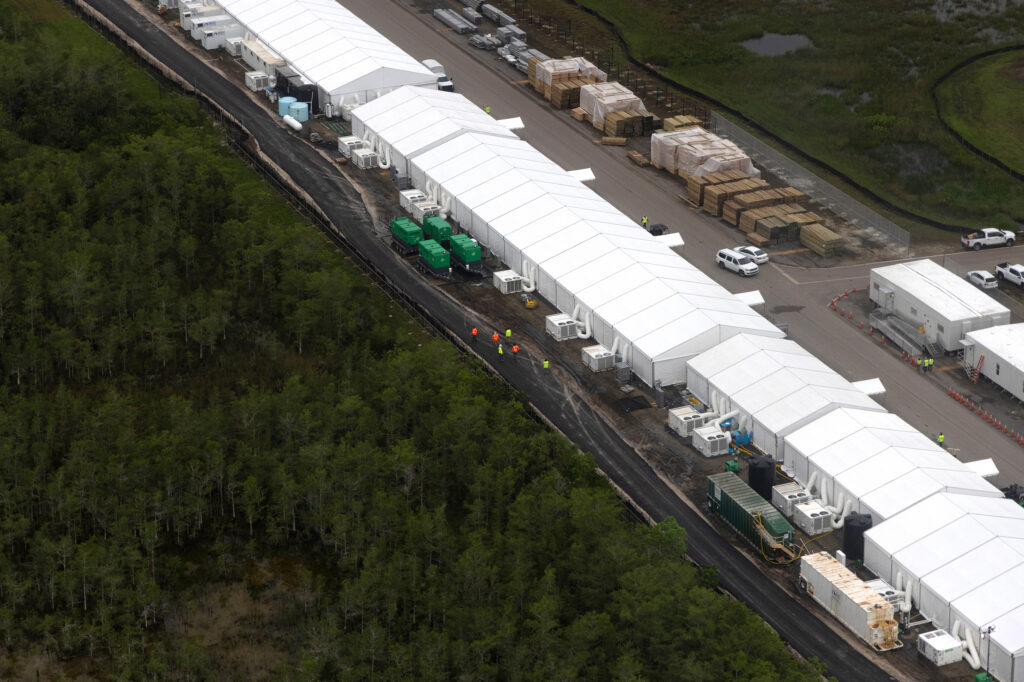
In the shadow of the Big Cypress National Preserve, a temporary detention facility in the Florida Everglades has sparked a federal lawsuit over air pollution so intense that environmental advocates compare it to hundreds of diesel trucks circling the site continuously. The facility, known colloquially as Alligator Alcatraz, opened in early July 2025 as part of the Trump administration's immigration enforcement operations, but its power infrastructure — more than 200 diesel generators and 100 diesel-burning lighting towers running constantly — now sits at the center of a Clean Air Act violation claim.
The lawsuit, filed May 27 in U.S. District Court for the Southern District of Florida by the Center for Biological Diversity, accuses Florida's Division of Emergency Management of constructing and operating the facility without securing the required air quality permit. The complaint contends that the state bypassed a mandatory process that demands detailed air quality analysis, pollution control implementation, and public participation before such a facility can operate. For people living and working in this remote location, the implications are concrete and immediate.
The detention site, designed to hold 3,000 detainees alongside 1,000 workers and more than 400 security personnel, generates emissions of carbon monoxide and fine particulate matter that, according to the complaint, can trigger cancer, asthma attacks, cardiovascular disease, and premature death. The threat extends beyond those incarcerated. The Miccosukee Tribe has ten villages within a three-mile radius of the facility, with one village situated just 1,000 feet away — close enough that residents and their families breathe air directly affected by the generators' output. The pollution also threatens Everglades National Park's air quality and visibility, located roughly seven miles distant in an ecosystem already fragile by nature.
Betty Osceola, a Miccosukee resident living three miles away, articulates a frustration that captures the harm of the facility's rushed construction: the state never allowed the community to establish a baseline measurement of air quality before operations began, making it nearly impossible to document the true scope of damage caused. She worries not only about herself and her grandchildren but also about the endangered Florida panther and other wildlife that depend on the Everglades ecosystem.
Ryan Maher, staff attorney at the Center for Biological Diversity, drew the comparison that gave the case its human dimension: the pollution would be equivalent to hundreds of diesel trucks driving continuously around those exposed to it. "The state essentially built a power plant that runs on diesel in the middle of one of America's first national preserves, which is already fragile in terms of its ecosystem and air quality, and they did so in blatant disregard for the Clean Air Act," he said.
The lawsuit seeks an immediate halt to generator and lighting tower operations until a permit is secured, and calls for civil penalties of up to $124,426 per day per violation. Those fines would be paid to the U.S. Treasury. Reports suggest the facility may close as early as June, though state officials have not officially confirmed closure plans. U.S. Representative Maxwell Frost visited recently and observed operations winding down, with staff no longer accepting new detainees and transfers underway to other facilities. Whether the site closes or remains operational, the legal question now pending before federal court will shape how the state manages environmental compliance when rapid expansion of detention infrastructure collides with air quality law.