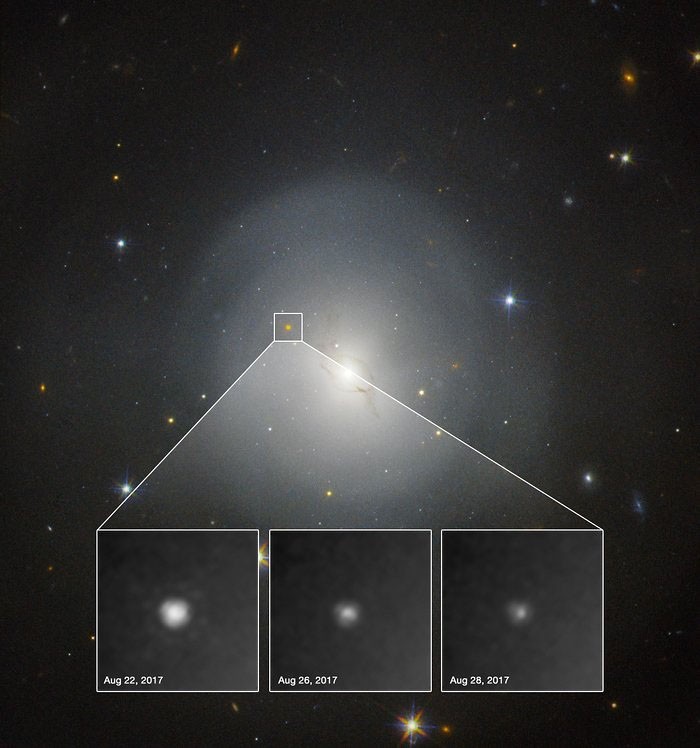
A fading flash from a neutron-star collision can vanish in days, but a telescope owner on another continent may still help scientists catch it. NASA’s Kilonova Catcher project brings amateur astronomers into the fast-moving search for these rare cosmic events.
Neutron stars are the city-sized, ultra-dense remains of dead stars. When two collide, they can create a brief burst of light called a kilonova. The collision also forges many of the universe’s heavy elements, including gold and platinum. Because the glow fades quickly and no single observatory can watch the entire sky, scientists need many eyes ready to look in different places.
Kilonova Catcher is a rapid-response network of volunteers around the world. When detectors pick up gravitational waves—the ripples in space caused by powerful events—or space telescopes send an alert, members use telescopes with cameras to search for and follow the fading light. They also help track gamma-ray bursts, the universe’s most powerful explosions, and other short-lived events when they appear.
The network has more than 150 registered members across several continents. Working alongside professional astronomers and observatories, volunteers have contributed to more than 64 official reports shared through NASA’s General Coordinates Network, a system scientists use to circulate discoveries in real time. Some volunteers have also been named as authors on peer-reviewed research papers, giving formal credit for their work.
Their efforts have reached beyond distant star systems. During the Artemis II mission, Kilonova Catcher volunteers joined NASA’s Lunar Impact Flash! campaign, recording tiny flashes made when meteoroids struck the Moon. The project is now preparing to help follow up on thousands of new alerts expected from NASA’s Nancy Grace Roman Space Telescope.
For Cristina Andrade, the project’s head of operations at the Minnesota Institute for Astrophysics, the work shows how one collision can connect scientists and observers across enormous distances. “We need more human minds, more people with their eyes on the sky and on the data,” she said, adding that people can take part in science regardless of their background.
Andrade co-leads the project with Principal Investigator Dr. Damien Turpin, a researcher at France’s Alternative Energies and Atomic Energy Commission. Turpin said amateur astronomers bring expertise and drive, and that the science could not be done without their contributions.
Anyone with access to a telescope and camera can register at kilonovacatcher.in2p3.fr or contact the project at kilonovacatcher@gmail.com. As new alerts arrive, this worldwide team of volunteers will be ready to turn a quick look at the night sky into useful evidence about some of the universe’s most dramatic events.