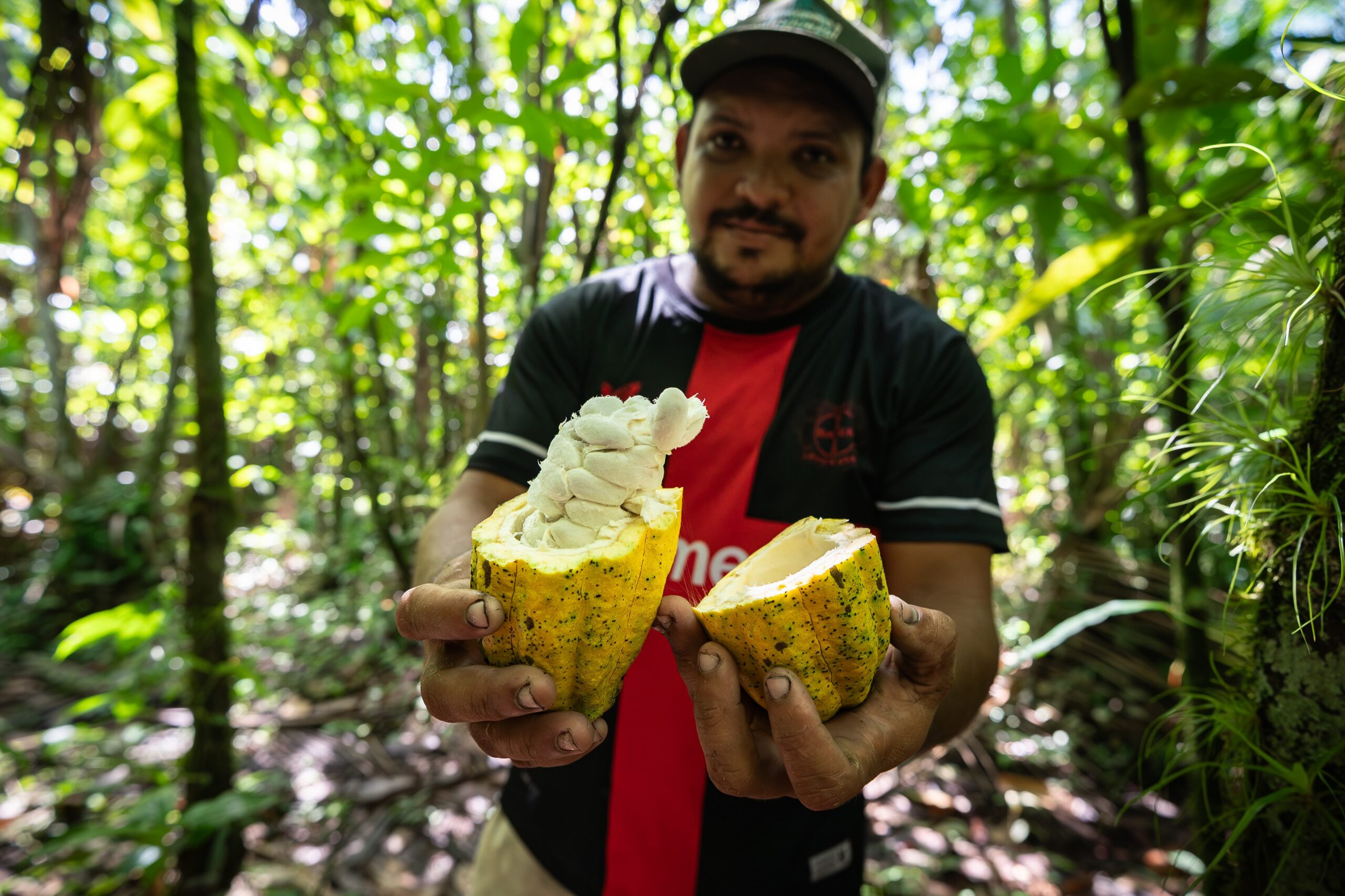
Sunlight filters through dense Amazonian foliage as Elene Elda Mota and her husband Giovanne navigate a narrow stream in their small motorboat, machetes and baskets in hand. They disembark and push through the thick forest until they reach a tree heavy with dozens of bright yellow cocoa pods. Here, in the floodplains of Barcarena, Pará state, where Amazon rivers meet the Atlantic, cocoa grows in a natural agroforestry system that has sustained communities for generations.
"Our cocoa is native cocoa," Elene said. "We don't plant our cocoa, we just manage it."
That hands-off approach, deeply rooted in traditional knowledge, is proving remarkably well-suited to a warming world. Protected and irrigated by the forest canopy, Elene's cocoa resists pests like vassoura de bruxa—the fungus that devastated Brazilian crops in the 1980s—as well as climate impacts like droughts and heavy rains. The dense floodplain forest acts as a natural buffer, providing consistent moisture and shade that industrial monocultures cannot replicate.
Traditional communities including ribeirinhos like Elene and Giovanne, as well as Indigenous and Quilombola groups, are pioneering what experts are calling a new frontier for fine chocolate. Like Burgundy wine or Ethiopian coffee, Pará's emerging "bean to bar" scene is defined by its unique terroir—the interplay between local climate, soil, and biodiversity that gives its native beans distinctive earthy, fruity, and acidic notes. Marlucia Martins, a researcher at the Paraense Emílio Goeldi Museum, explained that abundant local pollinators improve reproduction, yielding fruit more resistant to disease, higher in quantity, and superior in flavor.
The numbers tell a striking story of transformation. Between 2000 and 2024, Pará's share of Brazil's cocoa market more than tripled from 14.4% to 46.2%, cementing its position as the nation's top producer. Reforested cocoa areas expanded more than fourfold, from 38,000 hectares to 165,000 hectares, while average yields climbed from under 0.75 to over 0.84 tons per hectare. Elene has channeled this momentum into her brand, Arauaia, named for the river where she grew up. Caramelized cocoa nibs are her best seller, alongside artisanal chocolate bars, creams, powders, and oils.
Peak fruiting runs from March to June, sometimes requiring harvesters to wade knee-deep in water. After gathering pods, beans ferment for five to seven days—an essential step for quality—then dry in the sun before being roasted, peeled, and refined in a melanger. "My grandmother used to make cocoa bread from crushed cocoa pulp," Elene recalled. "She'd roll it and bake it."
Global demand for organic, ethically sourced chocolate is projected to rise, positioning Pará to fill international supply gaps. Yet hurdles remain: logistics bottlenecks, limited access to credit, and inadequate public policies challenge scaling. Still, in Barcarena—home to the bustling Vila do Conde port and surrounded by bauxite and aluminum operations—Elene and Giovanne cultivate their two and a half hectares of floodplain forest with a quiet confidence. Theirs is a living example of how ancestral practices and forest stewardship can produce something the world craves, without sacrificing the ecosystems that make it possible.