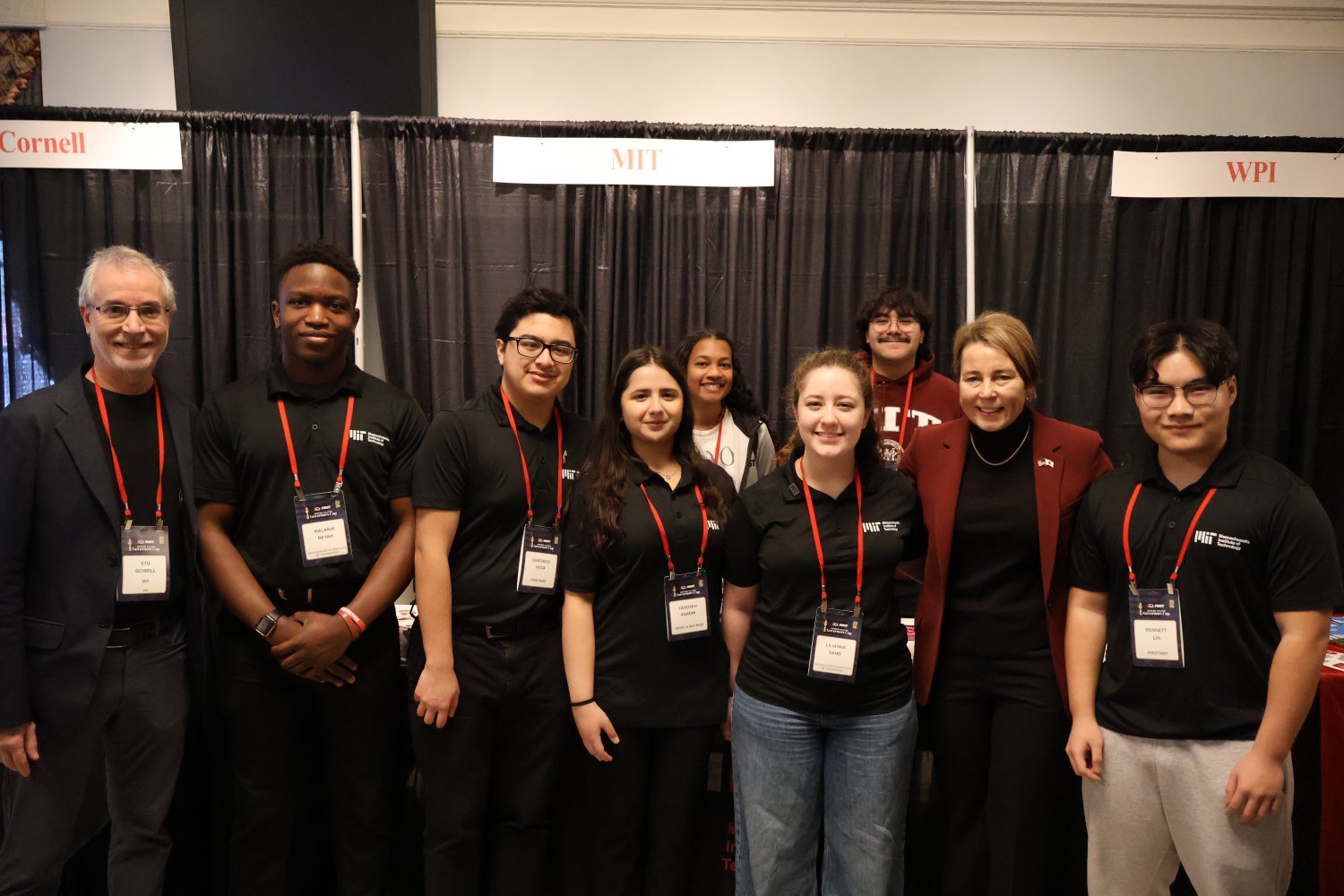
When Timbot's Wi-Fi failed on the floor of the United States Governors Cup in Washington, D.C., a roomful of high school students watched MIT undergraduates problem-solve their way through a technical crisis. The robot—a sleek foam-ball-slinging machine built in just 72 hours—had arrived to inspire. What happened instead became something more profound: as the MIT students rewired Timbot with a long Ethernet cable, sprawling cross-legged with soldering irons and cables, the high schoolers gathered closer, whispering to each other in recognition. "We do that too," they said. In that moment of shared mechanical struggle, something clicked.
This is the work FIRSTxMIT set out to do when the club launched at MIT this academic year—to bridge the gap between elite robotics and the students still building their first robot in a school gymnasium. The club's roots run deep. FIRST Robotics, the nonprofit behind decades of student competitions, was co-founded in 1992 by inventor Dean Kamen and the late MIT Professor Woodie Flowers, a legendary figure in hands-on engineering education. Today, FIRST reaches K-12 students worldwide, teaching not just wiring and code but what Flowers called "gracious professionalism"—a philosophy of excellence, respect, and cooperation even amid competition.
Debbie Ang and Perry Han, both sophomores at MIT, noticed something striking: FIRST was born here, yet no student organization existed to connect the numerous MIT undergraduates who'd grown up building FIRST robots. MIT associate director of admissions Trinidad Carney estimates that 15 to 20 percent of MIT's undergraduate body has participated in FIRST—a cultural touchstone among the Institute's engineers. Ang still mentors her high school team in New Hampshire. Han and Ang had met through FIRST in high school, reconnected at MIT, and decided to act. They launched FIRSTxMIT under the Edgerton Center, expecting modest interest. Their kickoff event drew 185 students. Their Discord channel now connects about 200.
The club has moved quickly from existence to impact. Members volunteered as judges at local competitions, collaborated with Josiah Quincy Elementary School in Boston to launch a LEGO Robotics league, and hosted a New England alumni gathering. But their most visible moment came through Timbot—the robot they built in just three days during MIT's January Independent Activities Period, as part of Ri3D (Robot in 3 Days), a collegiate challenge. High school teams typically need six weeks to build a FIRST competition-level robot. MIT's team did it in 72 hours, then traveled to Washington, D.C., to demonstrate it as STEM ambassadors at the Governors Cup, an event bringing together state leaders to underscore the importance of STEM education.
When Timbot broke down, when the Wi-Fi died and the ethernet cable became the solution, the moment wasn't a failure. It was pedagogy. The high schoolers learned that building robots isn't about perfection—it's about persistence, creativity, and the people beside you willing to solve problems together. Carney reflects on what the club has accomplished: "Having MIT students tell the story of the power of FIRST is incredibly compelling." Other universities have already begun reaching out to MIT, asking how to replicate this success. The answer seems simple: find the alumni who still care, give them space to organize, and trust them to pass the torch.