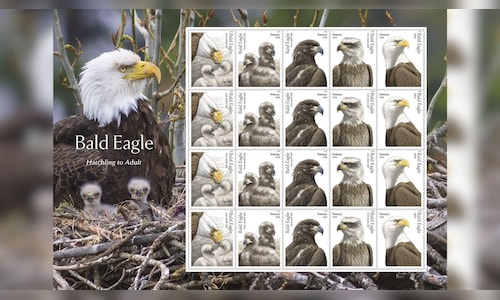
On a stamp no larger than a postage square, David Sibley captured the full arc of American renewal. The Massachusetts-based artist spent nearly a year designing the United States Postal Service's new bald eagle stamp collection, unveiled at the National Eagle Center to mark America's 250th birthday. What makes these five stamps remarkable is not just their artistry—it's the story they tell about a nation's power to heal what it nearly destroyed.
The bald eagle has represented American strength and freedom since Congress adopted the Great Seal in 1782, but the bird itself came perilously close to vanishing. In the 1960s, the pesticide DDT ravaged eagle populations, weakening their eggshells and causing widespread reproductive failure. The population plummeted. Then came intervention. The United States banned DDT in 1972 and listed the bald eagle as an endangered species in 1978. The numbers began to climb. Today, more than 300,000 bald eagles soar across the continental United States—a transformation so complete that the bird was removed from the endangered species list in 2007.
Sibley's stamp design reflects this journey visually, showing the eagle across five life stages: from a fuzzy hatchling to the iconic white-headed adult that graces the country's seal. Postal Service historian Steve Kochersperger noted that these stages also mirror America's own growth and development over time. Because stamps are impossibly small canvases, Sibley focused primarily on the eagle's distinctive head, letting fine detail do what bold scale cannot. The result is a collection that works both as mail decoration and as a miniature lesson in what recovery looks like.
The eagle's symbolism runs deeper than patriotic imagery. Its position atop the food chain and its commanding presence in the sky made it a natural choice for a nation forging its identity. But it was not officially designated the national bird until 2024—a detail that underscores how recently we truly acknowledged what we had nearly lost. The stamps arrive at a moment when that recognition feels urgent. They celebrate not just what the eagle means to America, but what America's stewardship of the eagle means to us.
Sibley himself hopes viewers will see beyond symbolism. He told the Associated Press that he wants people to recognize the bald eagle not only as a national emblem but as a vital part of nature and the ecosystem. That distinction matters. Too often, symbols become abstract—divorced from the living creatures they represent. These stamps, in their modest way, reconnect the two. They tell the story of a species brought back from the brink through deliberate action and sustained commitment. And they suggest that such stories need not remain rare. In a world that often feels fractured, the bald eagle's recovery stands as evidence that we are still capable of choosing differently, of choosing restoration over decline. For a nation turning 250, that is perhaps the most important message any stamp could carry.